

Good morning, and happy National Heroes Day. Today Jamaica pauses to honor the seven men and women whose courage shaped the nation, and at King’s House the Governor-General is presenting this year’s national honors and awards to people who have served the country in public life, business, philanthropy and the uniformed services.
Yet this is a Heroes Day with a heavy heart. Two police officers, Corporal Trevoy Shaw and Constable Devoney Rose, were killed after a long gunfight at Five Miles near Sligoville, St. Catherine, and a 10-year-old girl is fighting to recover. At the same time, families are feeling the squeeze at the market and the gas pump: Jamaica’s inflation rate has climbed to its highest level in nearly four years.
Beyond our shores, two crises are pressing on the same pressure point, energy. In the Gulf, Iran is pushing a “seven-day” plan to reopen the Strait of Hormuz while a U.S. naval blockade of Iranian ports continues and oil hovers near US$110 a barrel. And in Washington, President Trump has waived a sweeping new Russia sanctions law just before it took effect, tied to a deal for Russian diesel, even as Russia launched one of its broadest attacks on Ukraine’s power grid in months.
Here are today’s top five stories, what they mean, and what to watch next.
Also on our radar: two Jamaican permanent residents are among 16 immigrants charged by the U.S. Department of Justice with illegal voting and falsely claiming citizenship, two weeks before the U.S. midterm elections on November 3. And in France, weekend protests over living costs and school conditions turned into rioting and looting, with at least 2,400 arrests reported.
1. Heroes Day 2026: Jamaica honors its own
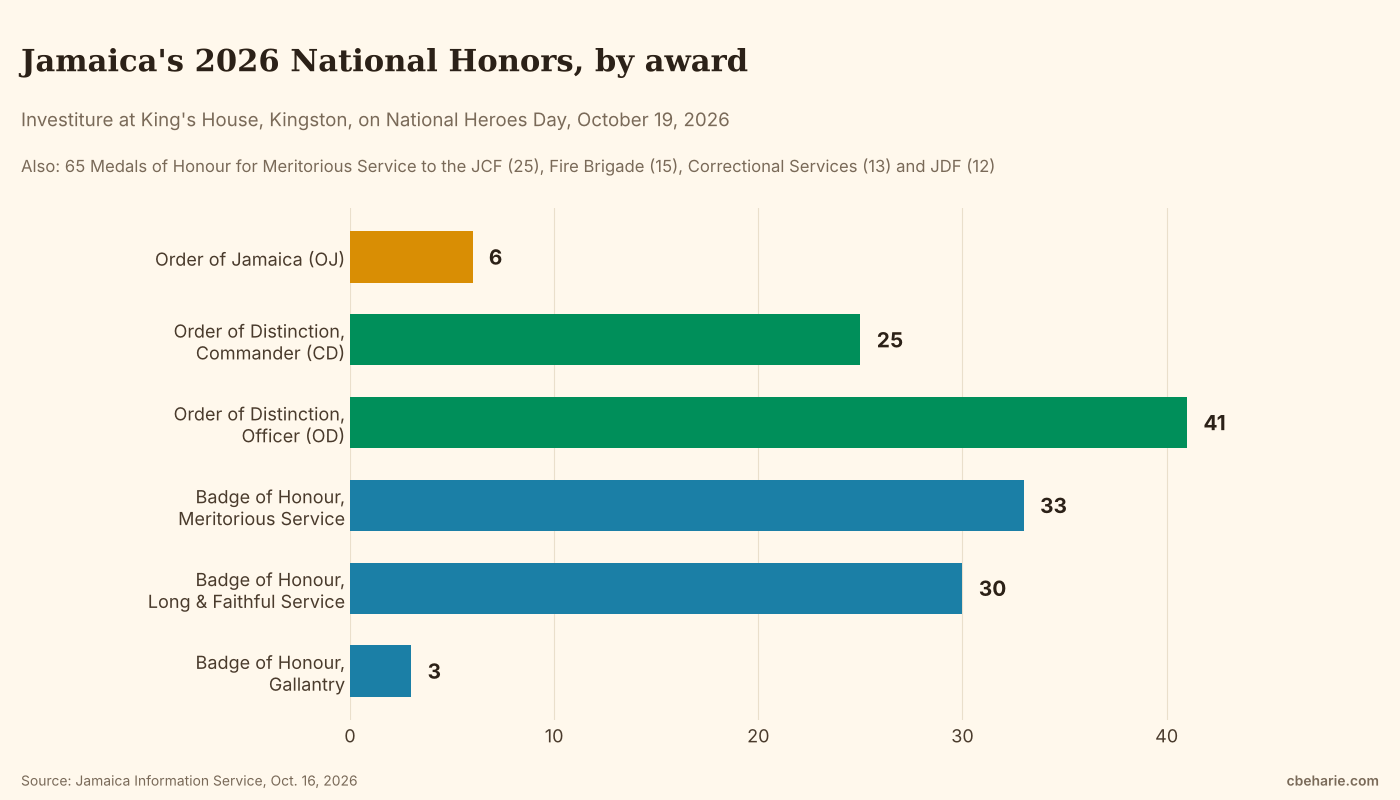
Horizontal bar chart of Jamaica’s 2026 national honors: 6 Order of Jamaica, 25 Order of Distinction Commander, 41 Officer, 33 Badge of Honour for Meritorious Service, 30 for Long and Faithful Service, and 3 for Gallantry.
Jamaica’s 2026 national honors by award, as announced by the Jamaica Information Service. Original graphic for cbeharie.com.
What is happening today
This morning, on the lawns of King’s House in Kingston, Governor-General Sir Patrick Allen presides over this year’s investiture ceremony for national honors and awards. The ceremony is set to begin at 9:00 a.m. and is being streamed live by the Jamaica Information Service (JIS), which reports that 140 Jamaicans are to be recognized this year.
At the top of this year’s list are six new members of the Order of Jamaica (OJ), which the JIS describes as the nation’s fifth-highest honor. They are Richard Byles, former Governor of the Bank of Jamaica; Daryl Vaz, Minister of Energy, Transport and Telecommunications; Christopher Zacca, chief executive of Sagicor Group Jamaica; philanthropist Donette Chin-Loy Chang; and two former government ministers, Maxine Henry-Wilson and Derrick Smith.
Behind them come 25 people appointed Commander of the Order of Distinction (CD) and 41 appointed Officer (OD). The Badge of Honour for Meritorious Service goes to 33 people, and 30 receive the Badge of Honour for Long and Faithful Service. Members of the uniformed services are also being recognized with the Medal of Honour for Meritorious Service: 25 from the Jamaica Constabulary Force, 15 from the Jamaica Fire Brigade, 13 from the Department of Correctional Services and 12 from the Jamaica Defence Force.
The quiet heroes
Some of the most moving names on the list are among the smallest group. Three people are receiving the Badge of Honour for Gallantry, an award for bravery: Danielle Anna-Marie Barnswell, her husband, Councilor Scean Barnswell, and Susan Annmarie Higgins. The JIS announcement does not detail the acts being recognized, but the gallantry award exists precisely for ordinary citizens who did something extraordinary when it counted.
That matters on a day like this. National honors can sometimes look like a parade of the already prominent, and this year’s OJ list does lean heavily toward business leaders and politicians from both sides of the aisle. But the bulk of the awards go to teachers, nurses, community workers, church and civic volunteers, and uniformed officers whose names rarely make headlines. A Badge of Honour for Long and Faithful Service is, in a sense, a national thank-you for showing up year after year.
Why the day matters
National Heroes Day honors the seven people who hold Jamaica’s highest honor, the Order of National Hero: Nanny of the Maroons, who led the Windward Maroons; Samuel Sharpe, leader of the Baptist War slave rebellion; Paul Bogle, the deacon who led the Morant Bay protesters in 1865; George William Gordon, a fierce critic of the colonial government; Marcus Garvey, the activist and philosopher; Norman Manley, the country’s first and only Premier; and Sir Alexander Bustamante, its first prime minister. The order was established in 1968, and Garvey, Gordon and Bogle were its first recipients in 1969.
For two of them, faith and freedom were bound together: Bogle was a deacon, and Sharpe’s uprising is remembered as the Baptist War. Nanny’s leadership came from the Maroon tradition of resistance and self-reliance. Garvey gave the African diaspora a language of dignity that still echoes from Kingston to Brooklyn to London. For Jamaicans abroad, including those of us in Europe, today is a reminder that the story of Jamaica has always been bigger than the island itself.
A year after Melissa
This Heroes Day also arrives in the shadow of an anniversary. In nine days, on October 28, it will be one year since Hurricane Melissa made landfall near New Hope in Westmoreland as a Category 5 storm with sustained winds of about 185 mph. Melissa is blamed for 45 deaths in Jamaica, and damage has been estimated at as much as US$12.2 billion, making it the costliest hurricane the country has ever faced.
Many of the people being honored this year, and many who never will be, spent the past twelve months clearing roads, rebuilding schools, feeding neighbors and keeping churches and community centers open. If any year has shown that heroism is not only a matter of history books, it is this one.
What to watch
Look for the full list of CD, OD and Badge of Honour recipients from the JIS and the national newspapers, and for the speeches at King’s House. Expect, too, a renewed public conversation, already visible in this weekend’s newspaper columns, about who counts as a hero today and whether the nation is doing enough to honor everyday courage. As Hurricane Melissa’s anniversary approaches, watch for stock-taking on how far recovery has come in the hardest-hit parishes.
2. Sligoville standoff: two officers dead, and a hard look at the crime fight
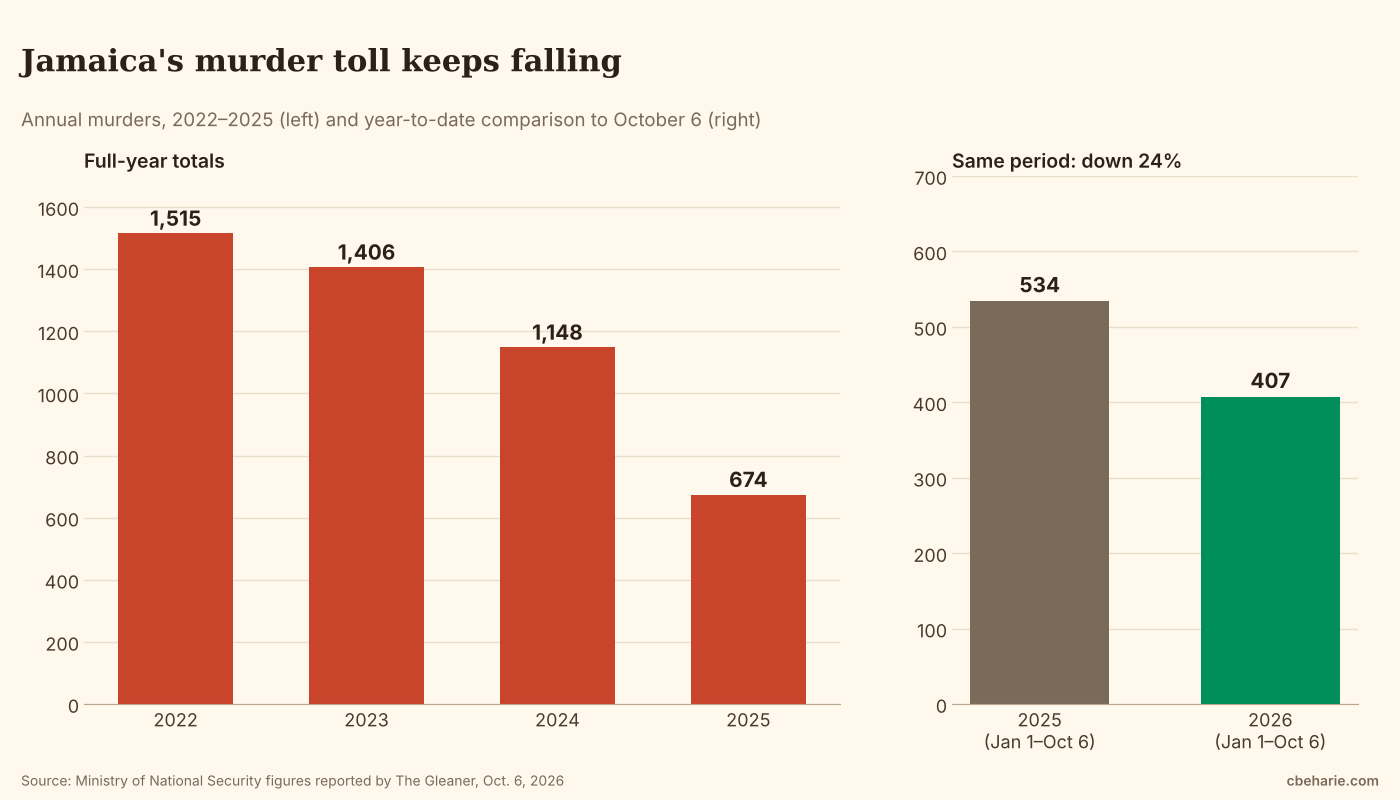
Bar charts showing Jamaica’s annual murders falling from 1,515 in 2022 to 1,406 in 2023, 1,148 in 2024 and 674 in 2025, and a same-period comparison of 534 murders in 2025 versus 407 in 2026 through October 6.
Murders in Jamaica have fallen sharply since 2022, even as violent incidents like the Sligoville standoff continue. Original graphic for cbeharie.com.
What happened
On Friday morning, members of a specialized Jamaica Constabulary Force operations unit went to Five Miles, an area off the Sligoville main road in St. Catherine, searching for a man police described as a high-risk target wanted for four murders. According to the police, officers came under fire and returned it, and several men barricaded themselves inside a house with a woman and children.
What followed was an hours-long standoff. Police say the men signaled that they wanted to surrender and held a child out of the door, but when officers moved forward to retrieve the child, they were shot at. Corporal Trevoy Shaw died on Friday. Constable Devoney Rose, of Ewarton, died on Saturday. Three men in the house, Errol Hussey, his son Malique Hussey and his nephew Javoun Cogle, were killed. Police say they recovered two firearms, including a rifle.
The Independent Commission of Investigations (INDECOM) has said 10 people suffered gunshot wounds, including two minors, three police officers and a soldier. The most seriously hurt child, a 10-year-old girl, was reported to be in critical but stable condition over the weekend.
Two accounts
The Jamaica Observer has reported on an 18-minute recording, made during a WhatsApp video call with relatives, that captures part of the negotiations. In it, gunfire can be heard, and the men repeatedly say they are not the ones shooting. A relative living overseas has disputed the police account, saying the men were trying to surrender, and has called for an independent investigation into how the two officers died. Those claims have not been verified, and the police account stands as the official version while INDECOM does its work.
Presenting both accounts is not taking sides. It is simply what a fair process requires, and it is why Jamaica has an independent oversight body in the first place.
The government’s response
Prime Minister Andrew Holness, briefed by Police Commissioner Dr. Kevin Blake after returning from New York on Saturday, described the attack as carefully planned, pointing to reports of misdirection, diversionary gunfire and prearranged transport. He called the slain officers heroes, accused the gunmen of using their own families as human shields, and described illegal gunmen as “parasites and pestilence upon our society.”
The prime minister directed the security forces to intensify operations against gang leaders and the networks that shelter, finance and arm them, and said resources would be discussed when the National Security Council holds its monthly meeting this week. He called the incident a turning point.
The opposition People’s National Party struck a unifying note. Its national security spokesman, Fitz Jackson, expressed sadness at the deaths, offered condolences to the officers’ families and colleagues, prayed for the injured girl’s recovery, and urged anyone with information to contact the police or Crime Stop.
The bigger picture
The tragedy comes in a year when Jamaica’s murder numbers have fallen dramatically. National Security Minister Dr. Horace Chang told Parliament on October 6 that the country had recorded 407 murders so far in 2026, compared with 534 for the same period last year, a decline of 24 percent. September’s 36 murders were the lowest monthly total in more than 30 years. Annual murders have fallen from 1,515 in 2022 to 674 in 2025. Chang cautioned that the gains cannot be taken for granted.
There is another number in the same report that deserves attention: 228 people had been fatally shot by police since the start of 2026. Supporters of the government’s approach see that as the cost of confronting heavily armed gangs. Human rights advocates have raised concerns, arguing that a sustainable decline in violence depends on public trust, accountability and due process. Both points can be held at once. A country can be grateful for falling murder numbers, mourn its fallen officers, and still insist that every police killing is properly investigated.
The diaspora angle
For Jamaicans abroad, crime is often the first thing friends and colleagues ask about. This year, many in the diaspora have had good news to share for once. The Sligoville standoff is a sobering reminder of how fragile those gains are, and of the debt the country owes to officers who walk toward danger. It also shows how the diaspora is woven into these stories: a relative overseas is among those raising questions about what happened at Five Miles.
What to watch
Watch for the National Security Council meeting this week and any new operational or resource announcements; INDECOM’s findings on the Five Miles shootings; funeral arrangements and support for the families of Corporal Shaw and Constable Rose; and updates on the injured child. Over the longer term, the question is whether Jamaica can lock in its lower murder rate while keeping the trust of the communities where these operations happen.
3. Inflation hits 8.6 percent, the highest since 2022
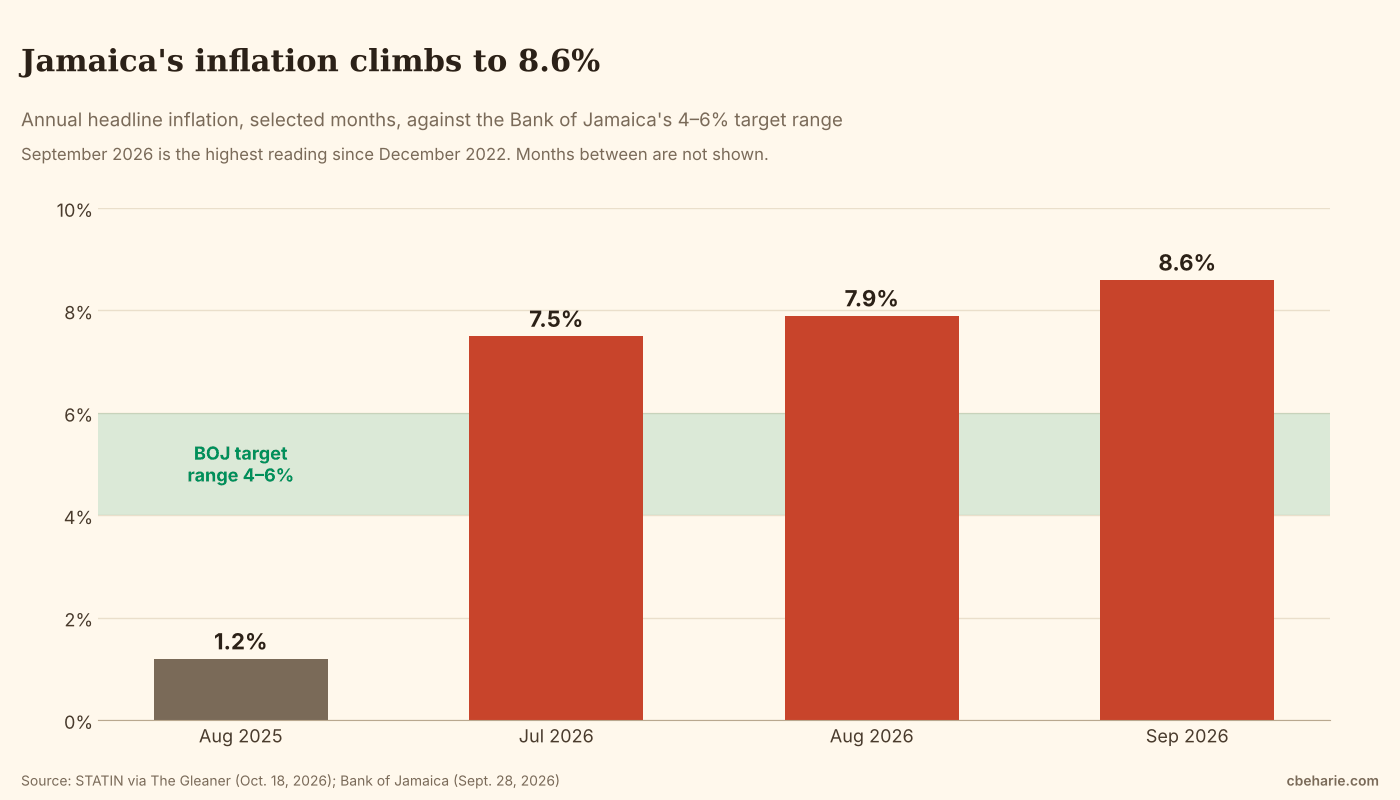
Bar chart of Jamaica’s annual inflation: 1.2 percent in August 2025, 7.5 percent in July 2026, 7.9 percent in August 2026 and 8.6 percent in September 2026, all compared with the Bank of Jamaica’s 4 to 6 percent target range.
Jamaica’s headline inflation has moved well above the central bank’s target range. Original graphic for cbeharie.com.
What happened
Jamaica’s annual inflation rate rose to 8.6 percent in September, the highest reading since December 2022, according to the Statistical Institute of Jamaica (STATIN), as reported by The Gleaner. Prices rose 1.5 percent in September alone. That puts inflation well above the Bank of Jamaica’s target range of 4 to 6 percent, and it marks a sharp turn from August 2025, when inflation stood at just 1.2 percent.
Where the pain is
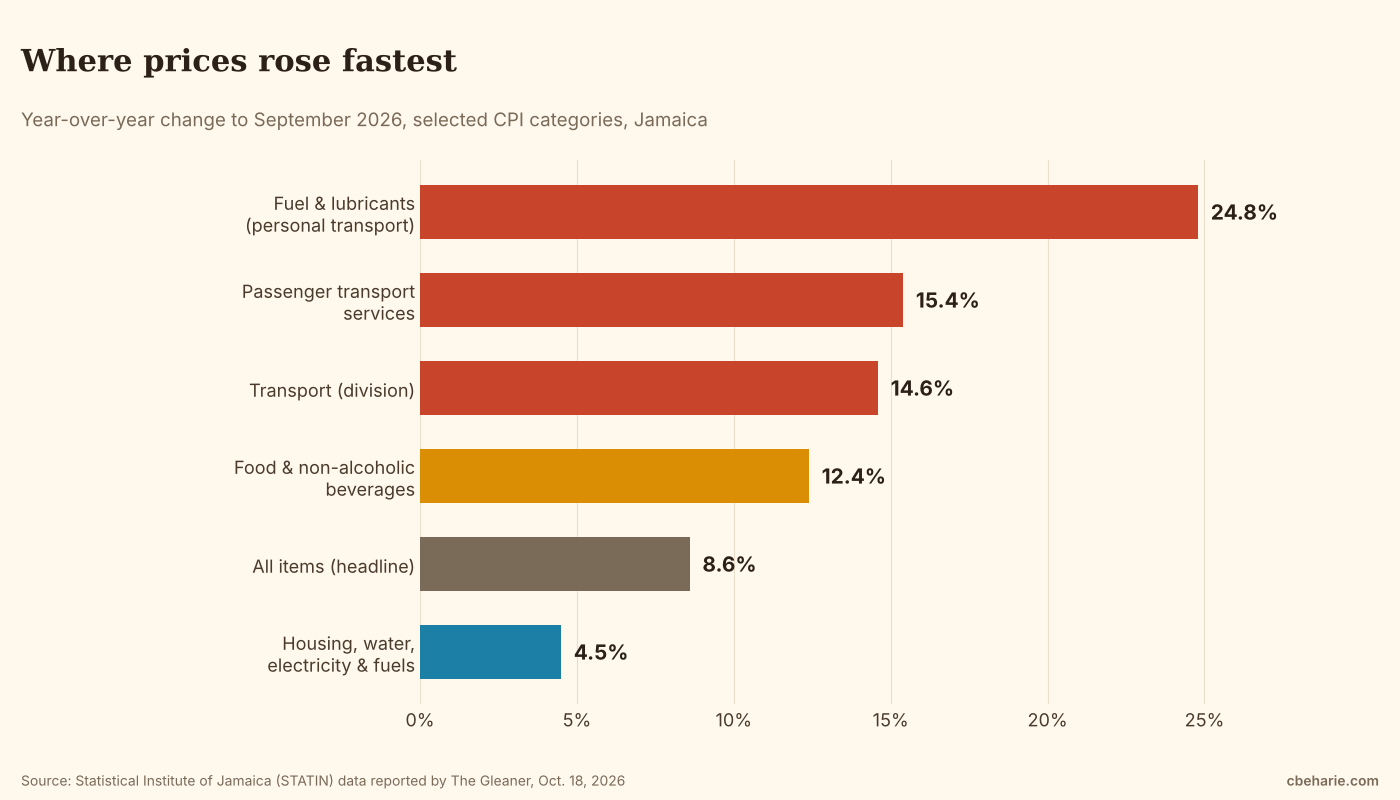
The biggest increases are in the things families cannot easily cut back on. Food and non-alcoholic beverages rose 12.4 percent over the past year, and 2.9 percent in September alone. Vegetables, tubers, plantains, cooking bananas and pulses jumped 10.5 percent in the month, led by tomato, carrot, lettuce, pumpkin, Irish potato and sweet potato.
Transportation was the fastest-rising category over the year, up 14.6 percent. Fuel and lubricants for personal vehicles were up 24.8 percent, and passenger transport services rose 15.4 percent as route taxi and hackney fares increased. Housing, water, electricity and gas rose a more modest 4.5 percent over the year, while education costs rose 4.0 percent in September as private primary schools raised tuition for the new term. Rural areas saw the steepest monthly increase, at 1.7 percent.
Horizontal bar chart of annual price increases in Jamaica to September 2026: fuel and lubricants 24.8 percent, passenger transport services 15.4 percent, transport 14.6 percent, food 12.4 percent, all items 8.6 percent, and housing and utilities 4.5 percent.
Fuel, transport and food have driven Jamaica’s inflation surge. Original graphic for cbeharie.com.
Why it is happening
Two forces are colliding. The first is local: Hurricane Melissa devastated farms last October, and dry weather linked to El Niño has hurt crop yields since. The second is global: the war involving the United States and Iran, and Russia’s war in Ukraine, have kept oil and shipping costs high, and those costs flow straight into Jamaica’s pump prices and bus fares. The Bank of Jamaica also points to post-hurricane recovery spending, which adds to demand in the economy.
The central bank has already acted. On September 28, its Monetary Policy Committee unanimously raised the policy interest rate by half a percentage point to 6.0 percent, after holding it in August. The bank expects headline inflation to keep rising in the near term before returning to the target range by mid-2027, but warned that the risks are tilted toward higher prices, especially if the conflicts drag on. Core inflation, which strips out farm food and fuel, was 5.2 percent in August, a sign that higher prices are starting to spread more widely.
Competing readings
Not everyone sees cause for alarm about the long term. Economist Dr. Damien King, executive director of the Caribbean Policy Research Institute (CAPRI), told The Gleaner that the spike will create hardships but “doesn’t reflect an underlying slippage of our low inflation stance.” In his view, food prices should ease as crop yields recover a full year after Melissa.
Others expect more pressure before relief arrives. Petrojam’s general manager, Danville Walker, said in early October that he expected fuel supplies to stay stable and price movements to remain contained through year-end, with 87-octane gasoline billed at J$209.62 per liter on October 1, down from above J$220 earlier in the year. But economist Keenan Falconer said the full effect of the oil shocks has not yet been felt and could show up between December and early 2027. Since then, world oil prices have climbed again, a point we return to in the next story.
The household view
For pensioners, minimum-wage workers and families on fixed incomes, an 8.6 percent rise in prices is a pay cut in all but name. In the Senate, Opposition Senator Ramon Small-Ferguson has urged the government to pursue carefully designed pension indexation reform to protect retirees’ purchasing power, while weighing what the country can sustain. Many in the diaspora will feel the squeeze too, through the calls home and the support they send to parents and grandparents.
What to watch
The Bank of Jamaica’s next policy decision is due on November 18. October’s inflation figures, the direction of world oil prices, and whether farm output recovers in time for the Christmas season will decide whether September is the peak or just a step along the way.
4. The Hormuz standoff: Iran’s “seven-day” offer and a world on edge
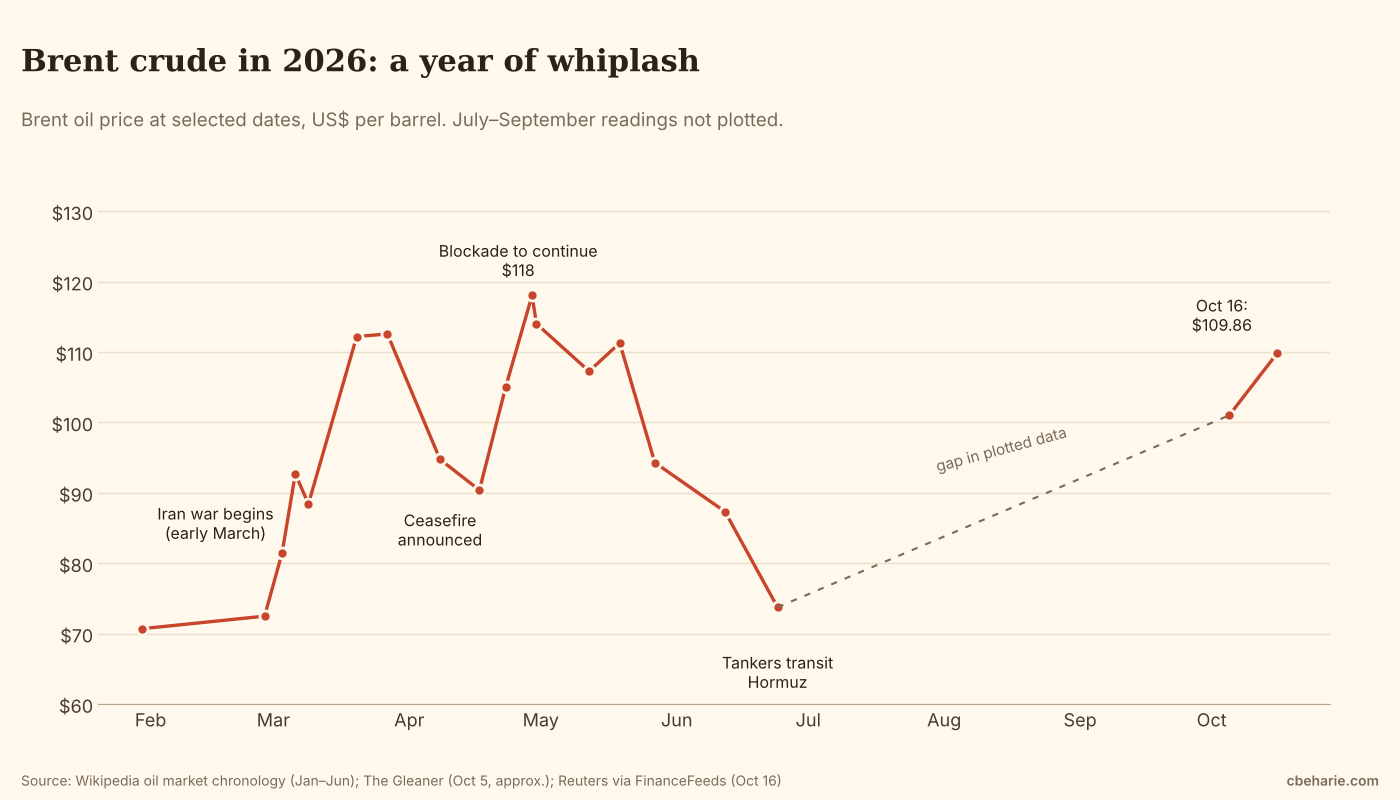
Line chart of Brent crude oil prices at selected dates in 2026, rising from about 71 dollars in January to peaks near 118 dollars in late April, falling to about 74 dollars in late June, then back to 109.86 dollars on October 16.
Brent crude has swung wildly in 2026 as the conflict with Iran has escalated, paused and flared again. Original graphic for cbeharie.com.
What happened
Iran’s foreign minister, Abbas Araghchi, said on Sunday in Baghdad, on the sidelines of a meeting of the Organization of Islamic Cooperation, that Tehran’s “seven-day” proposal to reopen the Strait of Hormuz remains on the table and urged Washington to accept it. He said Iran was reviewing comments sent by the United States. At the same time, he warned the U.S. against renewing attacks, said Iran had “unfinished jobs” of its own, and accused Israeli Prime Minister Benjamin Netanyahu of pushing America toward another war.
As described in reporting on Iran’s statements, the plan works like this: the United States would end its naval blockade of Iranian ports, waive some sanctions and release some frozen Iranian funds; Iran would fully reopen the strait by the sixth day; and on the seventh day the two sides would begin negotiations on a nuclear agreement. Iran is also calling for a ceasefire on all fronts. A senior Iranian security official said last week that the latest U.S. response was inadequate, though Washington had accepted some of Iran’s conditions.
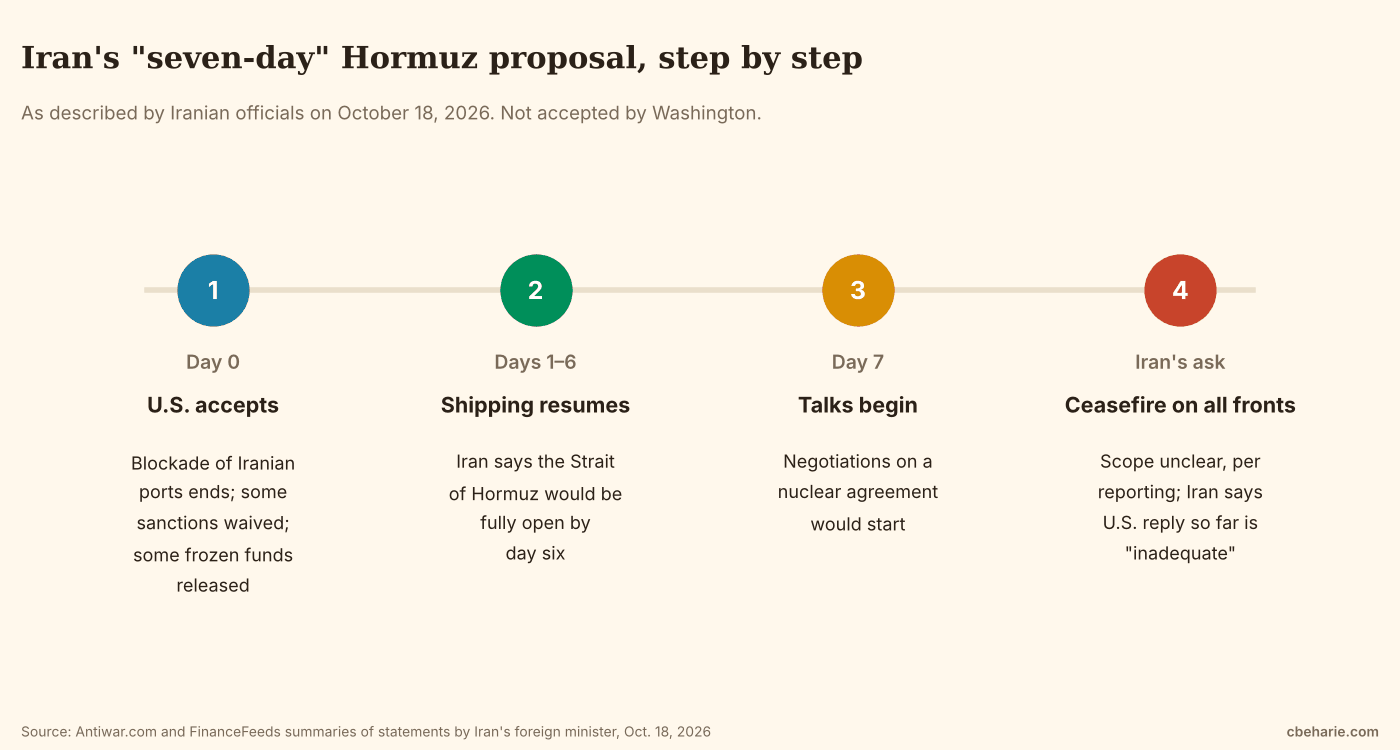
Four-step timeline of Iran’s seven-day proposal: the U.S. ends its blockade and eases some sanctions; shipping resumes and the Strait of Hormuz is fully open by day six; nuclear talks begin on day seven; and Iran asks for a ceasefire on all fronts.
Iran’s proposal for reopening the Strait of Hormuz, as described by Iranian officials. Washington has not accepted it. Original graphic for cbeharie.com.
The American position
The United States has not accepted the proposal, and the blockade continues. U.S. Central Command said on Saturday that its forces have redirected 138 commercial vessels while enforcing the blockade, and its commander, Adm. Brad Cooper, has said the blockade has cost Iran about $25 billion in lost revenue. Vice President JD Vance argued that the Navy is keeping oil and gas moving and said in some ways the U.S. has “decisively won.” On Sunday, President Trump endorsed Netanyahu ahead of Israel’s October 27 election, describing him as a partner against Iran.
Supporters of the administration’s approach argue that sustained pressure is what brought Iran to the table, and that easing the blockade before a nuclear deal would reward Tehran. Critics worry that the standoff risks a wider war and that the world economy is paying the price in the meantime.
Why it matters
The Strait of Hormuz is one of the world’s most important energy chokepoints, and 2026 has shown just how much it matters. When the war began in early March, oil prices surged; after Hormuz was closed later that month, Brent crude jumped above US$110 a barrel. A ceasefire on April 8 brought the largest one-day drop since 2020, but tensions returned and prices touched an intraday high of about US$126 on April 30. Prices fell back below US$75 by late June as tankers moved through the strait again, after a U.S.-Iran memorandum of understanding signed in June raised hopes that soon collapsed.
Now the pressure is back. Brent settled at US$109.86 a barrel on Friday, its highest close since May, and U.S. crude finished above US$101. Reports say Iran has sharply increased attacks on commercial shipping in and near the strait in recent weeks. In the United States, the average price of gasoline was $4.29 a gallon, according to AAA.
The conflict is also spreading along its edges. In Yemen, a Houthi missile attack on a government military training camp in Shabwa province killed at least 18 people, according to Reuters. Egypt’s National Defense Council, chaired by President Abdel Fattah el-Sisi, pledged support for Saudi Arabia’s security.
The Caribbean angle
Jamaica does not buy its oil from the Gulf; Petrojam says most of the island’s fuel comes from outside the region. But oil is priced on a world market, and so are shipping and insurance. When Brent jumps, the price of gasoline in Half Way Tree, the cost of electricity, and the fare for a route taxi in May Pen all follow, usually with a lag of weeks or months. That is exactly what the Bank of Jamaica cited when it raised interest rates last month. The same is true across the Caribbean, where most islands import nearly all of their energy. For the region, a deal in the Gulf would be one of the best inflation-fighting tools available, and it is one we have no control over.
What to watch
Watch for any formal U.S. reply to Iran’s proposal, and for the dates analysts say could bring escalation: Israel’s election on October 27 and the U.S. midterms on November 3. Reporting by Axios says President Trump and Netanyahu have discussed a possible major strike on Iran before both votes. Watch oil prices, shipping incident reports from the Gulf, and the U.S. Federal Reserve’s meeting on October 27–28.
5. Trump waives new Russia sanctions as Moscow pounds Ukraine’s grid
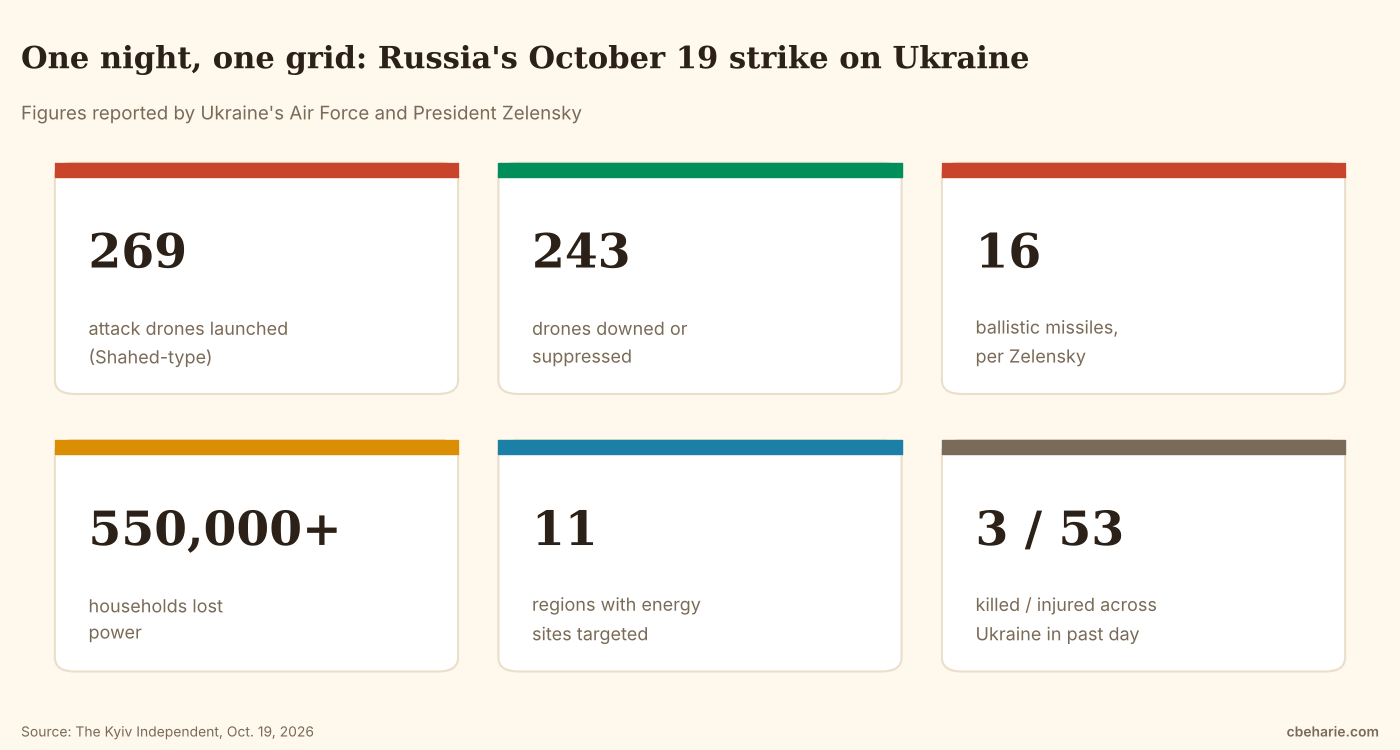
Infographic of Russia’s overnight attack on Ukraine on October 19, 2026: 269 attack drones launched, 243 downed or suppressed, 16 ballistic missiles according to President Zelensky, more than 550,000 households without power, energy sites targeted in 11 regions, and 3 killed and 53 injured in the past day.
Key figures from Russia’s overnight attack on Ukraine’s energy system, as reported by Ukrainian officials. Original graphic for cbeharie.com.
What happened
On Friday, President Trump signed an executive order waiving the Russia provisions of a sweeping sanctions law just two days before they were due to take effect on October 18. The law, named for the late Senator Lindsey Graham, who championed it and died suddenly in July, passed Congress by large margins and was signed by the president in September.
As reported by ABC News, the law would have allowed tariffs of up to 500 percent on Russian goods, including oil and gas, and up to 100 percent on the five biggest buyers of Russian crude and natural gas and on the five countries doing the most to help Russia evade oil sanctions. It also targeted Russian banks, oligarchs and the so-called shadow fleet of tankers used to move sanctioned oil. The waiver covers every operative Russia-related section of the law and stays in place until the administration decides otherwise. It is the second Russia sanctions waiver in about two weeks.
The diesel connection
The waiver is tied to energy. Rising diesel prices have pushed the White House toward a deal under which Russia would supply hundreds of thousands of tons of diesel to the United States and world markets. Earlier this month, the Treasury Department issued a license allowing Russian diesel to be imported into the U.S. through April. Without the waiver, the new law would have required tariffs on those petroleum products and sanctions on the ships carrying them.
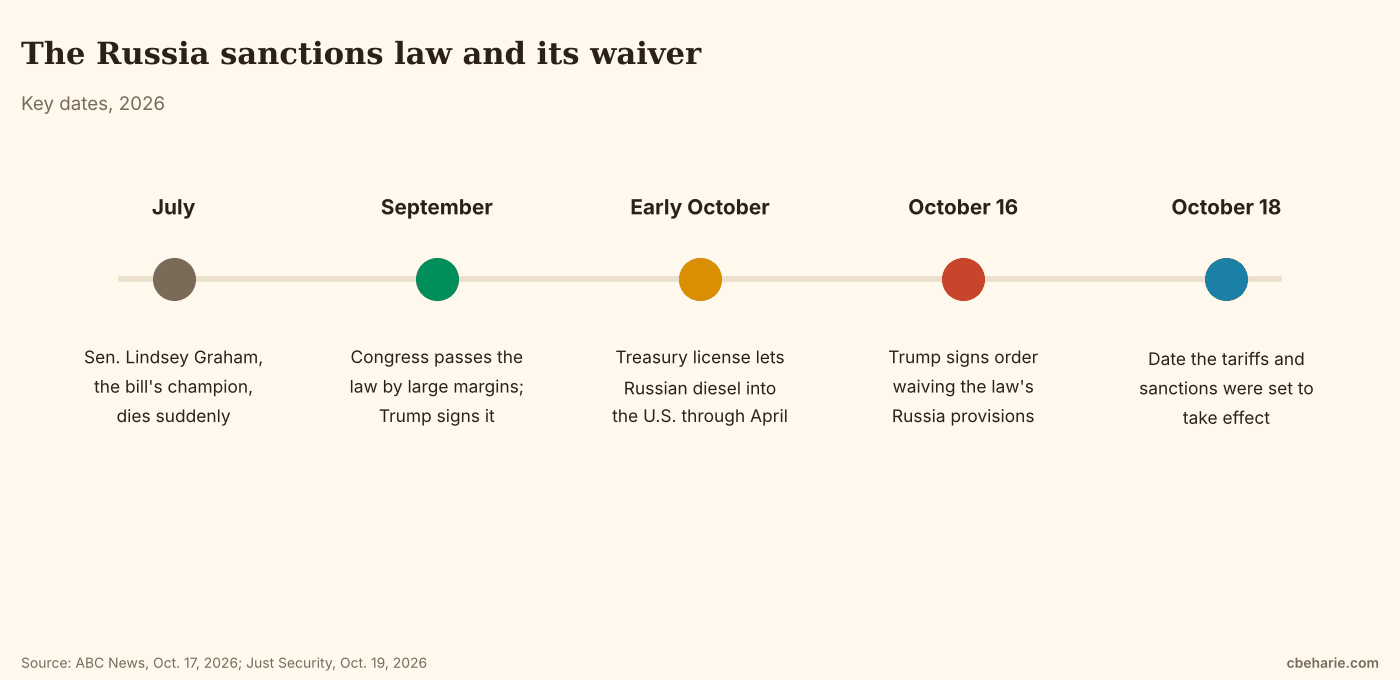
Timeline of the Russia sanctions law in 2026: Senator Lindsey Graham dies in July; Congress passes the law and President Trump signs it in September; a Treasury license allows Russian diesel imports in early October; Trump signs a waiver on October 16; the sanctions had been set to take effect on October 18.
How the Russia sanctions law moved from passage to waiver in 2026. Original graphic for cbeharie.com.
Competing views
The White House says the president wants the war to end and that enforcing the sanctions now would hinder ongoing efforts to negotiate peace between Ukraine and Russia. It stresses that the president can use the law’s powers at any time. Mr. Trump has said the move keeps Russia at the bargaining table. Representative Thomas Massie, one of the few Republicans who voted against the bill, welcomed the waiver.
Critics span both parties. Senate Democratic leader Chuck Schumer called it a major gift to Vladimir Putin. Republican Senators Mitch McConnell, Thom Tillis, Susan Collins and John Cornyn had urged the president to drop the diesel deal and enforce the sanctions; Tillis called the decision “beyond irresponsible.” Ukrainian President Volodymyr Zelensky said the move only helps Russia and encourages Moscow to keep fighting. Russian envoy Kirill Dmitriev called it historic.
Meanwhile, on the ground
Overnight into Monday, Russia launched one of its broadest attacks in months. Ukraine’s Air Force said Russia fired 269 Shahed-type attack drones, along with cruise and ballistic missiles; 243 drones and four cruise missiles were shot down or suppressed. Zelensky said 16 ballistic missiles were fired, mostly at Kyiv and the surrounding region, and that Ukraine received no early warning from its partners. Energy facilities in 11 regions were targeted, more than 550,000 households lost power, and at least three people were killed and 53 injured across the country in the past day, according to the Kyiv Independent. Zelensky said strikes also hit a medical clinic, a school, a metro station and homes.
Ukraine, for its part, carried out its largest drone attack on St. Petersburg since the war began, hitting oil infrastructure and briefly halting airport operations; the city’s governor reported one death and five injuries. Zelensky said U.S. intelligence sharing for missile defense has resumed after a pause, while Secretary of State Marco Rubio denied there had been a pause at all.
The diplomacy
There is a flurry of activity behind the scenes. Zelensky said he spoke with U.S. envoys Steve Witkoff and Jared Kushner about next steps. The Wall Street Journal reported that Putin has floated a summit with Trump and Chinese President Xi Jinping to discuss Ukraine’s future, though a senior U.S. official said Trump had not agreed. The New York Times reported that the U.S. envoys suggested Europe buy more Russian gas to encourage an end to the war, an idea European officials reportedly rejected. And German Chancellor Friedrich Merz insisted that frozen Russian assets must stay in Europe.
Why it matters here
From Norway, where I live, the war in Ukraine is never far away; Europe’s security and energy bills are tied to its outcome. For Jamaica and the Caribbean, the link is less obvious but just as real. The Bank of Jamaica has named the Russia-Ukraine war, alongside the Middle East, as a reason world commodity prices remain high. Diesel moves trucks, fishing boats, generators and farm equipment. A cheaper barrel of diesel helps islands like ours; a longer war hurts everyone. The debate in Washington is, at its heart, about which of those goals to put first.
What to watch
Watch whether Congress tries to push back on the waiver, whether the diesel shipments materialize and ease prices, whether the proposed Trump–Putin–Xi summit takes shape, and whether Russia keeps hammering Ukraine’s power grid as winter approaches.
A closing reflection: heroes for a hard season
National Heroes Day invites us to look backward, but its real power is in how it makes us look at ourselves. Sam Sharpe, Paul Bogle and George William Gordon did not set out to become names on monuments. They looked at the suffering around them and decided they could not stay silent, and for Sharpe and Bogle, that conviction was rooted in faith. Nanny, Garvey, Manley and Bustamante each carried the same courage into their own time and in their own way.
Today’s headlines are a reminder that every generation faces its own tests. Two officers gave their lives at Five Miles, and a child is fighting to heal. Families are doing math at the supermarket that does not add up. Far from our shores, decisions about oil, sanctions and war ripple all the way to a route taxi fare in St. Catherine. It is easy to feel small in the face of all that.
The prophet Micah offered a simple answer to the question of what God requires of us: “to do justly, and to love mercy, and to walk humbly with thy God.” Justice means wanting the truth about Five Miles, whatever it turns out to be. Mercy means remembering that grieving families stand on every side of a tragedy. Humility means admitting that none of us, on any side of any political argument, has all the answers about inflation, crime or war.
Heroism, in the end, is rarely dramatic. It is the nurse on a double shift, the teacher who buys supplies with her own money, the neighbor who rebuilt a roof after Melissa, the officer who goes back to work this morning. On this Heroes Day, may we honor the seven by becoming, in small and faithful ways, the kind of people they believed Jamaica could produce.
Walk good, and God bless Jamaica.
Sources
- Jamaica Information Service – Six Outstanding Jamaicans to Be Conferred with OJ on Oct. 19
- Wikipedia – Order of the National Hero (Jamaica)
- Wikipedia – Hurricane Melissa
- Jamaica Observer – PM wants security forces to get tougher on criminals (Oct. 19, 2026)
- Jamaica Observer – Inside the Sligoville stand-off (Oct. 18, 2026)
- The Gleaner – ‘They are heroes’ (Oct. 19, 2026)
- The Gleaner – Murder rate down 24 per cent as Jamaica records 407 homicides so far this year (Oct. 6, 2026)
- The Gleaner – Highest inflation in four years will result in ‘some hardships’ says Dr King (Oct. 18, 2026)
- Bank of Jamaica – Monetary Policy Press Release, September 2026
- The Gleaner – Petrojam sees stable fuel prices through year-end as oil markets settle (Oct. 11, 2026)
- Jamaica Observer – Small-Ferguson urges Gov’t to pursue indexation reform (Oct. 18, 2026)
- Antiwar.com – Araghchi says Iran’s proposal to open Strait of Hormuz within seven days is still on the table (Oct. 18, 2026)
- FinanceFeeds – Oil price near $110 as Iran demands US withdrawal but keeps Hormuz proposal open
- Wikipedia – 2026–2028 world oil market chronology
- Just Security – Early Edition: October 19, 2026 (summarizing Reuters, AP, BBC, NYT, WSJ and Axios reports)
- Everything Briefing – Global Developments on October 19, 2026
- ABC News – Trump signs order waiving Graham Act sanctions on Russia
- The Kyiv Independent – 3 killed, 53 injured in Russian attacks as 550,000 households lose power (Oct. 19, 2026)
- The Gleaner – Jamaican, Haitian nationals among 16 charged with election-related offences in US (Oct. 18, 2026)