
Good morning, and welcome to today’s briefing. Jamaica is waking up from a Heritage Week that carried two very different moods at once. On Monday, King’s House filled with pride as the Governor-General pinned national honors on about 140 Jamaicans, from bank chiefs to a beloved percussionist. Yet the days before were shadowed by grief: two police officers killed in a stand-off near Sligoville, a 10-year-old girl wounded, and a country asking hard questions about how its hard-won fall in murders is being achieved.
Across the region, the news is just as weighty. In Haiti, gangs launched the biggest attack yet on the new international Gang Suppression Force, the mission Jamaica is helping to staff, and four Salvadoran soldiers are missing. In Florida, the state’s attorney general has issued an arrest warrant for 95-year-old Raúl Castro, three decades after the downing of two Brothers to the Rescue planes, just days before the UN votes again on the U.S. embargo of Cuba.
And from my adopted home of Norway comes the day’s top global story: President Volodymyr Zelensky met U.S. envoy Steve Witkoff and European leaders in Oslo, setting up fresh contact with Moscow today. Elsewhere, Storm Adam brought deadly flooding to eastern Spain, where at least four people died and tens of thousands were told to shelter or evacuate, a reminder, a week before the first anniversary of Hurricane Melissa, of what extreme rain can do.
Here are the five stories that matter most today, what they mean, and what to watch next.
1. Sligoville stand-off: two officers dead, a child wounded, and hard questions about policing
What happened
On Friday, October 16, officers from the Jamaica Constabulary Force’s Specialised Operations Branch went into the Five Miles area off the Sligoville main road in St. Catherine looking for Kenroy Willis, a high-risk target the police say is wanted for four murders. According to the police account, the officers came under fire, returned fire, and then faced men who barricaded themselves inside a house with a woman and children.
What followed became a stand-off that lasted hours and ended in heartbreak. Corporal Trevoy Shaw died that Friday. Constable Devoney Rose, of Thomas Road, Ewarton, died the next day. Three men the police identified as the gunmen, Errol Hussey, his son Malique Hussey and his nephew Javoun Cogle, were killed. The Independent Commission of Investigations (INDECOM) has reported that 10 people were wounded in all, including two minors, three police officers and a member of the Jamaica Defence Force. A 10-year-old girl was seriously injured and, at last report, was in critical but stable condition.
Two accounts of the same morning
Police spokesman Senior Superintendent Dennis Brooks says the men signaled that they wanted to surrender, even using a child to send that message, and then opened fire when officers moved forward to bring the child out. Prime Minister Andrew Holness, speaking at Norman Manley International Airport on his return from New York, said intelligence pointed to a coordinated trap built on misdirection and diversionary gunfire. He called the two officers “truly, truly, truly heroes” and said those who use children as human shields lose any moral standing.
A relative of the dead men tells a different story. Living overseas and on a WhatsApp call during the incident, she told the Jamaica Observer that the men were surrendering when they were killed, disputed that a rifle was found, and called for an independent investigation. She offered no independent evidence for her claim that the officers may have been hit by police fire. The Observer reviewed an 18-minute recording with audio from inside the house, in which the occupants repeatedly deny shooting and the child can be heard begging officers not to fire. INDECOM’s investigation now carries the weight of sorting out these accounts.
The political response
The Prime Minister promised full state support for stepped-up operations against high-risk criminals and their networks, directed the police and army to intensify targeted operations, and signaled more to come from next week’s National Security Council meeting. From the Opposition, national security spokesman Fitz Jackson offered condolences to the officers’ families, prayed for the little girl’s recovery, and urged anyone with information to call the police or Crime Stop. On this tragedy, at least, the two sides are speaking in a similar voice.
The Observer’s editorial page captured a more complicated mood. It mourned the officers and expressed no sympathy for the gunmen, but it also questioned the policy, as explained by SSP Brooks, that officers must respond to any sign of surrender, and argued that three officers shot is far too high a price for any operation. It urged the force to treat Sligoville as a training lesson.
Why it matters: a falling murder rate, and its costs
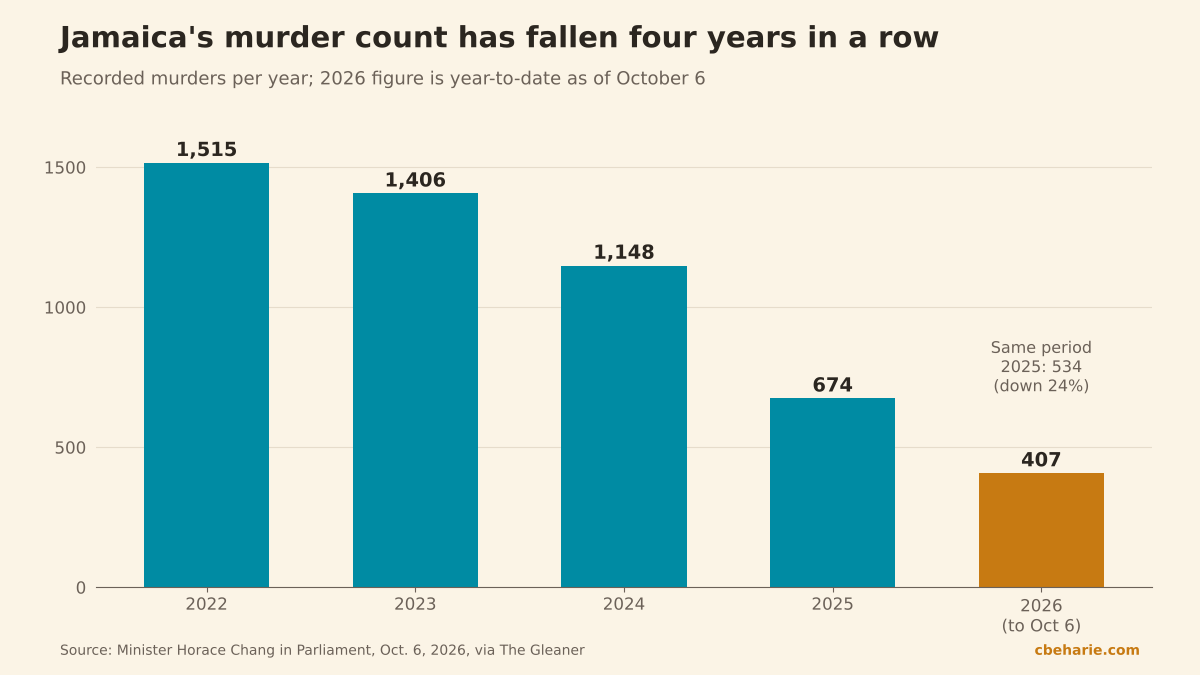
The Sligoville tragedy comes in a year when Jamaica’s crime numbers have moved in a direction few dared to hope for. National Security Minister Dr. Horace Chang told Parliament on October 6 that 407 people had been murdered so far this year, down from 534 in the same period of 2025, a drop of 24%. September’s 36 murders were the lowest monthly total in more than 30 years. The full-year count has fallen from 1,515 in 2022 to 674 in 2025.
But the same report noted another number that deserves equal attention: 228 people had been fatally shot by police since January 1. Supporters of the government’s approach argue that firm operations against gangs are a big part of why fewer Jamaicans are being murdered. Human rights advocates and many families in affected communities counter that every police killing must be independently examined, and that public trust is itself a crime-fighting tool. Both concerns surfaced again this week: INDECOM is probing the fatal police shooting of two men during a Monday operation in Mandeville, and the family of one man protested outside the courthouse, insisting he was innocent.
Meanwhile, at the ports
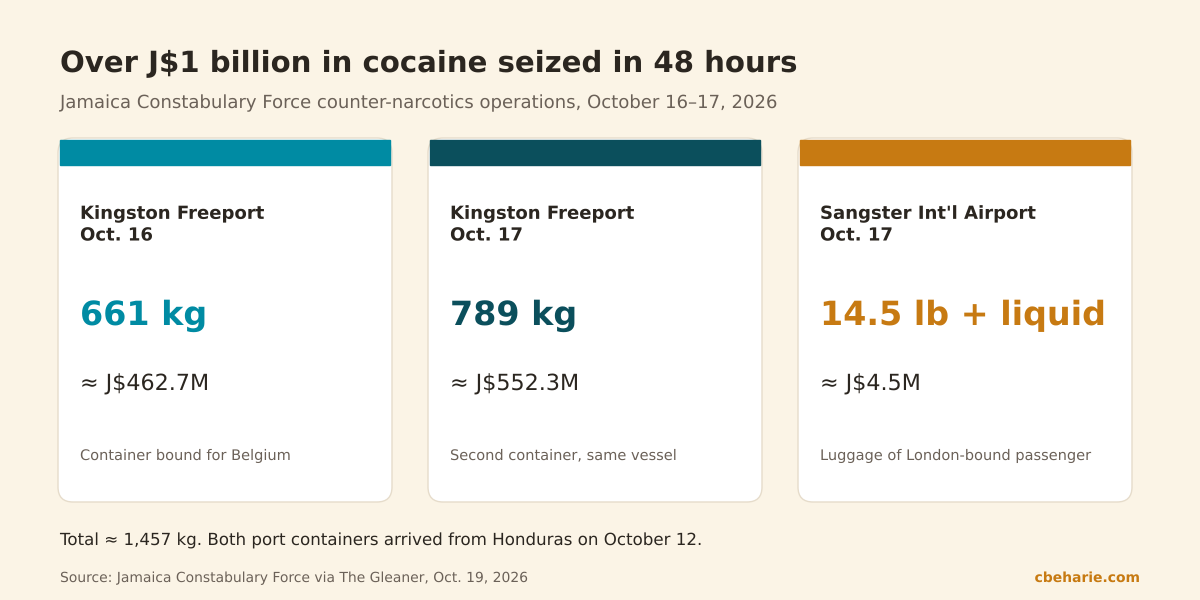
The police also had a significant win over the weekend. The Firearms and Narcotics Investigation Division, working with the Jamaica Customs Agency and international partners, seized about 1,457 kilograms of cocaine valued at more than J$1 billion on October 16 and 17. Most came from two containers at the Kingston Freeport Terminal that had arrived from Honduras on October 12, one of them bound for Belgium. At Sangster International Airport, a British national headed to London was detained after police found cocaine hidden in food packages and bottles. Acting FNID head Deputy Superintendent Oreth Dunkley described the haul as a serious blow to trafficking networks.
What to watch next
- The outcome of the National Security Council meeting next week, and whether new measures are announced.
- INDECOM’s findings on both the Sligoville stand-off and the Mandeville shooting.
- The recovery of the 10-year-old girl, whom many Jamaicans are holding in prayer.
- Whether the drop in murders holds through the traditionally difficult holiday season.
For Jamaicans at home and abroad, Sligoville is a painful reminder that the courage of ordinary officers and the rights of every citizen are not rival causes. A minister of religion writing in the Observer this week asked why the killing of two officers has not drawn more public outrage. It is a fair question, and so is its companion: how do we make sure every life lost in these encounters is accounted for?
2. A nation’s salute: Jamaica honors its own on National Heroes’ Day
What happened
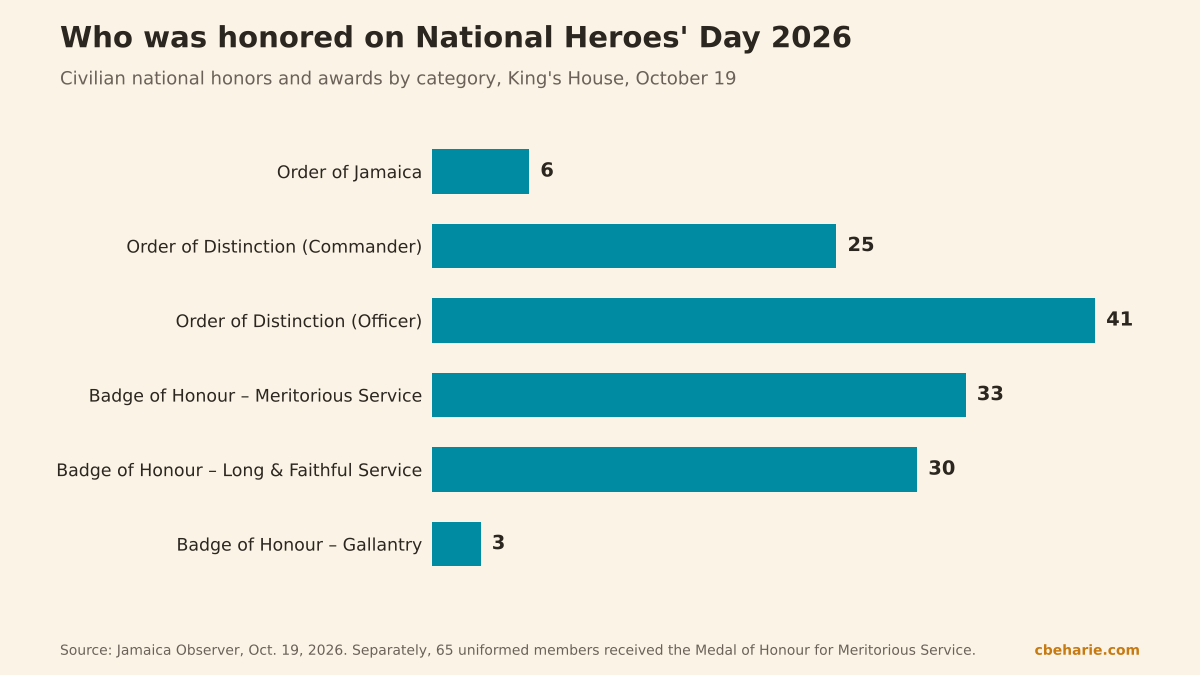
On Monday, October 19, National Heroes’ Day, Governor-General Sir Patrick Allen presided over the annual Ceremony of Investiture at King’s House in Kingston. The Gleaner and the Jamaica Information Service put the number of honorees at 140, though one Observer headline cited 149. By the Observer’s category count, six people received the Order of Jamaica, 25 the Order of Distinction in the rank of Commander, 41 the Order of Distinction in the rank of Officer, 33 the Badge of Honour for Meritorious Service, 30 the Badge of Honour for Long and Faithful Service, and three civilians the Badge of Honour for Gallantry. Another 65 members of the uniformed services received the Medal of Honour for Meritorious Service.
Who was honored
The six new members of the Order of Jamaica reflect business, politics and philanthropy: Sagicor Group Jamaica president and CEO Christopher Zacca; former Bank of Jamaica governor Richard Byles; Energy, Telecommunications and Transport Minister Daryl Vaz; former minister and veteran educator Maxine Henry-Wilson; philanthropist Donnette Chin-Loy Chang; and former National Security Minister Derrick Smith, whose son Duane accepted the honor on his behalf.
Among those named Commanders of the Order of Distinction were Auditor General Pamela Monroe Ellis, Director of Public Prosecutions Claudette Thompson, Jamaica Fire Brigade Commissioner Stewart Beckford, Professor Densil Williams, and the late businessman Kenneth Loshusan, honored posthumously.
Culture was well represented too. Dancehall star Mr. Vegas, born Clifford Roy Smith, received the Order of Distinction (Officer) and said he never imagined such a moment. Veteran percussionist Bongo Herman said he was glad to receive his honor while still alive to enjoy it, a sentiment many Jamaicans will understand. The late musician Wilburn “Stranger” Cole was honored posthumously, with his sons and granddaughter accepting. Veteran broadcaster Kerlyn Brown and Evan Thompson, director of the Meteorological Service of Jamaica, were also among the Officers, the latter a fitting recognition in a year shaped by Hurricane Melissa.
The celebrations reached well beyond King’s House. Municipal ceremonies across the island recognized local contributors on the same day: the Portmore Municipal Council honored 13 individuals, companies and staff members, and eight Clarendon residents were recognized for public service at their parish’s Heroes’ Day salute. These smaller ceremonies matter, because they celebrate the teachers, nurses, volunteers and small business owners whose names rarely make the national list but whose work holds communities together.
Some of the most moving awards went to ordinary people who did extraordinary things. Councillor Scean Barnswell and his wife, Danielle, of Clarendon, and Susan Higgins received the Badge of Honour for Gallantry. Midwife Myda Trail was recognized for long and faithful service, years of bringing Jamaican children safely into the world.
Melissa’s heroes
Heroes’ Day had a special weight this year, coming just over a week before the first anniversary of Hurricane Melissa, the Category 5 storm that struck on October 28, 2025. In Montego Bay, Mayor Richard Vernon led a moment of silence at Sam Sharpe Square for St. James residents who died and urged the parish to keep the resilience it showed during the storm. The St. James Municipal Corporation presented 10 Sam Sharpe Awards, four Mayor’s Special Awards and new Hurricane Melissa Medals of Honour.
The stories behind those medals are remarkable. Six police officers formed a human chain in neck-deep floodwater and finally used a hose and electrical wire to pull a woman to safety. Volunteer Akeem Nesbeth moved homeless people and immobile elderly residents of a Mount Salem nursing home to safety despite a cut foot. Petroy Maxwell broke windows to free a trapped neighbor. Father Dalmas Agan was honored for protecting children at the Mustard Seed home. And Courtney Campbell of Westgreen was honored posthumously: he contracted leptospirosis after falling into floodwater while helping neighbors, and later died.
Why it matters
This year’s Heritage Week theme, “Resilient People with a Proud Heritage,” was not just a slogan. In a message read at a thanksgiving service at Kingston Open Bible Church, the Governor-General urged Jamaicans to honor their ancestors by building something lasting for the generations to come, a legacy rooted in compassion, respect, service and responsibility. It is a timely challenge for a country still rebuilding homes, schools and hospitals after Melissa.
Honors lists always invite debate, and this one is no different. Some Jamaicans question whether serving politicians should be recognized while still in office; others feel too many awards go to the already prominent. Supporters reply that public service at senior levels is demanding and deserves recognition, and that this year’s list balances executives with midwives, firefighters and flood rescuers. Both perspectives are part of a healthy national conversation about what we value.
What to watch next
- Commemorations marking one year since Hurricane Melissa on October 28.
- Progress on rebuilding in western parishes, including Cornwall Regional Hospital in Montego Bay.
- Diaspora celebrations: actress Sheryl Lee Ralph and Sandals executive Adam Stewart were celebrated at the American Friends of Jamaica gala in New York.
3. Haiti: gangs test the new international force, and four soldiers are missing
What happened
On Sunday, October 18, gunmen attacked an armored vehicle carrying Salvadoran military personnel in Croix-des-Bouquets, a gang-controlled community on the edge of Port-au-Prince. El Salvador’s armed forces said the vehicle was struck with explosives and set ablaze. The four men inside, described as aviation technicians returning to their camp, escaped the burning vehicle but remain unaccounted for. Salvadoran helicopters sent to the scene came under fire as well. No group has claimed responsibility.
It was the largest attack yet on the Gang Suppression Force, the UN-authorized mission that replaced the Kenya-led Multinational Security Support mission. The force’s special representative, Jack Christofides, put it bluntly: “Gangs are testing the gang suppression force.” He also acknowledged that the mission cannot be everywhere at once. U.S. Ambassador Mike Waltz said the attack involved hundreds of bullets and explosives.
Background: a force still finding its feet
The new force was designed to fix the weaknesses of its predecessor. The Kenya-led mission, first deployed in 2023, struggled throughout its tenure with a shortage of money and resources. The scale of the challenge is plain: reporting this week named several powerful armed groups operating around the capital, including Chèn Méchan, Kraze Barye, led by Vitelhomme Innocent, and 400 Mawozo, led by Lanmo Sanjou. Both leaders are under UN and U.S. sanctions. The UN also highlighted an August 23 to 24 attack in Kenscoff in which at least 47 people were killed and 52 taken hostage, showing how quickly gangs can strike beyond the capital.
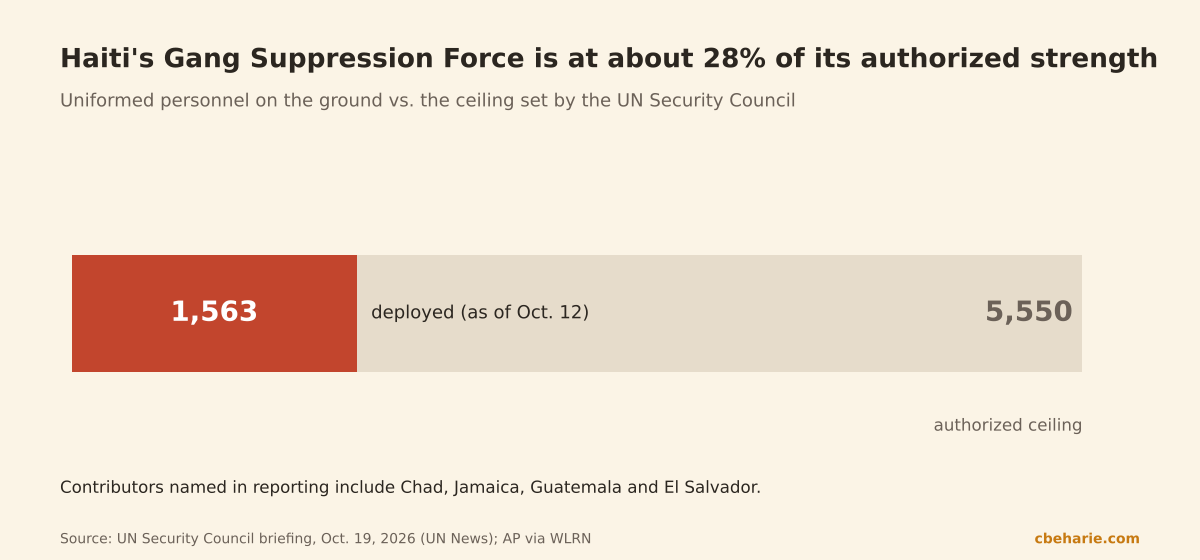
The UN Security Council authorized the Gang Suppression Force in September 2025, with a ceiling of 5,550 personnel. The first advance team, from Chad, arrived in April. As of October 12, the UN said 1,563 uniformed members were in place, roughly 28% of the authorized strength, although an Associated Press report this week put the number on the ground above 2,000. Countries named as contributors include Chad, Guatemala, El Salvador and Jamaica. The force has set up a base in the Artibonite region, and the UN provides logistical support.
Briefing the Security Council on Monday, the UN’s top official in Haiti, Carlos Ruiz Massieu, said gangs are adapting to the crackdown: carrying out reprisals against civilians, taking hostages, and spreading into rural areas. He also delivered a sobering statistic: security force operations accounted for 52% of the Haitians killed or wounded since early July, including 148 people with no link to gangs. That is a reminder that even well-intentioned operations carry a heavy civilian cost.
The human toll, and the stalled vote
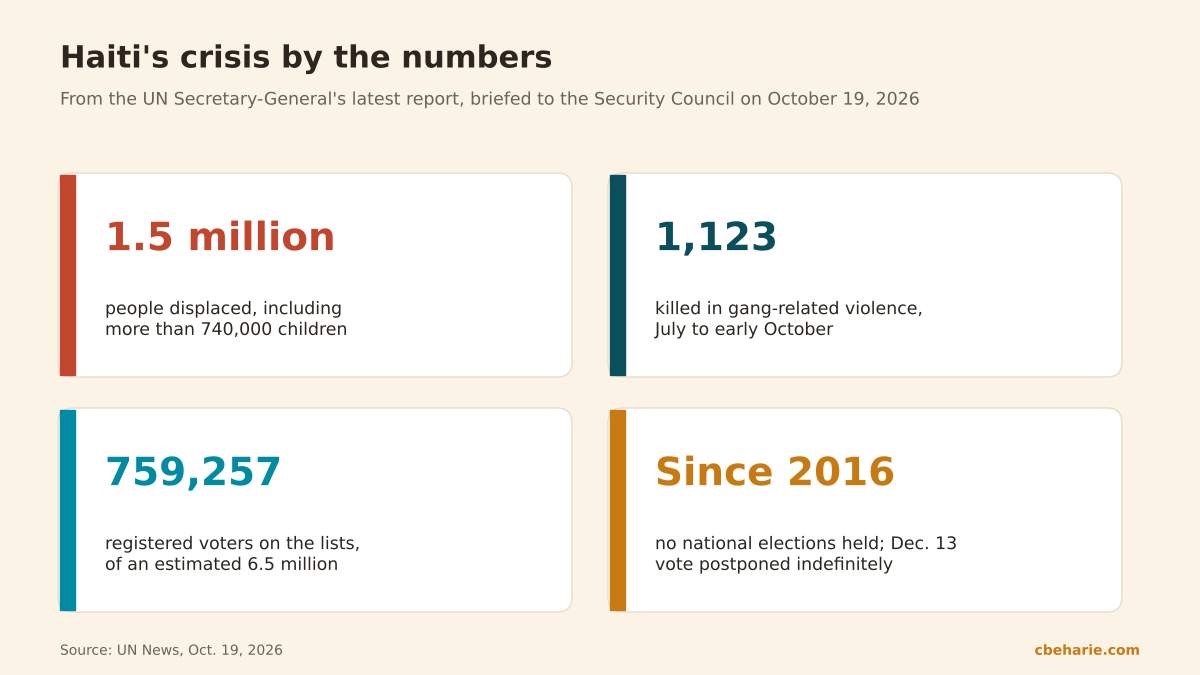
The numbers are staggering. According to the UN, 1,123 people were killed and 440 injured in gang-related violence between July and early October. Nearly 1.5 million Haitians are displaced, more than 740,000 of them children. The economy is expected to shrink for a seventh straight year, and the UN’s humanitarian plan for 2026 is only about half funded.
Politically, Haiti remains in limbo. Presidential and legislative elections planned for December 13 have been postponed indefinitely, and the country has not held a national vote since 2016. More than 35 parties and 3,500 candidates have registered, but as of October 5 only 759,257 people were on the voter lists, out of an estimated 6.5 million eligible voters. Ruiz Massieu cautioned against setting new dates without a realistic assessment, warning that empty promises could further damage public trust.
The Jamaican and Caribbean angle
For Jamaica, Haiti is not a distant story. Jamaican personnel have been part of the international effort, and the safety of every contributing soldier, whether from San Salvador, N’Djamena or Kingston, now rests on how the force responds to this test. Haiti is also a CARICOM member, and its instability shapes migration, drug and weapons flows across the northern Caribbean, including through Jamaica’s own waters.
There are honest disagreements about the way forward. Some argue the force simply needs more troops, money and equipment to take territory back. Others, including the UN’s own envoy, stress that guns alone will not bring lasting peace without a functioning state, disarmament and programs to pull children out of gangs. Most Haitians, and most of their neighbors, would say both are needed.
What to watch next
- News on the four missing Salvadoran personnel.
- Whether contributing countries, including Jamaica, adjust their deployments or rules of engagement.
- New pledges of troops and funding to bring the force closer to its 5,550 ceiling.
- Any realistic new election timetable from Haiti’s transitional authorities.
4. Cuba: Florida issues an arrest warrant for Raúl Castro as pressure on Havana mounts
What happened
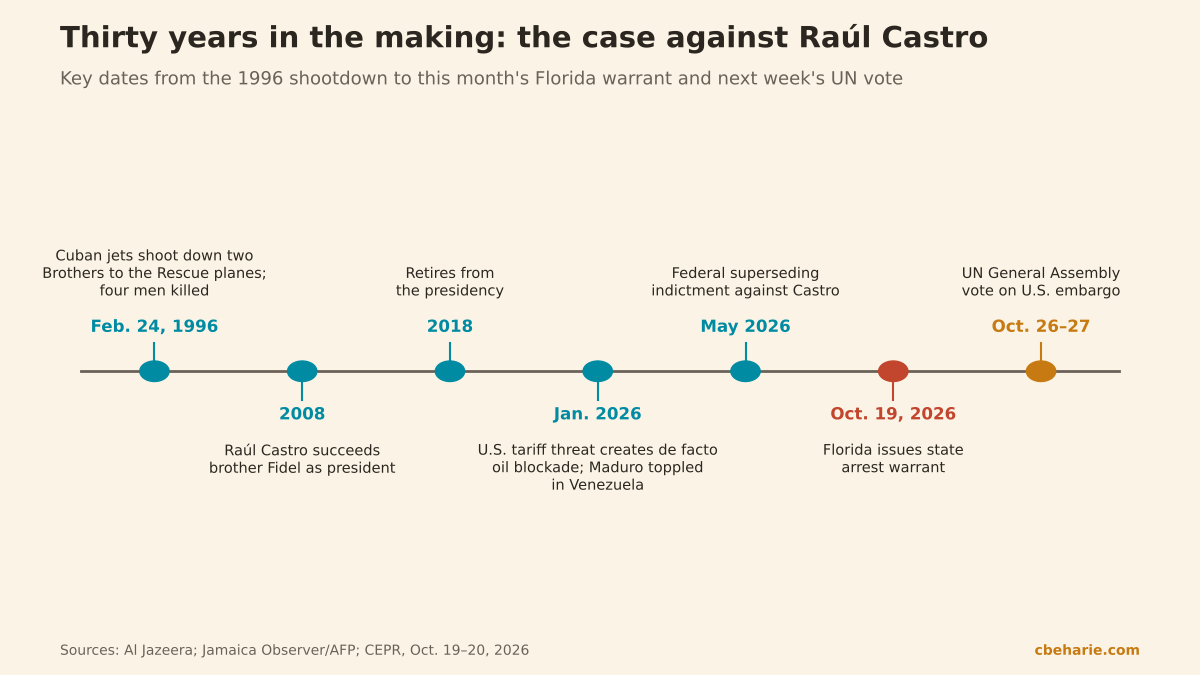
On Monday, October 19, Florida Attorney General James Uthmeier announced a state arrest warrant for Raúl Castro, Cuba’s 95-year-old former president, on a charge of conspiracy to commit first-degree murder. The case concerns February 24, 1996, when Cuban fighter jets shot down two unarmed planes flown by Brothers to the Rescue, a Florida-based group that helped Cubans fleeing the island by sea. Four men were killed: Carlos Costa, Pablo Morales, Mario de la Peña and Armando Alejandre Jr. At the time, Castro was Cuba’s defense minister.
Uthmeier’s office said in a statement that “Raul Castro ordered the murder of four Floridians in cold blood.” The state charge follows a superseding federal indictment unsealed in May, which accuses Castro of conspiracy to kill U.S. nationals, destroying aircraft, and four counts of murder. U.S. Attorney Jason Reding Quiñones said the federal case laid the groundwork for Florida’s, and that the administration supports parallel prosecutions.
Two very different readings
For the families of the four men and for much of Miami’s Cuban American community, the warrant represents long-delayed accountability. U.S. authorities maintain the planes were in international airspace and received no warning. Cuba has long countered that earlier Brothers to the Rescue flights had violated its airspace despite repeated warnings.
Havana and its allies see something else entirely. Cuban President Miguel Díaz-Canel has said the federal indictment has no legal basis and is an attempt to justify military aggression. On Tuesday, Russia’s foreign ministry called the Florida accusation baseless and contrived and pledged solidarity with Cuba. Critics also point to the precedent of January, when President Trump cited a U.S. indictment to justify military action that toppled Venezuela’s then-president Nicolás Maduro, a close Cuban ally.
Why it matters: a squeeze on the island
The warrant lands amid a broader campaign of economic, political and legal pressure. Since January, the threat of steep U.S. tariffs on any country supplying Cuba with oil has created what Al Jazeera describes as a de facto energy blockade, straining a power grid that depends heavily on imported fuel. On October 15, the U.S. Treasury sanctioned the Cuban state-owned bank BICSA, accusing it of serving a sanctioned Iranian bank. CBS News has reported shortages of medicine in pediatric and cancer wards. Supporters of the policy say pressure is the only language Havana’s leaders understand; critics say ordinary Cubans are paying the price.
The Caribbean vote
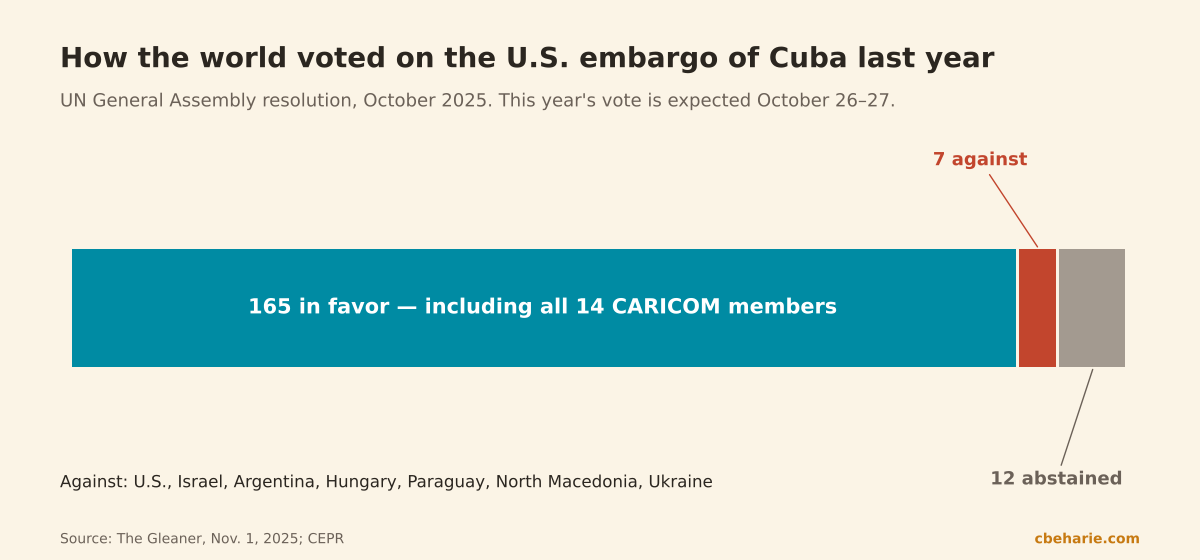
The next test comes at the UN General Assembly, which is expected to vote on October 26 and 27 on its annual resolution calling for an end to the U.S. embargo. Last year the resolution passed 165 to 7, with 12 abstentions, and all 14 CARICOM member states voted in favor. This week U.S. Ambassador Mike Waltz hosted a panel of Cuban dissidents at the UN and urged countries to vote no; Cuba’s ambassador called the event a sham.
That puts Caribbean governments, including Jamaica’s, in a familiar but now tighter spot: balancing a long regional consensus on Cuba, and long-standing ties with Havana, against a close relationship with Washington, a key partner on trade and security. How the region votes, and how the U.S. responds, will say a lot about the Caribbean’s room to chart its own course.
It is worth remembering what the 1996 shootdown means to the people involved. The four men killed were flying for a group that searched the sea for Cubans trying to flee, and their families have waited three decades for accountability. At the same time, Castro lives in Cuba, far beyond the reach of Florida’s courts, so the warrant is unlikely to lead to an arrest unless circumstances change dramatically. That is why it is fair to read it as a political and diplomatic signal as much as a legal step, and why both supporters and critics will be watching what Washington does next.
What to watch next
- The UN General Assembly vote on October 26 and 27, and whether any Caribbean votes shift.
- Any further U.S. legal or military steps tied to the indictments.
- Conditions on the island as fuel shortages and blackouts continue.
5. Peace talks in Oslo: Ukraine, the U.S. and Europe look for a path, and Moscow is next
What happened
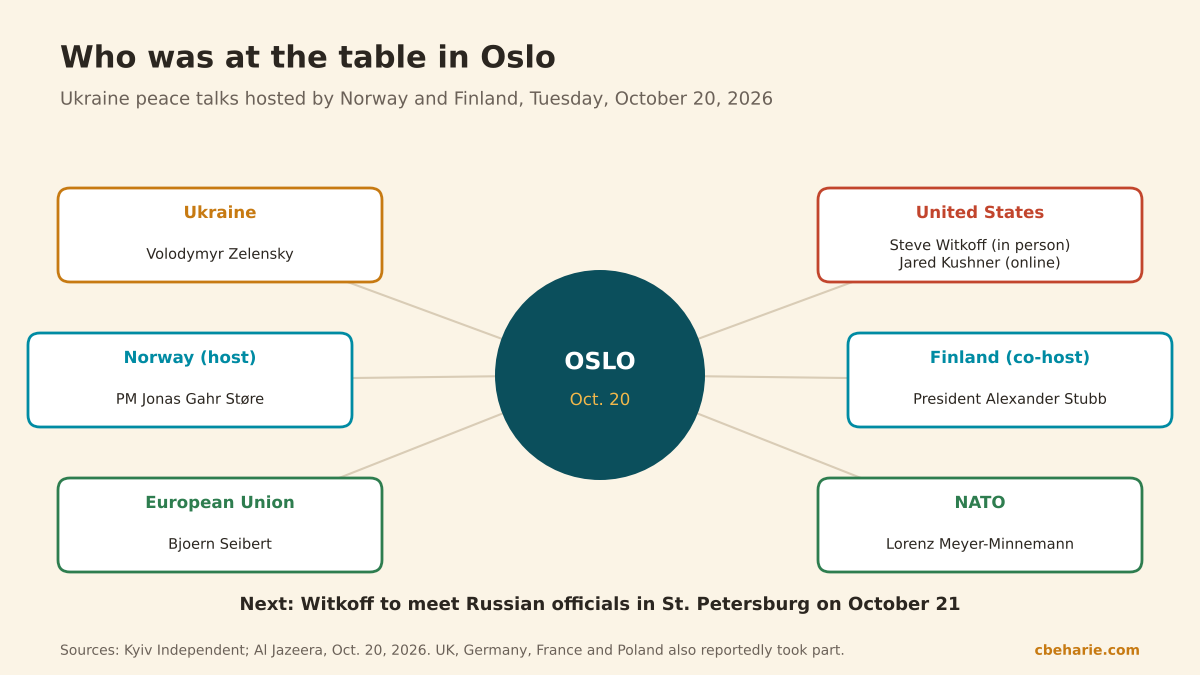
On Tuesday, October 20, Norway’s capital hosted one of the most important diplomatic meetings of the autumn. Ukrainian President Volodymyr Zelensky met U.S. special envoy Steve Witkoff, with Jared Kushner joining online, in talks organized by Norway and Finland at Zelensky’s request. Prime Minister Jonas Gahr Støre and Finnish President Alexander Stubb took part, along with Bjoern Seibert, chief of staff to European Commission President Ursula von der Leyen, and Lorenz Meyer-Minnemann from NATO’s leadership. The UK, Germany, France and Poland were also reportedly involved.
Arriving in Oslo, Zelensky said Ukraine was “maintaining all contacts that can help bring peace.” The format included a bilateral meeting with Witkoff, a three-way meeting with Støre and Stubb, and joint sessions.
What came out of it
No agreement was signed, but the talks produced a next step. Støre announced that Witkoff will meet Russian officials in St. Petersburg today, October 21, to discuss European and U.S. proposals, a move he said could possibly pave the way for a meeting at leaders’ level. Zelensky said Witkoff would carry proposals for postwar security guarantees for Ukraine modeled on NATO’s Article 5, and that a three-way leaders’ meeting is a priority. Stubb said negotiators had identified key elements on security and the economy, and that technical talks were progressing despite noise in public.
Zelensky said the Oslo agenda also covered strengthening Ukraine’s air defenses and joint weapons production with partners, practical concerns for a country bracing for another winter of strikes. Officials were also expected to meet national security advisers from European countries. There is a human thread, too: The New York Times reported that Witkoff may meet Vladimir Putin, possibly to discuss the release of Stephen Hubbard, a 72-year-old American detained by Russian forces in 2022. A humanitarian gesture like that would not end the war, but such gestures have sometimes opened doors for larger conversations.
Why it matters: a strained partnership
The meeting came at a tense moment between Kyiv and Washington. Relations soured after a surprise U.S.-Russia diesel deal announced October 9. Ukraine has accused the U.S. of using military aid and technology access to press it to stop striking Russian oil refineries, and Kyiv fears Patriot missiles paid for by its allies are being held up. Secretary of State Marco Rubio has said any delays were not deliberate. President Trump has publicly accused Zelensky of not wanting to end the war, while Zelensky has warned that siding with Vladimir Putin would be a historic mistake.
The war itself has not paused. Seven people were killed in Ukraine on the day of the talks, and Russia has been escalating attacks on energy infrastructure as winter approaches. Moscow still demands that Ukraine give up the Donbas region, and it reportedly wants a Putin-Trump meeting in China next month without Ukraine at the table. That is precisely what Kyiv and its European partners are trying to avoid.
A view from Norway, and from the Caribbean
Living in Norway, I am struck by how naturally this country has stepped into the role of host. Norway has a long tradition of quiet peacemaking, and its neighbor Finland shares a long border with Russia, so both have a direct stake in how this war ends. For Norwegians, the talks were not abstract; they were happening down the street.
For Jamaica and the Caribbean, the war in Ukraine has never been as distant as the map suggests. It has shaped what families pay for fuel, fertilizer and food. A credible path to peace could ease some of those pressures; a deal that rewards aggression could weaken the principle of sovereignty that small nations rely on. Reasonable people differ on how much compromise is acceptable, but nearly everyone agrees the killing must stop.
What to watch next
- The outcome of Witkoff’s St. Petersburg meeting today, and whether he meets President Putin.
- Any announcement of a three-way leaders’ meeting including Ukraine.
- Whether Patriot deliveries resume and U.S.-Ukraine tensions ease.
- Russia’s winter strikes on Ukraine’s power grid.
Closing reflection: heroes, legacy and the work of peace
Put today’s five stories side by side and a common thread appears. In Sligoville, two officers walked toward danger for the sake of a child. In Montego Bay, neighbors waded into floodwater for strangers, and one of them paid with his life. In Haiti, soldiers far from home are trying to give a suffering people room to breathe. In Oslo, diplomats are working through the night on something that may or may not hold. And in the Cuba story, families have waited 30 years for an answer they believe justice owes them, while ordinary Cubans endure the hardship of a long standoff between governments.
Heroism, it turns out, is rarely a single dramatic act. More often it is faithfulness: showing up, telling the truth, carrying responsibility for people we may never meet. The Governor-General’s call to leave a lasting legacy echoes an old biblical idea, that a good person leaves an inheritance to their children’s children. That inheritance is not only money or monuments. It is the kind of country, and the kind of world, we hand on.
The Scriptures also say, “Blessed are the peacemakers.” Peacemaking is hard work, whether it happens in a Kingston community, a Port-au-Prince neighborhood or a conference room in Oslo. It asks us to grieve honestly, to hold power accountable, to hear people we disagree with, and to keep hope alive when the headlines are heavy. As Jamaica prepares to mark one year since Melissa, may we keep praying for the wounded, honoring the faithful, and doing our own small part to build what lasts.
Thank you for reading. Walk good, and I will see you tomorrow.
Sources
- The Gleaner: ‘They are heroes’ – PM, Opposition salute slain cops
- Jamaica Observer: Inside the Sligoville stand-off
- Jamaica Observer: Sligoville shoot-out a teachable moment (editorial)
- Jamaica Observer: Where is the outrage?
- The Gleaner: Murder rate down 24 per cent as Jamaica records 407 homicides
- The Gleaner: More than $1 billion worth of cocaine seized in 48 hours
- The Gleaner: INDECOM probes fatal police shooting of two men in Mandeville
- Jamaica Observer: Family protests police killing in Mandeville
- Jamaica Observer: 149 outstanding Jamaicans to be honoured today
- Jamaica Observer: A nation’s salute
- The Gleaner: Jamaicans honoured for service, achievement
- JIS: 140 Jamaicans to receive national honours and awards this year
- Jamaica Observer: Bongo Herman glad to be awarded national honour
- Jamaica Observer: Vegas revels in national honour
- Jamaica Observer: Hurricane Melissa ‘heroes’ honoured in St James
- The Gleaner: MoBay mayor urges St James residents to uphold resilience post-Melissa
- The Gleaner: Governor General implores Jamaicans to honour ancestors
- The Gleaner: Ralph, Stewart celebrated for global achievements
- UN News: Haiti elections on hold as gangs adapt to security crackdown
- WLRN/AP: Gangs in Haiti target foreign troops in the biggest attack since new force began operations
- Al Jazeera: First troops from UN-backed Gang Suppression Force arrive in Haiti
- Al Jazeera: Florida issues arrest warrant for Cuban leader Raul Castro
- Jamaica Observer/AFP: Russia slams Florida arrest warrant for Cuba’s Raul Castro
- CEPR: US escalation in the Caribbean and Latin America, live updates, October 2026
- The Gleaner: CARICOM countries vote in favour of resolution to end US trade embargo against Cuba (2025)
- Kyiv Independent: Zelensky meets Trump envoy Witkoff in Norway as US-Ukraine ties sour
- Kyiv Independent: Witkoff to visit St. Petersburg after Zelensky talks, Norway’s PM says
- Al Jazeera: Zelenskyy to hold talks on Russia-Ukraine war with Witkoff, Europeans
- Morning Star: World in brief, October 20, 2026 (Spain floods, Ukraine, Haiti)
- Jamaica Observer: Four dead as floods sweep eastern Spain
All charts and graphics in this post are original work by cbeharie.com, built from the sourced data above.