Good morning from Norway. Thursday’s briefing begins with a quiet but significant change in Jamaican foreign policy. For the first time, Jamaica declined to vote for the annual United Nations resolution calling for an end to the U.S. embargo on Cuba, choosing instead to abstain. Trinidad and Tobago went further and voted against it, leaving CARICOM visibly divided on an issue where the region has spoken with one voice for three decades.
Across the Caribbean, King Charles III has begun a nine-day tour with words about slavery that were warmer than some expected and more limited than many had hoped, as Commonwealth leaders prepare to gather in Antigua and Barbuda this weekend.
In Europe, Spain is in mourning again. At least 68 people died on Wednesday when one high-speed train ran into the back of another near Toledo, and the transport minister has already pointed to an “inexplicable” order from rail control. In Britain, home to a large Jamaican diaspora, Chancellor John Healey delivered the first budget of Prime Minister Andy Burnham’s government, offering modest help with energy bills while leaving the hardest choices for next year.
And in our own hemisphere, Brazil’s defeated presidential candidate, Senator Flávio Bolsonaro, has left the country under a court order to surrender his passports and landed in Miami, with Washington’s blessing and Brasília’s disapproval.
Three of today’s stories follow up on earlier briefings, so we focus only on what is new. Let’s begin.
1. Jamaica Abstains on the Cuba Embargo Vote, and CARICOM Splits
This follows up on yesterday’s briefing, which previewed the vote. The result is in, and it changes the picture for the region.
What happened
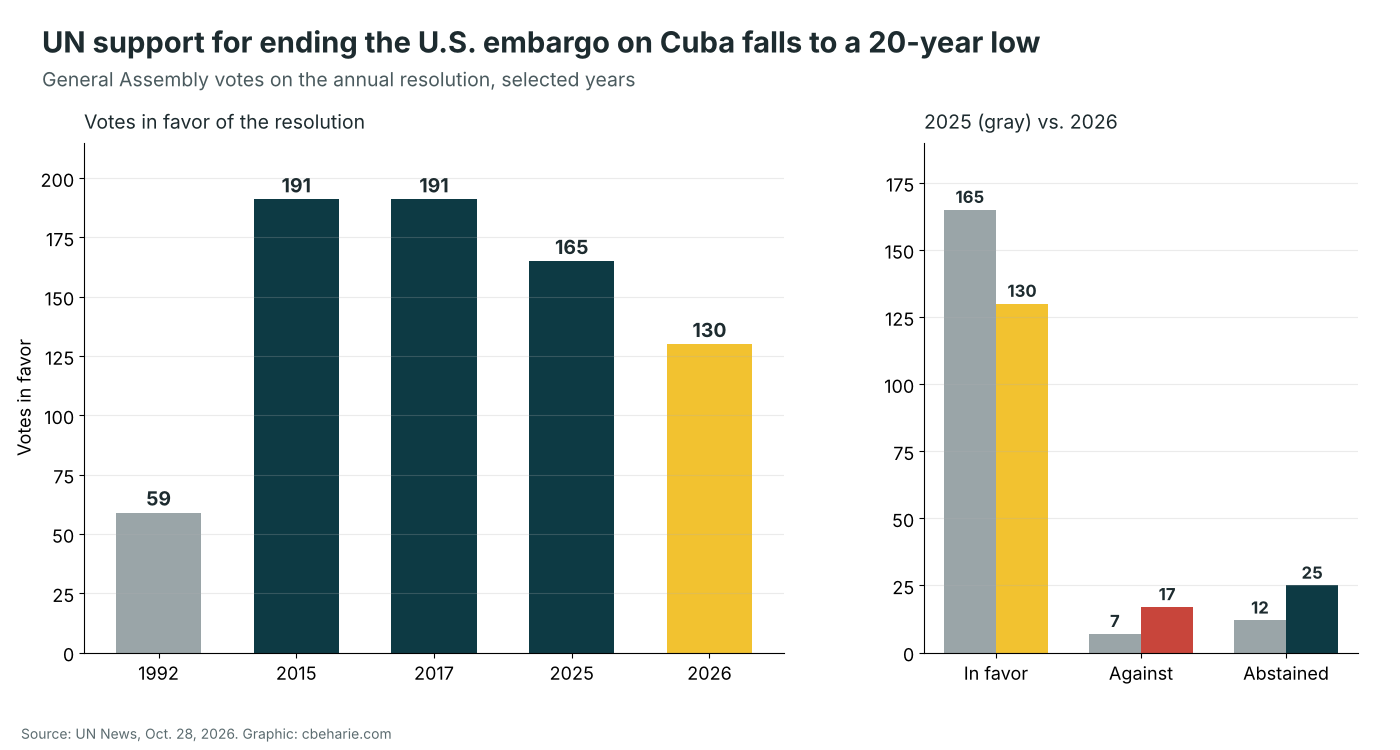
On Wednesday, October 28, the UN General Assembly once again called for an end to the U.S. economic, commercial and financial embargo on Cuba. The resolution passed 130 to 17, with 25 abstentions. A year ago, the same text won 165 votes, with only 7 against and 12 abstentions. UN News described it as the weakest support in two decades; AFP put it at the lowest level since 1995.
Jamaica was among the 25 countries that abstained, alongside Germany, Italy and Latvia, according to the Gleaner. Irie FM reported that it is the first time Jamaica has abstained on this resolution. Foreign Affairs and Foreign Trade Minister Kamina Johnson Smith told a post-Cabinet press briefing that the decision reflects a shift in government policy that had been under review for some time.
Jamaica’s explanation
The minister set out a middle path. Jamaica did not vote against the resolution, she said, because it does not support unilateral measures and stands by the UN Charter. But it did not vote in favor either, because the same text has been adopted year after year without improving life for ordinary Cubans, and because there is no room to amend it to reflect wider concerns, according to Demerara Waves. The government says it remains troubled by Cuba’s worsening humanitarian situation and wants direct, respectful dialogue between Washington and Havana. In her UN remarks, Johnson Smith said Jamaica encourages “domestic reform and greater integration of Cuba into the international economic system.”
The day before the vote, the government tabled a motion in Parliament along the same lines: rather than simply demanding an end to the embargo, it asks lawmakers to support peaceful dialogue between the two countries, aimed at easing barriers to trade, finance and investment. Prime Minister Andrew Holness made similar points at the CARICOM summit in July, suggesting the region could help bring the two sides together.
A region divided
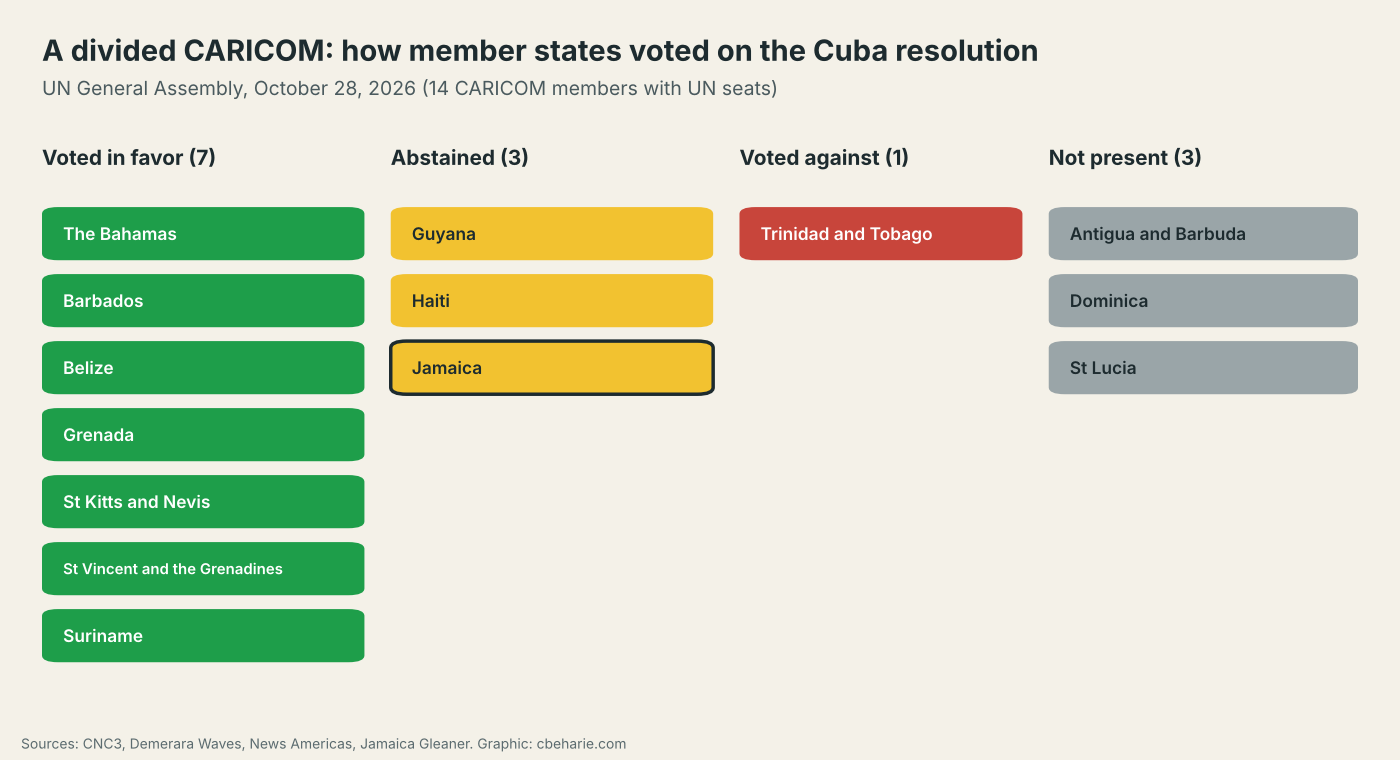
The CARICOM vote was the most fractured in memory. Seven member states voted in favor: The Bahamas, Barbados, Belize, Grenada, St Kitts and Nevis, St Vincent and the Grenadines, and Suriname. Jamaica, Guyana and Haiti abstained. Antigua and Barbuda, Dominica and St Lucia were not recorded as present. Trinidad and Tobago became the first CARICOM member ever to vote against the resolution, after supporting it every year from 1993 to 2025, CNC3 reported. Former prime minister Keith Rowley called the vote “so shameful,” and former foreign minister Amery Browne said it isolates the country in the region.
Background and competing views
Washington lobbied harder than usual this year. U.S. Ambassador Mike Waltz told the Assembly there is no blockade, citing more than $876 million in U.S. exports to Cuba in the first eight months of the year, and blamed Cuba’s hardship on its own government. Cuban Foreign Minister Bruno Rodríguez argued the embargo is choking the island’s health system, and the debate grew so heated that UN officials had to intervene. Cuba says some governments faced threats involving tariffs, visas and aid, though News Americas notes it has offered no evidence.
Critics will connect the dots to other recent decisions. In March, Jamaica ended its 50-year medical cooperation program with Cuba, with the Prime Minister saying the way Cuban personnel were paid conflicted with Jamaican law. Jamaica has also agreed to a U.S.-backed arrangement to host third-country nationals in transit; nine more people left the island under it this week, bringing departures to 10 of the 22 who arrived on October 13. News Americas is careful to say these arrangements do not prove any trade-off over Cuba. Supporters of the government’s position see a pragmatic small state protecting its relationship with its largest partner while still opposing sanctions in principle. Opponents see a break with a proud tradition of independent, non-aligned foreign policy.
Why it matters, and what to watch
For many Jamaicans, Cuba is not an abstraction. It is our nearest large neighbor, and for half a century Cuban doctors and nurses helped fill gaps in our public health system. Cuba, meanwhile, has endured blackouts since a U.S. fuel blockade began in January. Watch for the parliamentary debate on the government’s Cuba motion, the opposition’s response in that debate, and whether CARICOM heads try to restore a common position before their next meeting. Cuba still won the vote comfortably. The question for the Caribbean is whether it can still speak with one voice.
2. King Charles in the Caribbean: Acknowledging the Past, Stopping Short of Apology
Our October 27 briefing looked ahead to the Commonwealth summit in Antigua. Since then, the King has arrived in the region and spoken publicly about slavery for the first time on this tour.
What happened
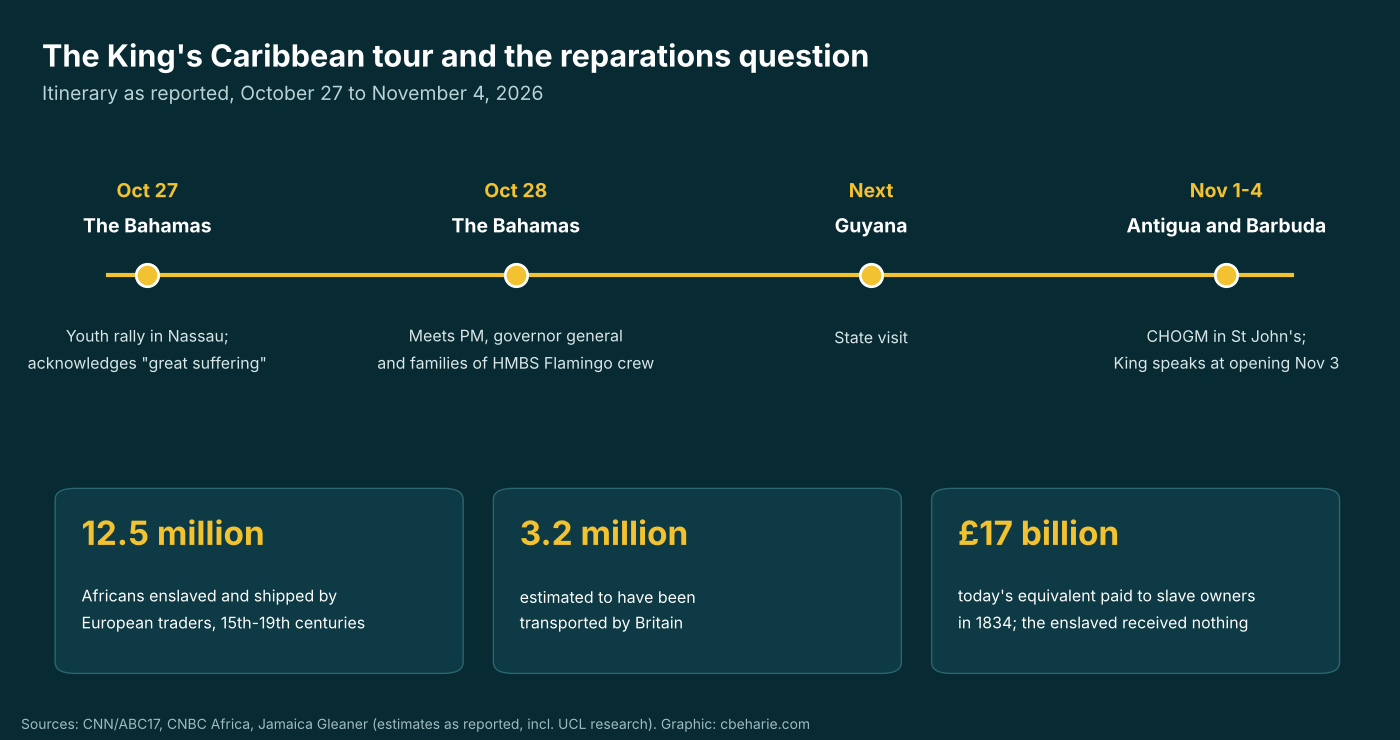
King Charles III and Queen Camilla began a nine-day Caribbean tour in Nassau on Tuesday, October 27. Speaking at a youth rally in Clifford Park, the King said it was only right to recognize “the great suffering and injustices of the past” in the islands and beyond, CNBC Africa reported. He added that some of the best of Bahamian culture grew out of that painful history and confirmed that Commonwealth leaders would discuss the legacy of slavery at their summit.
On Wednesday, his Bahamas program included meetings with the prime minister and governor general and time with the families of four Royal Bahamas Defence Force marines killed when Cuban fighter jets sank HMBS Flamingo in May 1980. He then travels to Guyana for a state visit before the Commonwealth Heads of Government Meeting (CHOGM) in St John’s, Antigua and Barbuda, which runs November 1 to 4. The King addresses the opening ceremony on November 3.
Where the line is drawn
Buckingham Palace has been clear that there will be no formal apology on this trip. The King acts on the advice of British ministers when abroad, and government policy rules out both an apology and financial reparations. Business Secretary Jonathan Reynolds said reparations are not a reasonable request, though he added that the subject should be open for discussion, according to CNN. Foreign Office sources argue there is no legal case because slavery was legal at the time.
On the other side, Commonwealth Secretary-General Shirley Ayorkor Botchwey said an apology from the King “wouldn’t hurt.” CARICOM Secretary-General Carla Barnett has framed reparations as a question of justice. Sir Hilary Beckles, chair of the CARICOM Reparations Commission, has dubbed this gathering the “reparations CHOGM,” while calling for a dialogue of decency and promising no attempt to embarrass the King, the Gleaner reported.
Antigua and Barbuda’s own reparations advocates are pressing too. Dorbrene O’Marde has written to the King asking him to address the slave trade directly, arguing that the monarch and the British government should follow the Church of England and the Church of Scotland, which have both apologized. He told the Gleaner that no formal reparations sessions are scheduled at the summit, though he hopes side events will take up the issue. The official program includes forums for youth, women, business and civil society, along with side events on eye health, sport, blue finance and governance, for a Commonwealth of 56 nations, most of them former British colonies.
Background
By widely cited estimates, at least 12.5 million Africans were enslaved and shipped across the Atlantic by European traders, about 3.2 million of them by Britain. When Britain abolished slavery in 1834, it compensated slave owners with sums equal to about £17 billion today, according to University College London research cited by CNN; the enslaved received nothing. In March this year, the UN General Assembly declared the transatlantic trafficking and enslavement of Africans the gravest crime against humanity, and in July CARICOM heads approved a revised 10-point plan for reparatory justice.
The King has edged forward before. At CHOGM in 2024, he spoke of painful aspects of the past that still resonate. In Kenya in 2023, he expressed the deepest regret for wrongdoings there. Each time, the words have stopped short of a state apology.
The Jamaican angle
Jamaica is not on this itinerary, but the conversation is ours too. Reparations is a long-running cause in Jamaica, and the King remains Jamaica’s head of state while the country works through constitutional reform aimed at becoming a republic. Many Jamaicans will notice that the King is choosing his words carefully, and many will ask whether acknowledgment without apology is a step forward or a polite way of standing still.
What to watch next
Watch the King’s speech at the CHOGM opening on November 3, whether the final communiqué mentions reparatory justice, and how the UK government responds if Caribbean leaders press the issue in the summit’s private sessions. The theme of this CHOGM is partnerships and investment, focused on climate, trade and youth jobs. Whether reparations sit on the official agenda or in the hallways, it is likely to be the issue the region remembers.
3. Spain’s Second High-Speed Rail Disaster This Year: At Least 68 Dead Near Toledo
What happened
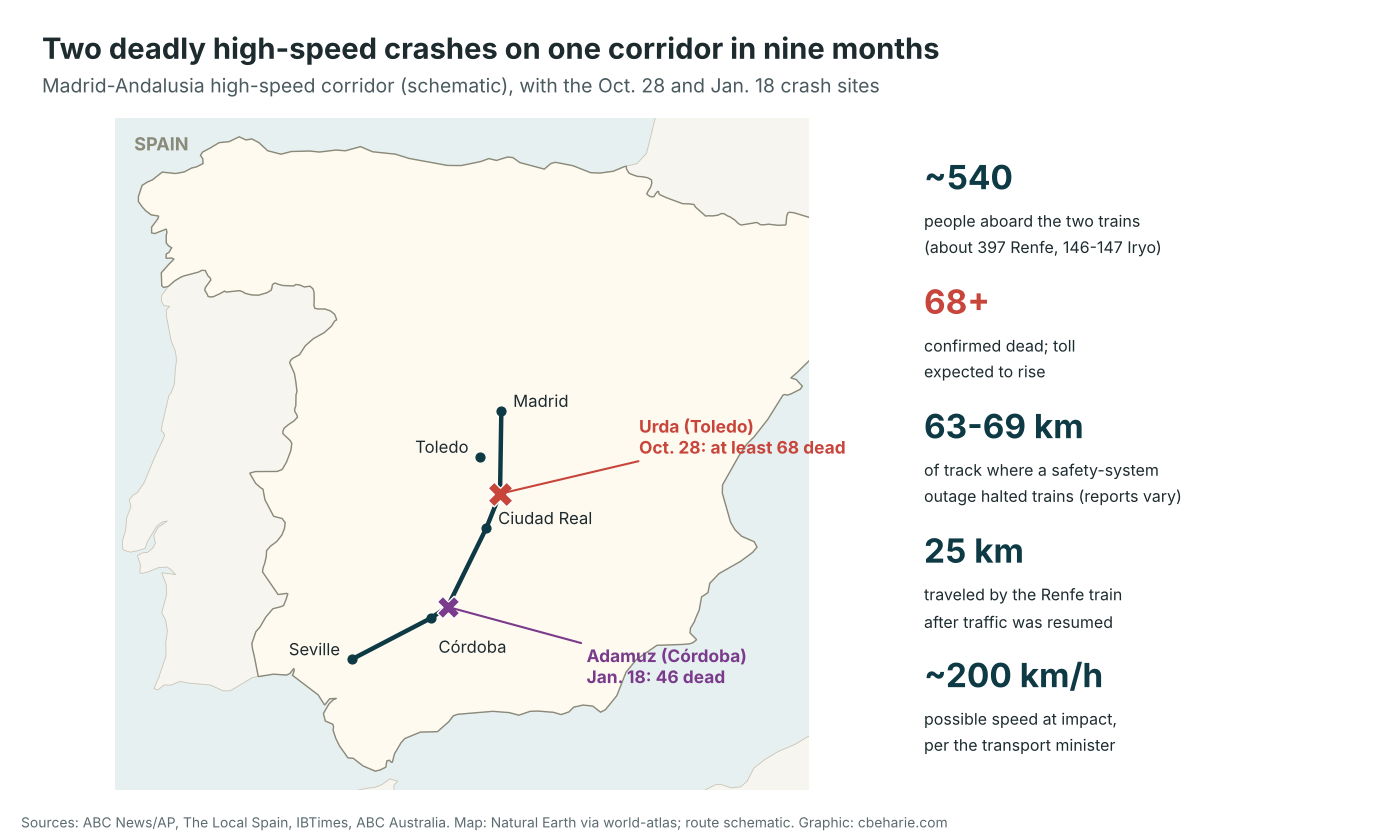
At about 8:53 a.m. on Wednesday, October 28, a Renfe high-speed train traveling from Madrid toward Seville ran into the back of a stationary Iryo train near the town of Urda, in Toledo province, south of Madrid. Two Iryo carriages were knocked off the track, and several fell down an embankment. The regional government of Castilla-La Mancha confirmed at least 68 deaths by Wednesday evening, and officials warned that the toll could rise as rescuers searched the wreckage. Regional president Emiliano García-Page said 24 of the dead were on the Renfe train and the rest on the Iryo train.
ABC News reported at least 15 people seriously injured and more than 50 hospitalized with lesser injuries. The Renfe train carried about 397 passengers and the Iryo train about 146 or 147, including a baby. The U.S. State Department said several American citizens were injured. Rail operator Adif suspended high-speed service between Madrid and Andalusia, and Spain’s soccer federation postponed all 24 Copa del Rey matches scheduled for Wednesday.
Survivors described confusion in the minutes before impact. One passenger, Miguel Ángel Pérez, told reporters that staff had announced the train was stopping because of an overload on the track, ABC News reported. The town of Urda turned its sports pavilion into a reception center for the injured, and Spain’s federation of municipalities called a nationwide minute of silence for 8 p.m. on Wednesday.
What we know about the cause
Unusually, the government offered a preliminary explanation within hours. Transport Minister Óscar Puente said a computer malfunction knocked out a safety system along a stretch of more than 60 kilometers at around 8:30 a.m., halting every train on that section. Reports differ on the exact length, with PBS citing 63 kilometers and The Local citing 69. Central control then told the Renfe train to resume without speed restrictions while a stop signal was still active. Puente called the order “inexplicable,” said the drivers were not to blame, and estimated the train may have been traveling at about 200 kilometers per hour when it struck. It had traveled roughly 25 kilometers after restarting.
Spanish media, citing government sources, have reported that an operator at the Atocha control center in Madrid authorized the train to continue. Those reports have not been officially confirmed, and Adif has not assigned responsibility. The independent railway accident investigation commission will lead the formal inquiry.
The political response
Prime Minister Pedro Sánchez visited the site, promised to find the cause, and said that if there was negligence, it would be known. He called two major high-speed accidents in a single year unacceptable and pledged safety reforms if investigators find weaknesses, while noting that early findings suggest the two crashes had different causes. The government declared three days of national mourning, from October 29 to 31. Opposition leader Alberto Núñez Feijóo of the People’s Party called for immediate government and judicial investigations and an independent review of Spain’s rail infrastructure, but declined to discuss political responsibility while the country grieves. Messages of sympathy came from European Commission President Ursula von der Leyen and French President Emmanuel Macron.
Background: a proud network under strain
Spain’s high-speed network has long been a source of national pride. That reputation is now under pressure. In January, an Iryo train derailed near Adamuz, in Córdoba province, and was struck by an oncoming Renfe train, killing 46 people. Wednesday’s crash is the deadliest on Spain’s high-speed lines since 2013. The two operators involved reflect Spain’s opening of its rail market to competition: Renfe is the public operator, while Iryo is a private competitor.
Why it matters, and the diaspora angle
Spain has deep ties to Jamaica through tourism: Spanish hotel groups have built and run many of the island’s resorts for decades, and Jamaican officials have long courted them. Many Jamaicans and Caribbean nationals live, study and work in Spain, and travelers often use this exact line between Madrid and the south. Families with loved ones in Spain should follow guidance from Spanish emergency services. More broadly, the crash is a reminder that safety systems are only as strong as the human decisions around them.
What to watch next
Watch for the final death toll, the identification of the victims, and whether the investigation confirms that a control-center order sent the train past a stop signal. Also watch for any suspension or disciplinary action at Adif, a parliamentary debate on rail safety, and how long the Madrid-Andalusia line stays closed.
4. Britain’s First Burnham-Era Budget: Modest Relief, Less Room for Error
What happened
On Wednesday, Chancellor of the Exchequer John Healey presented the UK’s Autumn Budget, the first since Andy Burnham became prime minister and Labour leader about three months ago. Healey framed it as giving the country breathing space after years of stagnation. The backdrop is harsh: energy prices have surged because of the U.S.-Israeli war with Iran and Iran’s closure of the Strait of Hormuz, with Brent crude trading around $116 a barrel this week, according to Al Jazeera.
The main measures
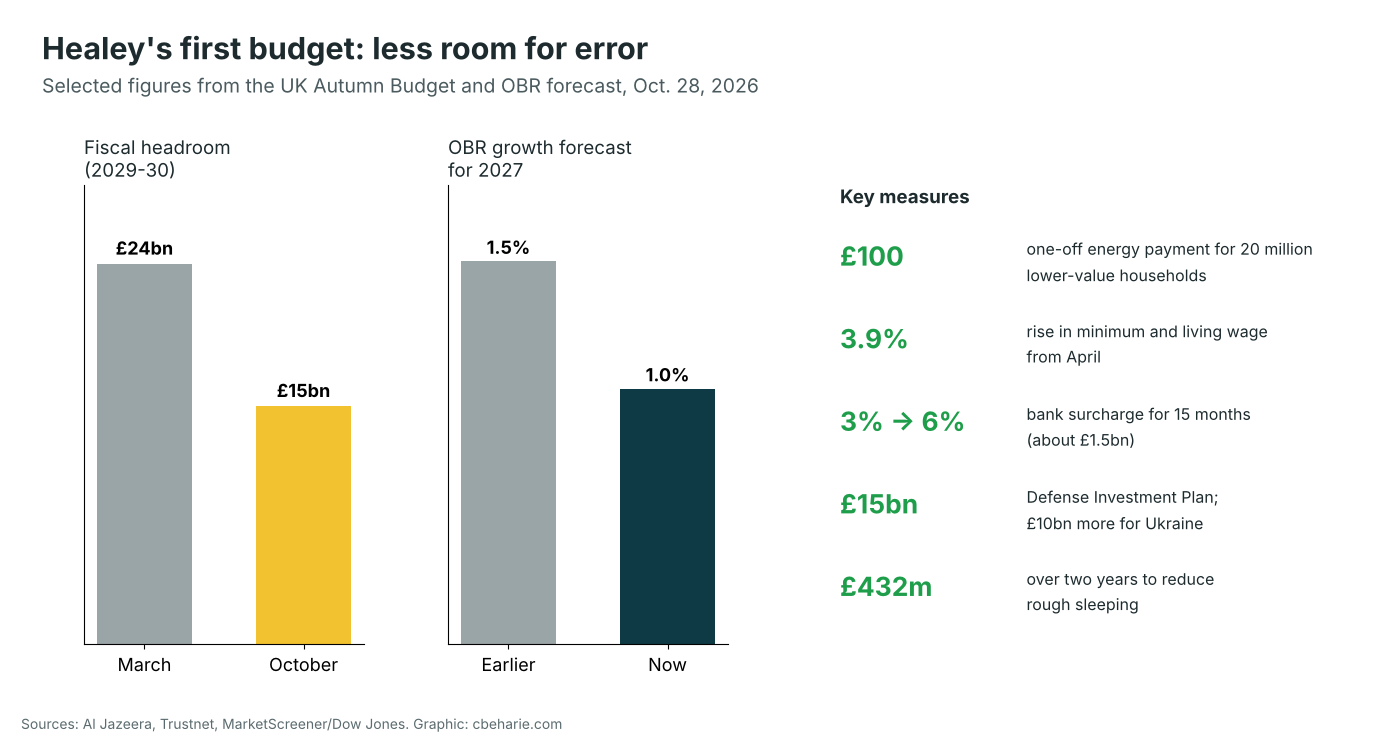
- Energy: a one-off £100 payment for about 20 million households in lower-value homes, and an extension of a temporary VAT cut on energy to July 1, worth about £50 a year on the price cap.
- Wages: the National Minimum Wage and National Living Wage rise 3.9% in April.
- Banks: the bank corporation tax surcharge doubles from 3% to 6% for 15 months, expected to raise about £1.5 billion.
- Defense and Ukraine: a £15 billion defense investment plan, with a £4.7 billion shortfall to be covered by trimming other departments, plus an extra £10 billion for Ukraine.
- Housing and homelessness: a new first-time buyer savings account from 2029 to replace the Lifetime ISA, and £432 million over two years to reduce rough sleeping.
- Savings: the Cash ISA allowance stays at £20,000 for under-65s, but tax rates on savings income rise from April 2027.
The numbers behind the speech
The independent Office for Budget Responsibility (OBR) now expects no real earnings growth next year and cut its 2027 growth forecast from 1.5% to 1%. Healey’s fiscal headroom, the cushion against his own borrowing rules, shrank from £24 billion in March to £15 billion, largely because of higher debt interest costs. The OBR expects about £14 billion more in debt interest this year than previously forecast, and it does not see inflation returning to target until 2028. Total UK borrowing passed £3 trillion for the first time in September.
How it landed
Financial markets took it calmly. The 10-year gilt yield eased slightly to around 5.3%, sterling was little changed near $1.33, and bank shares rose despite the higher surcharge, according to Dow Jones and Trustnet. Investment analysts called it credible and uneventful, the kind of budget bond markets wanted after a rough period. NATO Secretary-General Mark Rutte welcomed the defense commitment.
Others were less impressed. Economist James Meadway told Al Jazeera the package does not tackle the cost-of-living crisis in any serious way. Savings experts criticized the continued freeze on income tax thresholds, which pulls more people into higher tax bands as wages rise. And several analysts warned that the hardest decisions, including how to reach NATO’s defense spending targets, have simply been pushed into next year’s spending review.
Households are not out of the woods. The energy consultancy Cornwall Insight projects the price cap will rise about 16% in January, taking typical bills to nearly £2,000 a year, Al Jazeera reported, which is why many see the £100 payment as a cushion rather than a solution. For younger savers, the new first-time buyer account will offer a 25% government bonus on deposits of up to £4,000 a year, and the penalty for using a Lifetime ISA on a home above £450,000 falls from 25% to 20% immediately. Separately, Prime Minister Burnham has announced a national care service offering free personal care to older people, to be phased in, with an implementation report due in summer 2027.
The Jamaican and diaspora angle
Britain is home to a large and long-established Jamaican community, and many work in the very jobs this budget touches, from care and health to transport and retail. The 3.9% wage rise and the energy payment will matter to working households. Higher living costs in Britain also tend to squeeze remittances, a vital source of income for families in Jamaica, particularly in a year of hurricane recovery. Pensioners who have returned to Jamaica from the UK will want to follow changes to pensions and taxes closely, including the Burnham government’s plan to fund free personal care for older people partly by scrapping the state pension triple lock.
What to watch next
A Bank of England interest rate decision follows next week, and analysts at Trustnet expect a rise. Watch also for the price of oil, the January energy price cap, and the spending review where Healey has promised to set out the path to higher defense spending.
5. Brazil: Defeated Candidate Flávio Bolsonaro Leaves for Miami Under a Passport Order
Our October 27 briefing covered President Lula’s runoff victory. This is a major new development in the aftermath.
What happened
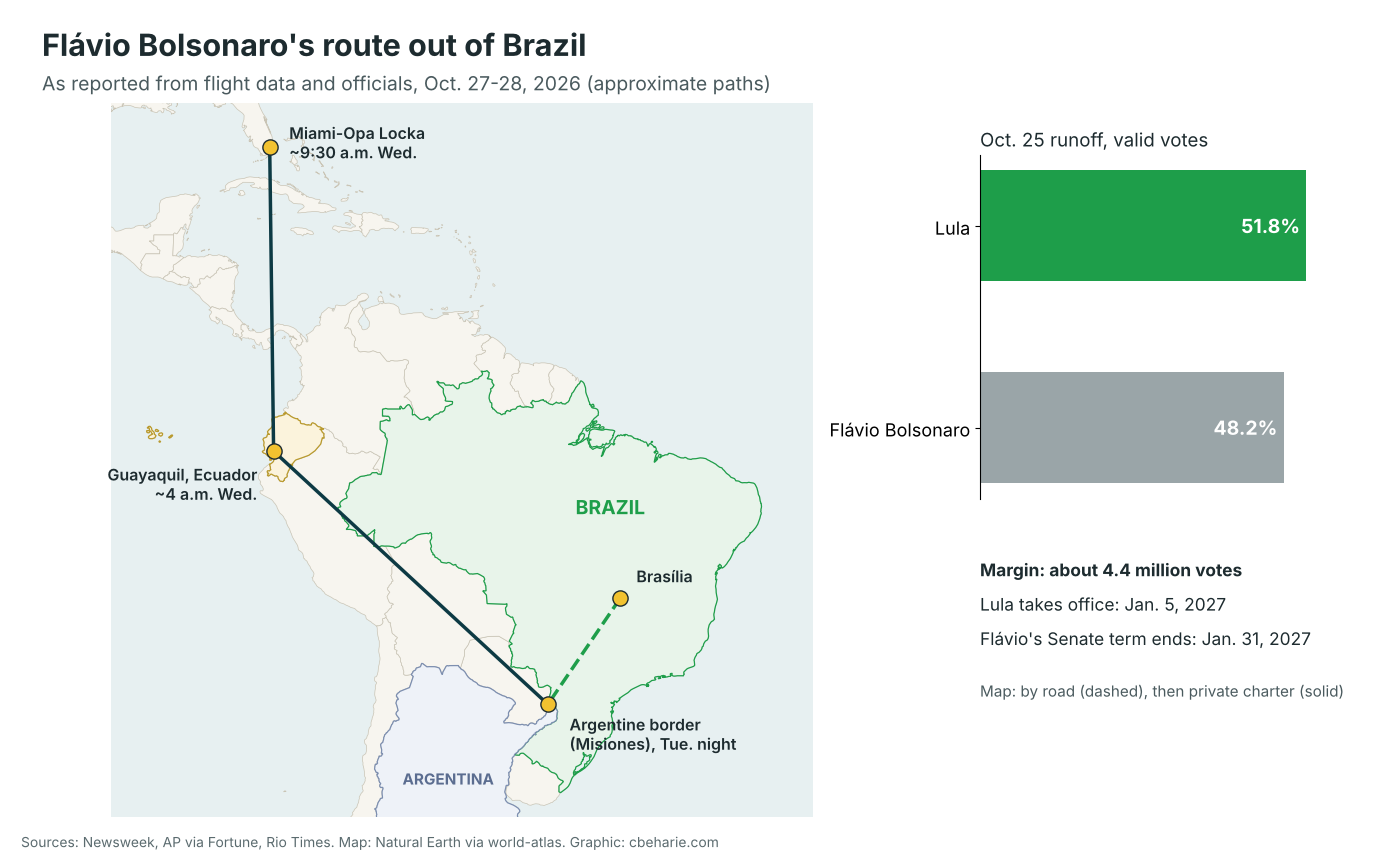
Senator Flávio Bolsonaro, who lost Brazil’s October 25 presidential runoff to Luiz Inácio Lula da Silva by 51.8% to 48.2%, has left the country. On Monday, he was served a Supreme Court order to surrender his regular and diplomatic passports as part of a corruption and money-laundering investigation, which he denies. On Tuesday night, he crossed by road into Argentina’s Misiones province, using an Italian passport according to a Brazilian diplomat quoted by AP, and boarded a private charter flight within the hour. Flight data showed a matching plane landing in Guayaquil, Ecuador, around 4 a.m. Wednesday, and at Miami-Opa Locka Executive Airport around 9:30 a.m., Newsweek reported.
The reactions
The U.S. State Department had already said it would issue visas to him and his family. President Trump said he approved, called the family fine people, and described Brazil’s election as strange, without endorsing the result. Lula said Flávio could have stayed to prove the accusations untrue and called the departure “shameful,” according to AP. Argentina’s government, led by Trump ally Javier Milei, who campaigned for Flávio, first denied he had entered the country, then reversed itself, and said no asylum request had been made. A close ally said Flávio was safe and resting, and a press conference was planned in Miami for Thursday.
Background
Flávio is the eldest son of former president Jair Bolsonaro, who is serving a 27-year sentence under house arrest for plotting a coup after his 2022 defeat. Like his father, who left for Florida after losing in 2022 and returned three months later, Flávio has not conceded and has talked about challenging the result. Brazil’s Supreme Court is examining claims that he used a sports betting company to launder money taken through fraudulent deductions from pensioners’ benefits, and separately that he took millions from a disgraced banker. Only days earlier, he had said in a video that he never thought about leaving and would lead the opposition from inside Brazil.
The details of the exit have raised questions in Brasília. Federal police were not monitoring him because no arrest warrant had been issued, and Brazil does not run exit checks at its borders, so his departure left no official record, Newsweek reported. He crossed into Argentina over the Tancredo Neves International Bridge at about 10:50 p.m. Even his own campaign manager, Rogério Marinho, said the campaign had heard nothing from him about the trip. Left-wing lawmakers have since petitioned for his arrest, but no decision had been announced. Oliver Stuenkel of the Getulio Vargas Foundation in São Paulo told Newsweek that Lula’s win surprised many and that the Bolsonaro campaign had shown overconfidence and a lack of discipline.
His supporters see political persecution by an activist court. His critics see a candidate fleeing accountability. Both sides agree on one thing: his Senate term, and with it his right to be tried only by the Supreme Court, ends on January 31, 2027. Lula’s fourth term begins January 5, and the result must be certified by December 18.
Why it matters for the region
Brazil is a regional heavyweight, and the way its transition unfolds affects the whole hemisphere, including the Caribbean, for which Brazil is an important hemispheric partner. Washington’s open welcome for a politician under investigation, and its refusal to endorse a result accepted by the Organization of American States and leaders around the world, adds strain to U.S.-Brazil relations. It may also sour ties between Brasília and Buenos Aires. For smaller states like Jamaica, which rely on respect for institutions and the rules of international cooperation, it is a case worth watching closely.
What to watch next
Watch Thursday’s Miami press conference, whether Brazil’s Supreme Court orders an arrest or Brazil requests his return, whether he seeks asylum in the United States, and whether Lula’s certification proceeds smoothly. Also watch for any response from the Argentine and Ecuadorian governments about their role in the journey.
Closing Reflection: Owning the Truth
Look closely and today’s stories share a quiet thread: how we deal with the truth about ourselves. In Spain, a minister stood up within hours and admitted that his own rail system had given an order it never should have given. In the Caribbean, a King acknowledged great suffering and injustice, even if he did not go as far as many wanted. In Brazil, a man under investigation chose to leave rather than answer in his own country’s courts. And in Kingston and Port of Spain, governments are explaining hard foreign policy choices to citizens who are not all convinced.
Scripture is honest about how hard this is. Proverbs 28:13 says that whoever conceals their sins will not prosper, but whoever confesses and forsakes them will find mercy. That verse is not a political slogan, and it does not settle debates about embargoes, reparations or court cases. Good people disagree about all of them. But it does describe a path that works for nations and for families alike: name what went wrong, take responsibility for your part, and then do the slow work of putting it right.
Confession is not humiliation. It is the doorway to healing. Today, let us pray for the families in Spain who are waiting for news, for leaders who must make difficult choices, and for the courage to own our mistakes in our homes, churches and workplaces before someone else has to uncover them.
Walk good, and God bless.
Sources
- UN News – Backing for UN call to end Cuba embargo falls to 20-year low
- Jamaica Gleaner – Jamaica abstains from UN vote condemning US embargo against Cuba
- Irie FM – Jamaica abstains from UN on US embargo on Cuba
- Demerara Waves – Guyana abstains from vote on UN resolution condemning US embargo on Cuba
- CNC3 – T&T votes with US at UNGA on Cuba embargo
- News Americas – Cuba embargo vote splits Caribbean amid US pressure
- Jamaica Observer (AFP) – Cuba wins UN vote against US embargo with weakest backing in 30 years
- Jamaica Gleaner – Holness defends decision to end Jamaica’s medical cooperation with Cuba (March 2026)
- Jamaica Gleaner – Nine more US deportees leave Jamaica under TCN arrangement
- CNBC Africa (Reuters) – King Charles says Commonwealth to confront slavery’s injustices
- CNN via ABC17 – King Charles acknowledges “injustices of the past” as Caribbean tour gets underway
- Jamaica Gleaner – Eyes on reparations as King visits Caribbean
- ABC News – “Inexplicable” order probed as cause of Spain train crash
- PBS NewsHour (AP) – Dozens dead in Spain after high-speed train slams into another
- The Local Spain – Transport minister blames rail crash on “inexplicable human error”
- The Chronicle (Anadolu) – Spain train crash death toll rises to 68; Sánchez vows full investigation
- AFP via Yahoo News – High-speed train crash in Spain
- IBTimes UK – Report claims Renfe AVE was cleared past red signal
- ABC Australia – Spanish high-speed trains crash
- Al Jazeera – Five key takeaways from the UK Autumn Budget
- Al Jazeera – Burnham’s government unveils its first UK budget
- Trustnet – How the experts reacted to Healey’s first Budget
- MarketScreener (Dow Jones) – Gilt yields ease, sterling falls slightly after UK budget
- Newsweek – How Flávio Bolsonaro fled Brazil and reached Miami
- Fortune (AP) – Flávio Bolsonaro fled Brazil for Miami after US granted visas
- The Rio Times – On the run, Flávio Bolsonaro lands in Miami
- Jamaica Observer – Luis and Carmen Riu: Tourism’s game-changers (background)
- ConstitutionNet – Jamaica moves forward with constitutional reform (background)
- Newsweek – Flávio Bolsonaro and the US after election defeat
Discover more from Colin Beharie
Subscribe to get the latest posts sent to your email.