One year ago today, Hurricane Melissa came ashore near New Hope in Westmoreland with winds of 185 mph, and Jamaica has not been quite the same since. On the eve of the anniversary, Prime Minister Andrew Holness announced billions more for roof repairs, defended the pay of the man leading the rebuild, and faced fresh questions about spending while his government quietly tightens its belt. That is where today’s briefing begins.
Next door, Haiti is facing floodwaters and a new military surge at the same time. Heavy rains have killed at least four people in the south, while El Salvador has rushed about 1,000 troops to the country after a gang ambush left four of its personnel missing. In the United States, Haitian advocates are pleading for an end to deportations.
At the United Nations, the General Assembly votes today for the 34th year on ending the U.S. embargo against Cuba, and this year Caribbean governments are under unusual pressure. In Israel, record turnout has produced a cliffhanger, with Netanyahu’s bloc ahead in the count but short of a majority. And in Central Africa, the Ebola outbreak in Congo has passed 10,000 confirmed cases, the second-largest on record.
One bright note before we begin: congratulations again to Khadija “Bunny” Shaw on her historic third-place finish in the women’s Ballon d’Or. Here are today’s top five, with the context you need and what to watch next.
1. Melissa at One Year: New Money for Roofs, a Salary Row, and a Spending Freeze
What happened
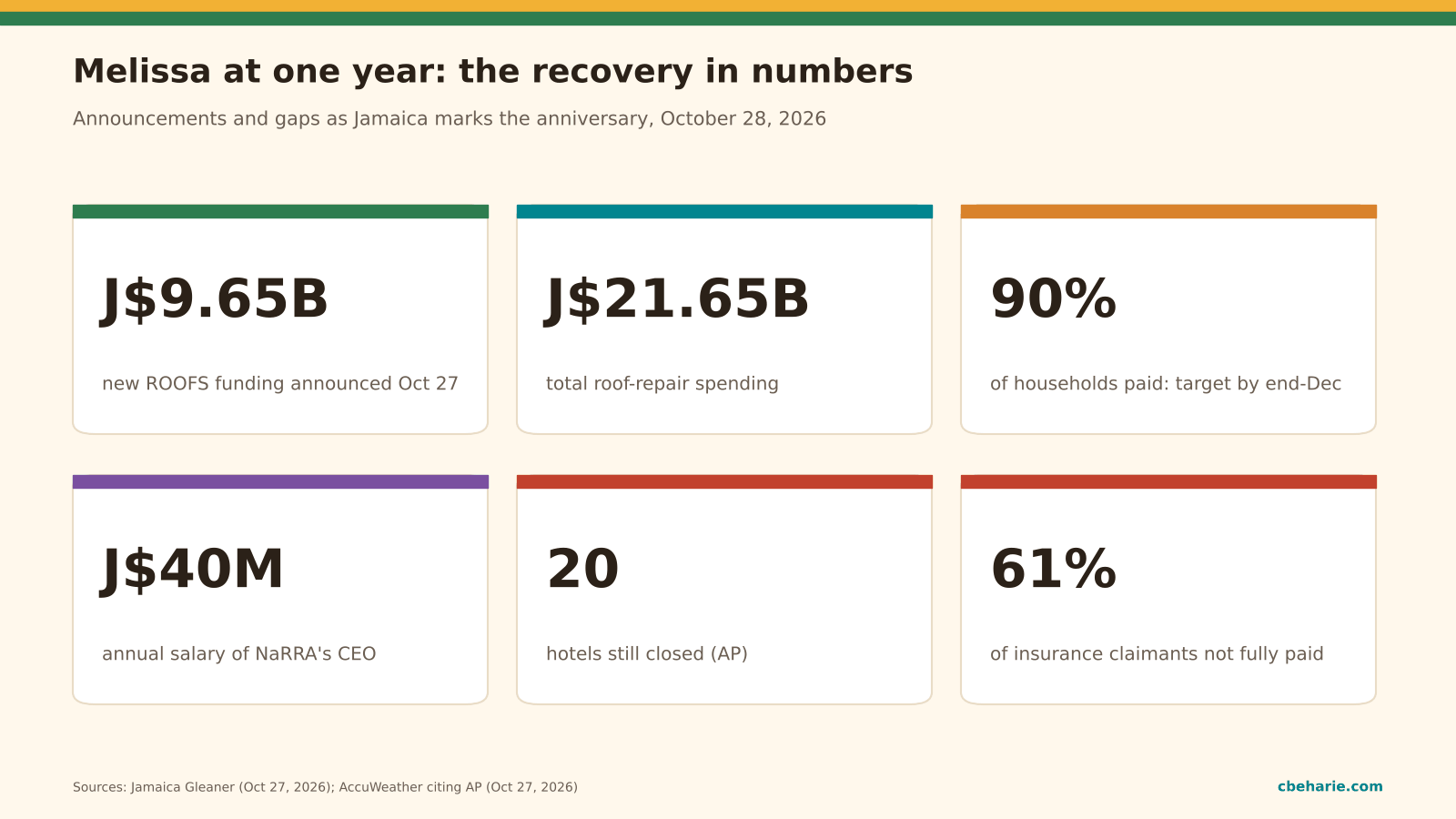
On Tuesday, October 27, at a special press briefing at Jamaica House, Prime Minister Andrew Holness announced an additional J$9.65 billion to complete payments under the ROOFS program, the government’s flagship effort to repair homes stripped bare by Hurricane Melissa. According to the Jamaica Gleaner, that brings total public spending on roof repairs since the storm to J$21.65 billion. The government says it wants assessments and payments completed for 90 percent of affected households by the end of December.
The government also says the National Reconstruction and Resilience Authority (NaRRA), which leads the recovery, will open sub-offices in western Jamaica, the region that took the worst of the storm. Yesterday’s briefing looked at the Caribbean Policy Research Institute’s critique of how slowly relief money moved. Tuesday’s announcements are, in part, the government’s answer: more money, a firmer deadline, and a bigger footprint in the west.
Remembering the day
Melissa made landfall one year ago today as a Category 5 hurricane, and at least 45 people in Jamaica lost their lives, according to AccuWeather’s anniversary report. Months later, U.S. forecasters revised its peak winds over water upward to 190 mph, tying it with the strongest Atlantic hurricane on record, and the name Melissa has since been retired. Today, many families will pause to remember loved ones.
In November 2025, the World Bank and Inter-American Development Bank put the physical damage at an all-time high of US$8.8 billion. For a small island economy, that is a staggering figure, and it helps explain why the recovery still feels unfinished in so many communities.
Why it matters now
Anniversaries invite scorekeeping, and the scorecard is mixed. AccuWeather, citing the Associated Press and Gleaner reporting, notes that around 20 hotels remain closed and that 61 percent of insurance claimants have not received full settlements. Private insured losses could reach US$4.2 billion. Insurers point to complex claims and a shortage of loss adjusters.
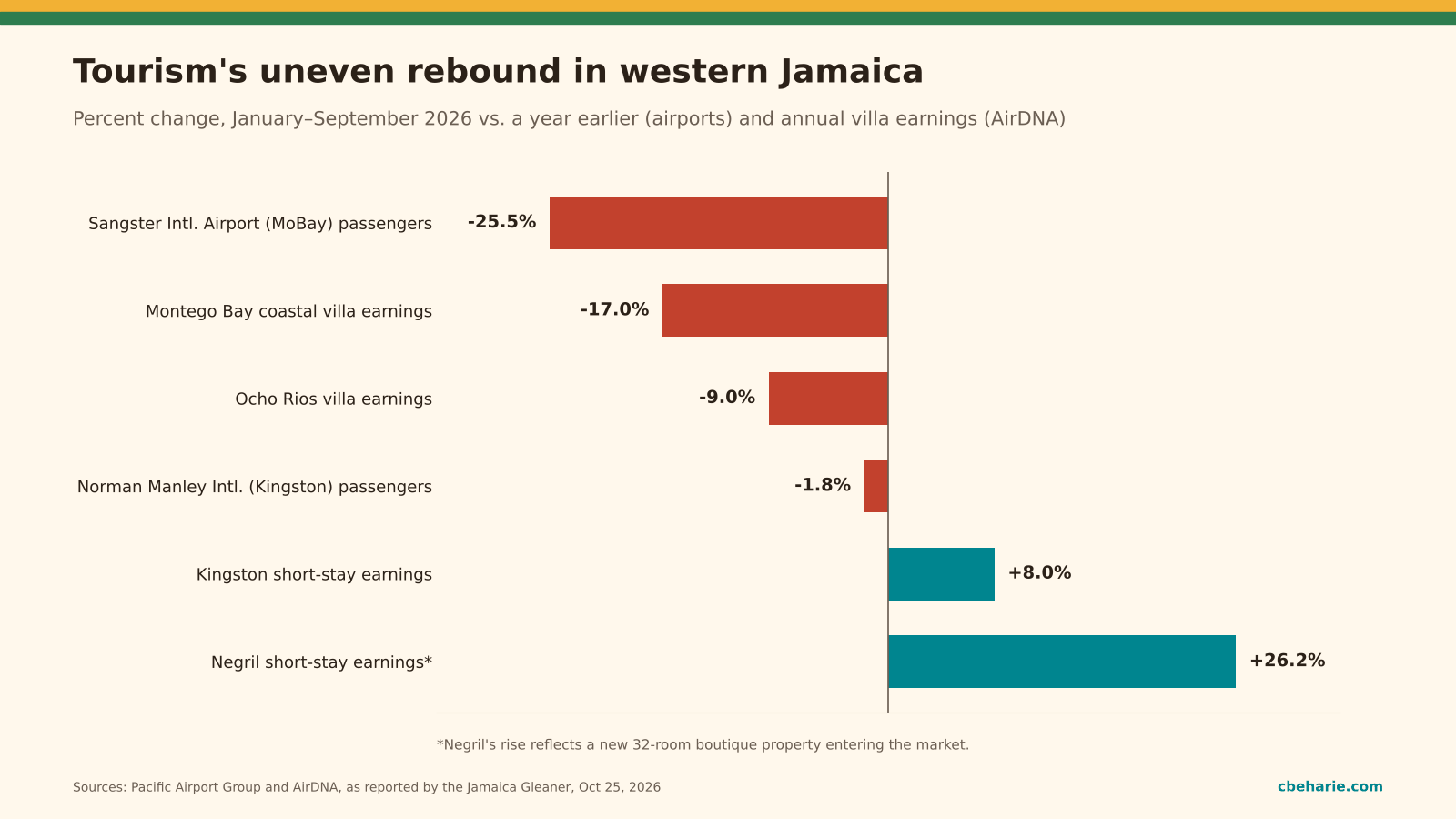
Tourism, Jamaica’s economic engine, is recovering unevenly. The Gleaner’s business desk, citing AirDNA and Pacific Airport Group data, reports that passenger traffic through Sangster International in Montego Bay fell 25.5 percent between January and September, while Norman Manley in Kingston dipped only 1.8 percent. Coastal villa earnings in Montego Bay fell 17 percent. Around 3,500 hotel rooms are expected to remain unavailable this coming winter season, leaving roughly 90 percent of room stock operational.
The debate over spending and salaries
The same press briefing produced a sharper exchange. Asked by Television Jamaica about the optics of paying NaRRA’s chief executive, Major General Antony Anderson, J$40 million a year while the country is still recovering, Holness defended the salary. As reported by the Gleaner, he argued that the job demands speed and accountability, that the pay was set within a market range by the Transformation Implementation Unit, and that frugality should not be confused with being cheap.
Critics see a contradiction with the government’s own message of restraint. In recent weeks, the Cabinet has imposed a moratorium on official overseas travel until the end of March, and public bodies have been told to pause new asset purchases, new leases, and hotel retreats. The Gleaner reports that economist Keenan Falconer welcomed the move and suggested cost discipline should be routine, perhaps through zero-based budgeting. The opposition People’s National Party, through finance spokesperson Julian Robinson, says the freeze raises more questions than it answers, since the government has not said how much it expects to save.
Both perspectives have merit. A country rebuilding from its costliest disaster needs competent leadership and cannot afford waste. The test will be results: roofs on, claims paid, and hotels reopened.
What to watch next
- Whether the December target of 90 percent of households assessed and paid is met.
- A hurricane reconstruction agreement between Jamaica and the United Kingdom, which the Gleaner reports is expected to be signed next week.
- How many hotel rooms are back in time for the winter tourist season.
- The progress of insurance settlements for families and small businesses.
For Jamaicans in the diaspora, from Brooklyn and Brixton to Toronto and Oslo, the anniversary is a reminder that many families back home are still living under tarpaulins. Many answered the call with remittances, barrels, and church partnerships. A year on, steady, targeted support for rebuilding, rather than one-off giving, may matter most.
2. Haiti: Floodwaters, a Troop Surge, and a Diaspora Under Pressure
What happened
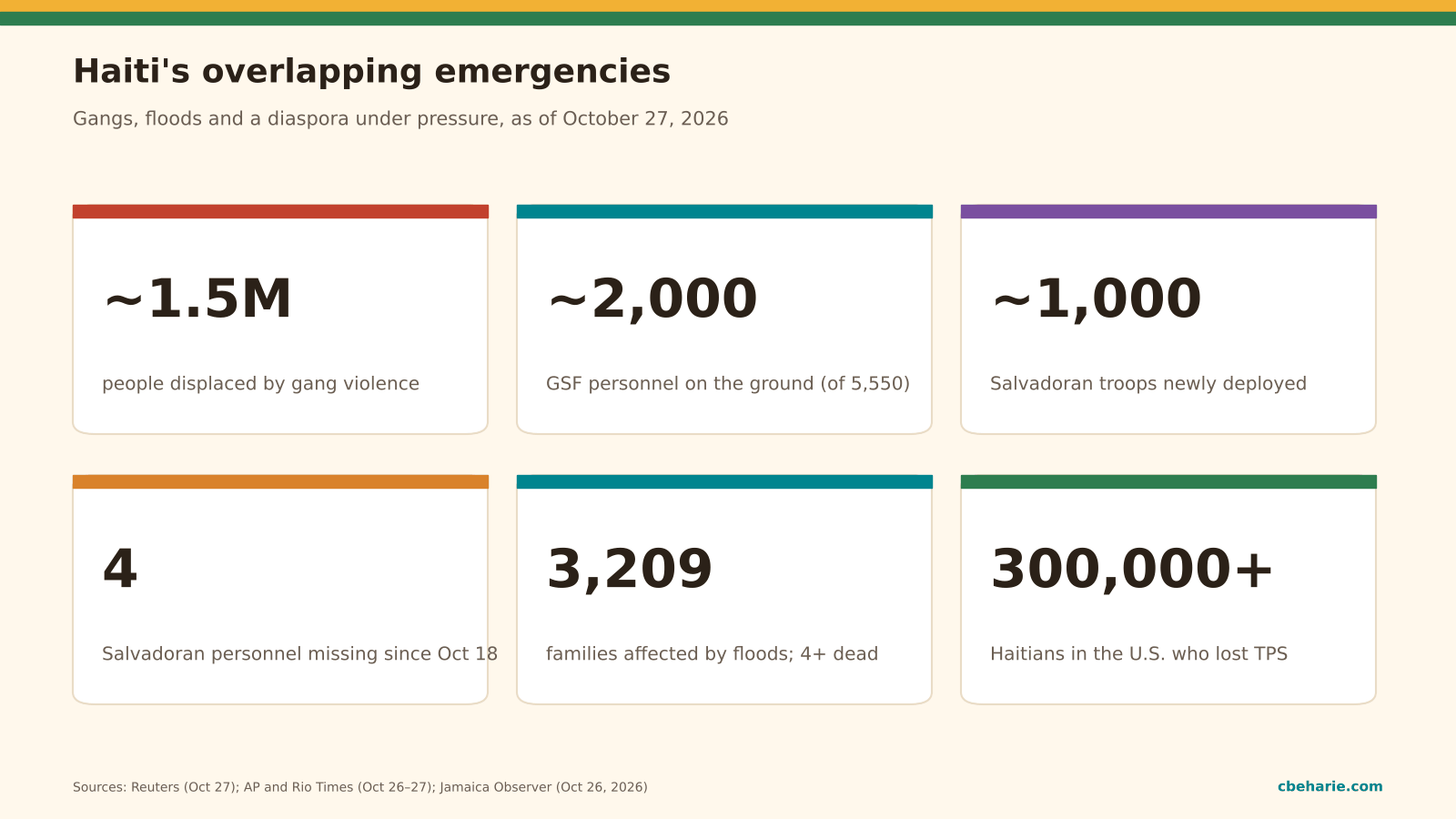
Haiti’s long emergency took several new turns this week. First, the rain. A low-pressure trough over the central Caribbean, not a named storm, dumped heavy rain on the country’s southern peninsula. According to the Associated Press via the Gleaner, at least four people died, two more were missing, and more than 3,200 families were affected, with hundreds of homes destroyed and landslides cutting roads in the southwest. Across the border in the Dominican Republic, at least 30 communities were cut off and more than 100 homes flooded.
The Rio Times reports that the deaths were in Nippes, Sud, and Grand’Anse, and that five of Haiti’s ten departments, including the West department that holds Port-au-Prince, were placed on orange alert. Rivers swept away vehicles and farmland near Les Cayes, and landslides blocked stretches of National Road 7.
Second, the guns. Reuters reported on Tuesday that El Salvador has rushed about 1,000 troops to Haiti, citing a Haitian security official. The surge follows a gang ambush on October 18 on the outskirts of the capital, after which four Salvadoran air force technicians serving with the UN-backed Gang Suppression Force went missing. President Nayib Bukele says he believes criminal groups are holding them hostage. The United States provided C-130 transport aircraft for the deployment, according to a U.S. military official quoted by Reuters.
Background
Gangs have expanded their grip on Port-au-Prince and surrounding areas since the 2021 assassination of President Jovenel Moïse, and the violence has driven nearly 1.5 million people from their homes. The Gang Suppression Force, authorized by the UN Security Council for up to 5,550 personnel, has only about 2,000 on the ground a year into its mandate, just over a third of its planned strength, according to Reuters. Elections that had been planned for December 13 have been postponed with no new date, the Rio Times reports.
The gang leader Wilson Joseph of 400 Mawozo has released videos denying that his group holds the missing Salvadorans. No group has claimed responsibility.
Competing views on the surge
For many Haitians living under gang control, any serious show of force is welcome. Others are uneasy. Rights groups have criticized Bukele’s crackdown at home for sacrificing due process, and Pierre Esperance of Haiti’s National Human Rights Defense Network reminded Reuters that not everyone living in gang-held areas is a gangster. A Salvadoran security analyst told Reuters that some of the new troops may operate outside the UN chain of command. Supporters of a tougher approach argue that years of under-resourced missions have let the gangs grow stronger, and that civilians have paid the price for international hesitation.
The Jamaican and diaspora angle
Jamaica has a direct stake. Jamaican soldiers and police have served in Haiti since the earlier Multinational Security Support Mission, and in December 2025 the Gleaner reported that a third contingent of 18 JDF soldiers and 7 JCF officers had deployed to support the Gang Suppression Force headquarters. Every escalation in Haiti affects them, and it tests CARICOM’s diplomacy and the region’s capacity to respond.
In the United States, the Haitian diaspora is facing its own pressure. As the Jamaica Observer reported, the California-based Haitian Bridge Alliance renewed its call this week for Washington to halt deportations to Haiti. The administration ended Temporary Protected Status for Haitians effective July 27, 2026, affecting more than 300,000 people. The House passed a bipartisan extension in April, but the Senate has not acted. The group points out that the State Department itself keeps a Level 4 do-not-travel warning on Haiti.
For Jamaicans, Haiti is not a faraway headline. It is a neighbor just across the Jamaica Channel and a fellow CARICOM member. Its pain is a regional responsibility.
What to watch next
- Whether the four missing Salvadoran personnel are found, and how the new troops are commanded.
- Whether more countries commit troops to bring the Gang Suppression Force closer to full strength.
- Recovery needs in Haiti’s southern departments after the floods.
- Senate action, or inaction, on restoring TPS for Haitians.
3. Cuba at the UN: A Caribbean Vote Under Pressure
What happened
Today, Wednesday, October 28, the UN General Assembly votes for the 34th time on a Cuban-drafted resolution calling for an end to the U.S. economic embargo. The debate opened on Tuesday with an unusual flash of drama: UN News reports that Cuba’s foreign minister, Bruno Rodríguez Parrilla, interrupted U.S. Ambassador Mike Waltz on a point of order, and the session was briefly suspended. Waltz rejected the premise of the debate, saying there is no blockade, and pointed to more than US$876 million in U.S. exports to Cuba in the first eight months of this year.
Speaking for CARICOM, Haiti’s representative described the Community as a long-standing friend of both Cuba and the United States, called for the two countries to normalize relations, and said civilian needs must remain the priority, according to the UN’s official meeting record.
Background
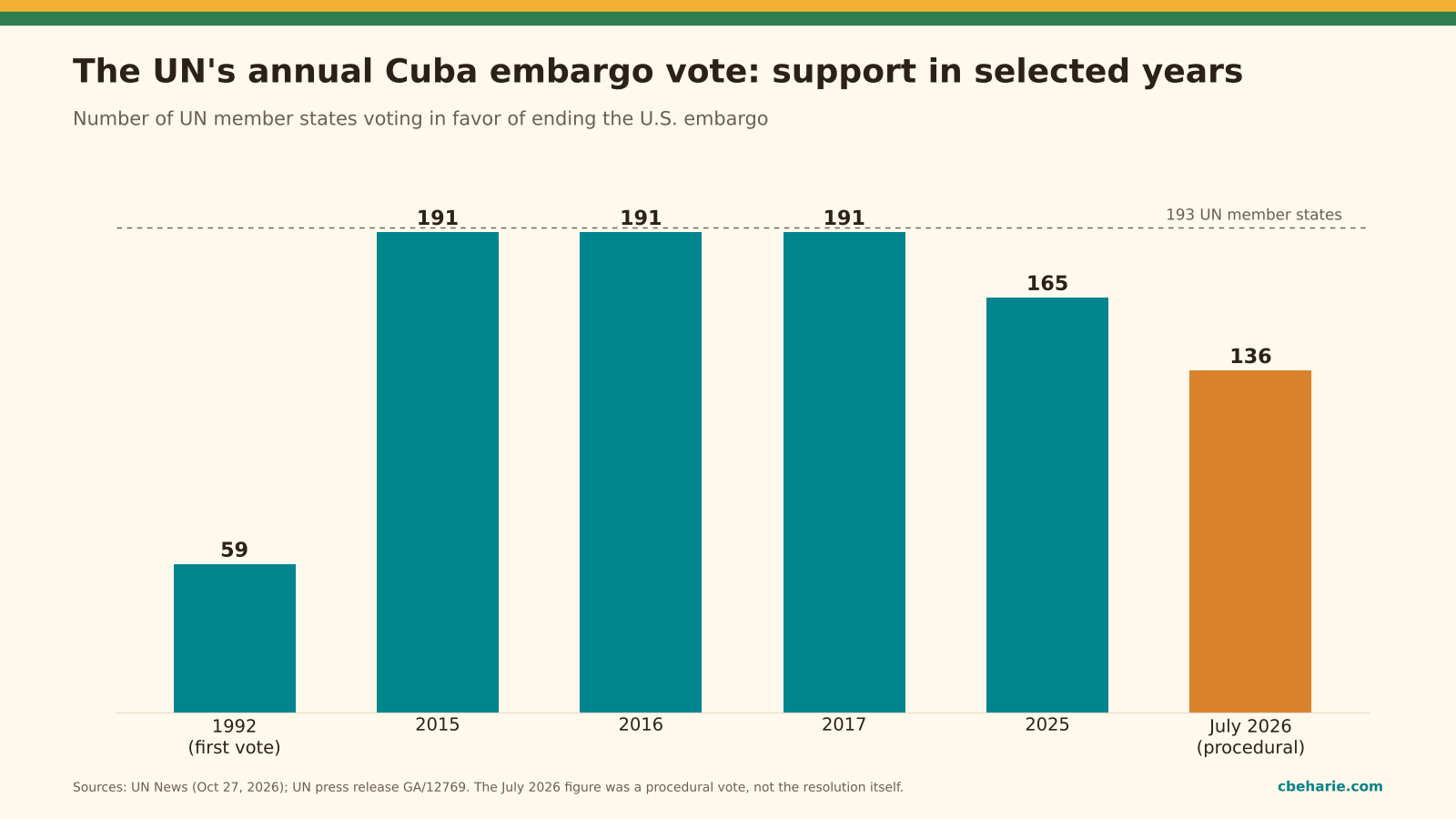
The resolution has passed comfortably every year since 1992. Support peaked at 191 votes in 2015, 2016, and 2017, a period of thaw between Washington and Havana. Last year, it passed with 165 votes in favor, 7 against, and 12 abstentions. A procedural vote in July this year drew only 136 votes in favor, 9 against, and 30 abstentions, a sign that the coalition may be fraying.
The text itself is familiar. It reaffirms the sovereign equality of states, non-intervention, and freedom of trade and navigation, and it takes particular aim at the Helms-Burton Act, the 1996 U.S. law whose extraterritorial effects, the resolution argues, undermine other countries’ sovereignty and trade. The United States, usually joined by Israel, has voted against it every year but one; in 2016, both abstained. Last year, Argentina, Paraguay, Ukraine, North Macedonia, and Hungary joined them in voting no.
The context is a hard year for ordinary Cubans. A Gleaner editorial notes that Washington imposed an oil blockade in January, cutting Cuba off from imported fuel; the island produces only about 40 percent of the roughly 100,000 barrels a day it needs. The results have included prolonged power cuts and factory closures. Ambassador Waltz, for his part, blamed Cuba’s own government for the crisis.
The Caribbean angle
This is where the story comes close to home. According to CiberCuba, the United States held a UN forum on October 20 and circulated an opinion piece to Caribbean governments through its chargé d’affaires in Barbados. Trinidad and Tobago broke from its usual pattern by abstaining in July’s procedural vote, while Canada and Germany have signaled that their positions are under review.
Costa Rica, which closed its embassy in Havana in March, voted against in July. CiberCuba also reports that Secretary of State Marco Rubio reached out to El Salvador’s president, Nayib Bukele, about the vote. Havana accuses Washington of strong-arming smaller states, and Cuban President Miguel Díaz-Canel has acknowledged that some countries may change their votes under pressure.
Meanwhile, 11 former CARICOM leaders have urged a yes vote, and former heads of government, including former Jamaican prime ministers P.J. Patterson and Bruce Golding, signed an open letter urging world leaders to resist pressure. The Gleaner’s editorial argues that small states depend on consistent rules of non-interference and urges all 14 independent CARICOM members to vote yes.
Jamaica has its own history here. The country once hosted around 400 Cuban specialist doctors and nurses, most of whom left after the government sought to renegotiate the arrangement following U.S. concerns about forced labor in Cuba’s medical missions. For a region that values its relationships with both Washington, its largest trading partner and home to much of its diaspora, and Havana, a neighbor and longtime partner in health and education, there are no cost-free choices.
Why it matters
The resolution is not binding, and it will not lift the embargo on its own. Its power is symbolic: a yearly snapshot of how the world sees an embargo that has now lasted 64 years. For small Caribbean states, the vote is also a test of a principle they rely on, namely that big countries should not dictate the internal affairs of small ones. Supporters of the U.S. position counter that Cuba’s one-party government bears responsibility for its people’s hardship and that pressure is the only leverage left. How CARICOM handles that tension today will be read closely in Washington, Havana, and across the Global South.
What to watch next
- The final tally today, and whether support falls below last year’s 165.
- How each CARICOM member votes, especially Trinidad and Tobago.
- Any U.S. response toward countries that vote in favor.
- Conditions on the ground in Cuba as fuel shortages continue.
4. Israel Votes: Record Turnout, No Clear Winner
What happened
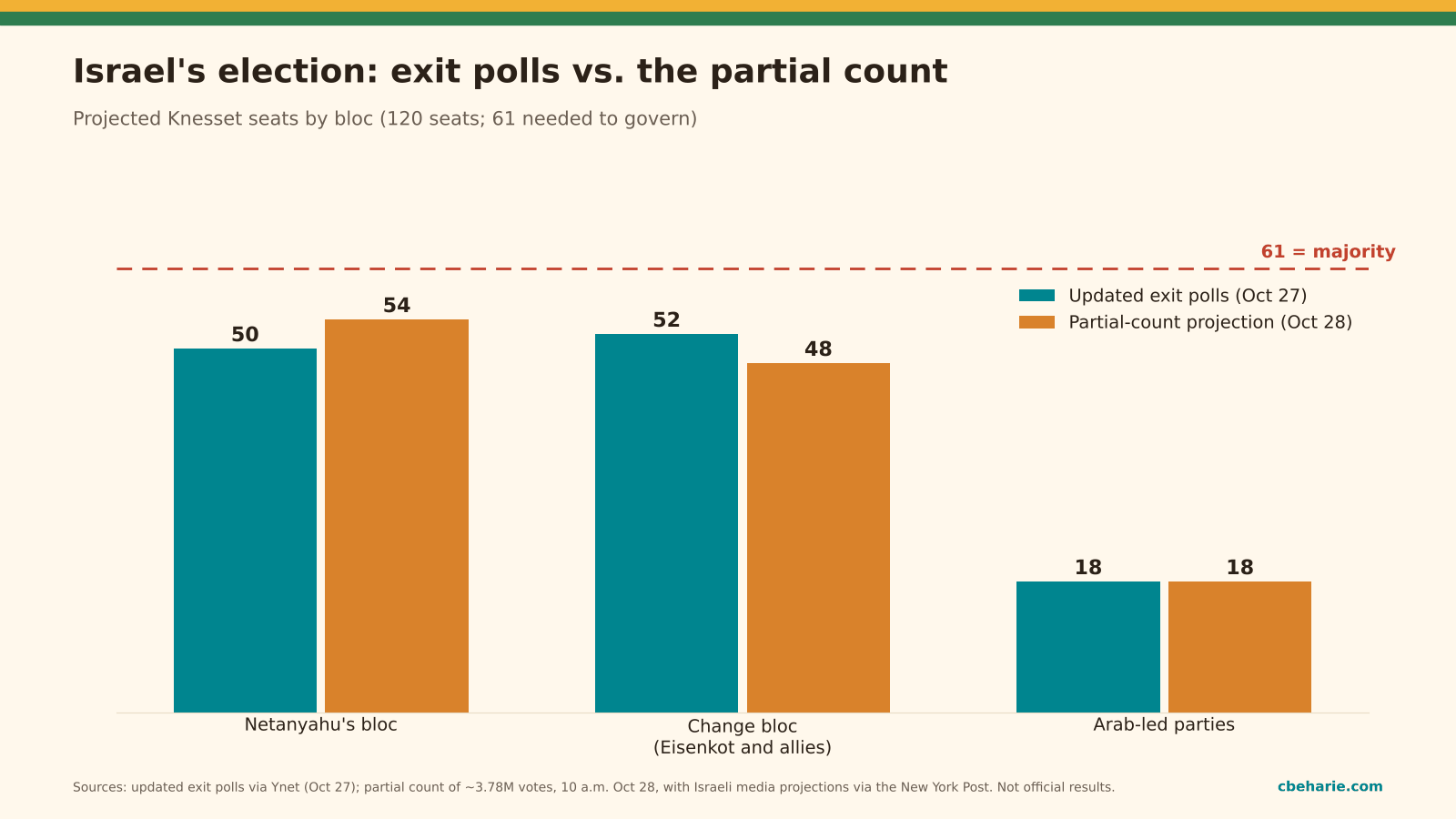
Israelis went to the polls on Tuesday, October 27, in their first general election in nearly four years, and the result is still a cliffhanger. Updated exit polls on the main channels showed the change bloc around 52 seats, Benjamin Netanyahu’s allies around 50, and Arab-led parties at 18, according to Ynet. A majority in the 120-seat Knesset takes 61. Netanyahu’s Likud was projected as the largest single party, ahead of former army chief Gadi Eisenkot’s new Yashar! party.
The actual count has since tilted toward Netanyahu. With about 3.78 million votes counted as of 10 a.m. Wednesday, Central Elections Committee figures showed Netanyahu’s bloc with 43.2 percent of the vote and the Eisenkot-led opposition with 37.5 percent; Israeli media projected that as roughly 54 seats to 48, with 18 for Arab-led parties, as the New York Post reported. Even on those numbers, no bloc reaches 61.
Turnout was 77.7 percent at the close of polls, the highest at that point in 25 years and about seven points above 2022, according to Ynet. Turnout was also high in Arab communities, helping Arab-led parties outperform their pre-election polling.
Behind the two front-runners, exit polls put Naftali Bennett’s party at 12 to 14 seats, Yair Golan’s Democrats at 9 to 10, and Avigdor Lieberman’s Yisrael Beiteinu at 7 to 9. Several smaller lists, including one led by Ofer Winter, appeared to fall below the 3.25 percent threshold needed to enter parliament. Not every network saw it the same way: right-leaning Channel 14 put the right-wing bloc at 60 seats, just one short of a majority, according to Israel Hayom.
What the leaders said
Speaking after 3 a.m. in Jerusalem, Netanyahu said Likud would be the largest party, cited Israel’s military achievements and his close ties with President Donald Trump, and said no government should rely on Arab parties, according to an Associated Press roundup. In Tel Aviv, Eisenkot pledged to form a government, framed the vote as a referendum on leadership, and said voters had chosen change. In the partial count, Likud had about 21 percent of the vote and Yashar about 16 percent.
Background
This election is the first since the Hamas-led attack of October 7, 2023, and the wars that followed across the region. Netanyahu campaigned on security and his record against Iran. His critics, including Eisenkot, argue the country needs new leadership and accountability for the failures of October 7. Netanyahu also sought re-election while facing corruption charges and an International Criminal Court arrest warrant, as Democracy Now! noted in its election-day headlines.
Until a new coalition is sworn in, Netanyahu remains caretaker prime minister, and AP notes that weeks of negotiations are likely. No single party has ever won an outright majority in Israel’s history, so coalition-building is the normal way governments form there. Election day was not without friction. Several parties lodged complaints of alleged ballot tampering, though the Central Elections Committee said it saw no sign of systematic problems, as reported by The Jewish Chronicle.
Why it matters
Israel’s next government will shape decisions on Gaza’s future, relations with the Palestinians, and the confrontation with Iran, all of which affect global security and energy prices. That has real effects for import-dependent economies like Jamaica’s, where fuel costs ripple through bus fares, electricity bills, and food prices.
For many Christians, including Jamaica’s churches, Israel and the Holy Land carry deep spiritual meaning. That bond can sit alongside sincere concern for Palestinian civilians, Israeli hostages and families, and all who have suffered in this conflict. Holding both is not a contradiction; it is compassion.
There is also a lesson in the coalition math itself. When neither side can govern alone, leaders must decide whether to bargain with rivals they have spent a campaign criticizing. Netanyahu has already ruled out relying on Arab parties; Eisenkot’s camp would likely need at least some of them, directly or indirectly, or defectors from the other side, to reach 61. The weeks ahead will show whether Israel’s divided politics can produce a stable government or another round of elections.
What to watch next
- More than 650,000 double-envelope ballots, cast by soldiers, diplomats, and others, still to be counted; they could decide which small parties clear the 3.25 percent threshold.
- Official results, which Israel Hayom reports are expected on November 4.
- President Isaac Herzog’s consultations with the parties before he asks someone to form a government.
- Whether Arab-led parties become kingmakers, or a broad unity government emerges.
5. Ebola Passes 10,000 Cases in Congo: The Fastest-Growing Outbreak in the Country’s History
What happened
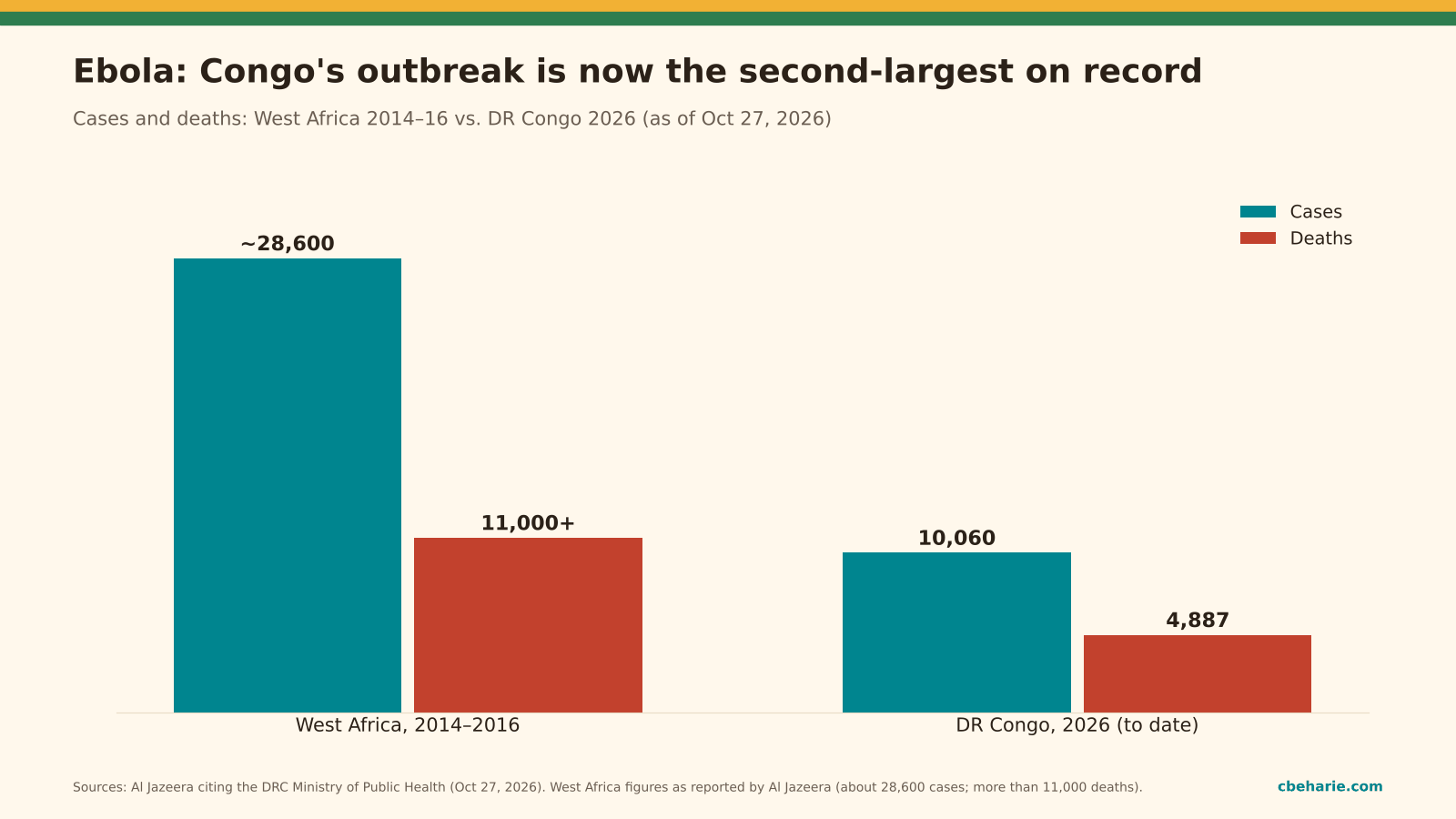
The Ebola outbreak in the Democratic Republic of the Congo has crossed a grim milestone. Government figures released on Tuesday put confirmed cases at 10,060 and deaths at 4,887, according to Al Jazeera, citing the DRC’s Ministry of Public Health. Nearly half of all confirmed patients have died. It is the fastest-growing and deadliest Ebola outbreak in the country’s history, and the second-largest anywhere on record, behind only the 2014 to 2016 epidemic in West Africa.
The outbreak was declared in May and is caused by the Bundibugyo virus, a rarer Ebola species for which there is no approved vaccine or treatment. The World Health Organization announced last Friday the start of the first clinical trial of a vaccine against it.
Why it is so hard to stop
Several warning signs stand out. About 80 percent of new cases are coming from outside the chains of transmission that health teams are tracking, while Africa CDC says at least 95 percent should come from known contacts before an outbreak can be considered under control. Cases have now been recorded in 66 health zones across eight provinces, up from three at the start. At least half of those who died were never admitted for treatment.
The health workers on the front line are stretched and, too often, in danger. On Saturday, attackers killed a nurse and seriously injured a colleague responding to a suspected case in Bafwasende, in Tshopo province, according to the WHO. Responders in parts of Ituri have stopped work over bonuses owed since late August. Families are often reluctant to hand over the sick or the dead for safe burial, which is understandable given fear and grief, but it also helps the virus spread. Routine care has suffered too, with childhood vaccinations disrupted and maternal deaths doubling in some provinces.
There are glimmers of hope. The AP reports that a video of staff celebrating as the last two patients were discharged from a treatment center in Mongbwalu went viral this week, and WHO chief Tedros Adhanom Ghebreyesus praised the team, noting that the outbreak is far from over but that every life saved deserves celebration. Those moments matter. They remind frightened communities that people do survive Ebola, and that seeking care early saves lives.
Beyond Congo’s borders
The virus has already traveled. Uganda recorded 20 cases, mostly imported, earlier in the year and now requires citizens returning from the DRC to quarantine for 21 days. Kenya’s tally has risen to nine confirmed cases, two of them fatal. A woman who was infected during a visit to Uganda was diagnosed in Nigeria and evacuated to Switzerland for treatment this week. According to the Associated Press, African health ministers are holding a virtual summit today to coordinate their response, and Africa CDC’s Jean Kaseya has warned that the response must move faster because the virus is crossing borders.
Why it matters here
It is easy for Caribbean readers to see Ebola as someone else’s problem. It is not. In a world of daily flights, an outbreak anywhere is a test of preparedness everywhere, as the Switzerland case shows. Jamaica’s own recent experience with Melissa showed how quickly a health system can be overwhelmed when infrastructure breaks down. The same lessons apply in Congo: trained staff, safe facilities, honest public communication, and the trust of local communities matter as much as medicine.
There is also a moral question about attention. It is fair to ask whether outbreaks in poorer countries get the coverage and funding they need before they reach wealthier ones. Supporting reputable medical charities, church partners, and health workers on the ground is one practical way to respond. So is simply paying attention.
What to watch next
- Results of the African health ministers’ summit and any new regional travel or screening measures.
- Progress of the first vaccine trial against the Bundibugyo virus.
- Whether the share of new cases from known contacts begins to rise toward the 95 percent target.
- Protection for health workers after this week’s deadly attack.
Closing Reflection: Who Is My Neighbor?
When a lawyer once asked Jesus, “Who is my neighbor?” (Luke 10:29), the answer came as a story about a stranger who stopped on a dangerous road to help someone he had every reason to pass by. Today’s stories put that old question to us again.
Our neighbors are the families in western Jamaica who are still waiting for a roof, and the officials trying to get one on faster. They are Haitians bailing water out of their homes in Nippes and Grand’Anse, and the Haitian nurse or teacher in Miami who fears a knock on the door. They are Cubans sitting in the dark through another power cut, whatever we think of the politics of the embargo. They are Israelis and Palestinians who long for security and peace. And they are the nurse in Tshopo province who went to help a sick stranger and did not come home.
None of us can carry all of that. But we can refuse to look away. We can pray with our eyes open, give where it counts, and ask our leaders, at home and abroad, to act with both courage and compassion. That is not a partisan position. It is simply what neighbors do.
To everyone remembering loved ones on this Melissa anniversary: you are not forgotten. Walk good, and God bless.
Sources
- Jamaica Gleaner – Holness announces additional $9.65 billion for ROOFS programme
- Jamaica Gleaner – Holness defends $40m salary of NaRRA CEO amid criticisms
- Jamaica Gleaner – Freeze order: Economist urges routine cost-cutting
- Jamaica Gleaner – Seaside villa earnings shrink a year after Melissa
- AccuWeather – One year after Hurricane Melissa, parts of Jamaica are still devastated
- World Bank – World Bank, IDB estimate Hurricane Melissa damage to Jamaica at US$8.8 billion
- Jamaica Gleaner (AP) – Flooding in Haiti and Dominican Republic causes deaths
- Rio Times – Haiti floods kill four as crisis deepens
- Reuters (via Internazionale) – El Salvador rushes some 1,000 troops to Haiti after gang ambush
- Jamaica Gleaner – JDF, JCF contingent deployed to Haiti to support fight against gangs
- Jamaica Observer – US-based Haitian group renews call to halt deportations to Haiti
- UN News – General Assembly weighs US embargo against Cuba ahead of 34th vote
- UN Press – General Assembly resumes debate on ending Cuban embargo (GA/12769)
- Jamaica Gleaner – Editorial: Watching the Cuba vote
- CiberCuba – Tense debate at the UN over the embargo on Cuba
- Ynet – Israel election turnout hits 77.7%, highest in 25 years
- Ynet – Exit polls and party projections
- Israel Hayom – Israel election 2026 exit polls: Full results
- New York Post (via Jingletree) – Netanyahu’s right-wing bloc ahead as vote count continues
- AP via Yahoo News – As votes are counted, no clear winner emerges in Israel’s election
- The Jewish Chronicle – Israel elections 2026 live
- Democracy Now! – Headlines for October 27, 2026
- Al Jazeera – Ebola cases in DR Congo surpass 10,000 in fastest-growing outbreak
- AP via News4Jax – Congo’s Ebola outbreak tops 10,000 cases
- Jamaica Observer – ‘Bunny’ Shaw finishes historic third in Ballon d’Or race