Good morning, and welcome to today’s Top Five. This Monday, October 26, 2026, finds Jamaica standing at a meaningful threshold. On Wednesday, the island marks one year since Hurricane Melissa came ashore as a Category 5 storm, and a new independent report is asking hard questions about how quickly help has reached the people who needed it most. At the same time, the National Security Council has put forward its toughest gun-law proposal yet, and the Court of Appeal is due to hear a challenge to the existing mandatory minimum sentence today.
Beyond our shores, Brazil has handed Luiz Inácio Lula da Silva a historic fourth term in a runoff so close that his opponent is refusing to concede. In Ukraine, a small, carefully negotiated truce is set to begin on Tuesday so that aid can reach a besieged town, with wider peace talks penciled in for November. And closer to home, two of our nearest neighbors are in the headlines: Venezuelan opposition leader María Corina Machado has made a surprise return after ten months abroad, while nine former Caribbean leaders, including two of Jamaica’s own former prime ministers, are urging the world to vote against the U.S. embargo on Cuba this week.
As always, the aim here is not to tell you what to think but to give you the facts, the context, and the questions worth asking. Each story is drawn from reporting published in the last day or two, and every source is listed at the end. Let’s begin at home.
1. Hurricane Melissa, one year on: relief under the microscope
What happened
Almost a year after Hurricane Melissa tore across western Jamaica, the Caribbean Policy Research Institute (CAPRI) has produced the most detailed reckoning yet of how the country responded. According to The Gleaner’s account of the report, titled Higher Ground: Lessons from Hurricane Melissa for Resilience, Relief, and Recovery, Jamaica did a good job of arranging disaster financing before the storm, but struggled to turn money into help on the ground afterward.
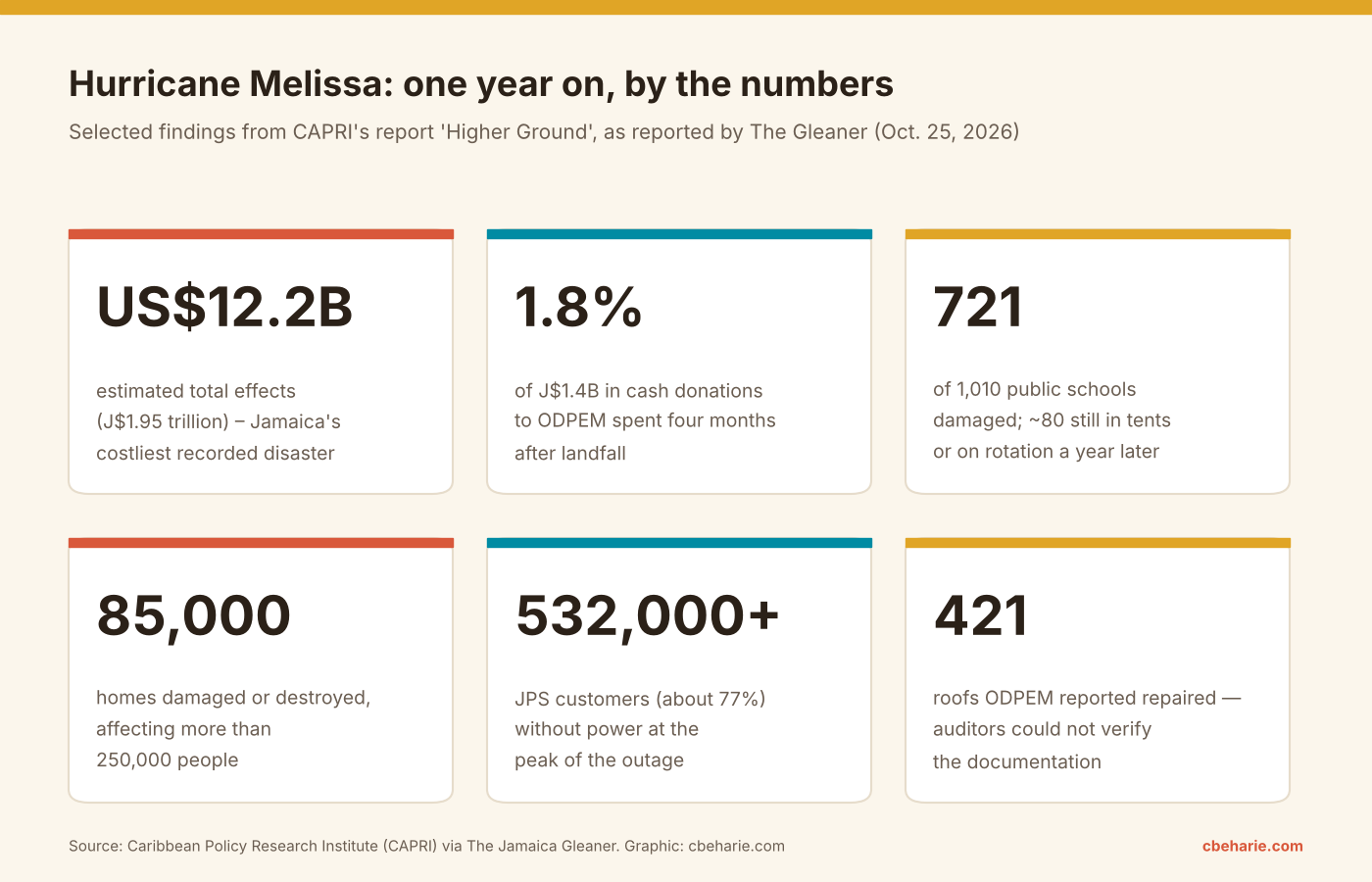
The headline figure is striking. The Office of Disaster Preparedness and Emergency Management (ODPEM) received about J$1.4 billion in cash donations, yet four months after the storm only J$26.2 million had been spent, roughly 1.8 percent. ODPEM has said it needed approval from the Ministry of Finance before spending, but CAPRI found that a request to spend around J$500 million on shelter repairs was not made until February 4, 2026, more than three months after landfall.
The report also flags procurement and record-keeping gaps. Three of four roofing-materials contracts, worth J$167 million in total, reportedly went to suppliers without valid procurement registration or current tax compliance certificates, justified under emergency rules. Of J$123 million in building supplies sent to Jamaica Defence Force distribution points, only about J$89 million was formally acknowledged as received. And while ODPEM reported 421 roofs repaired, the Auditor General’s Department could not find verifiable documentation to support the figure.
Why it matters
Melissa was no ordinary storm. The Pan American Health Organization recorded that it made landfall on Jamaica’s southwestern coast on October 28, 2025, as a Category 5 hurricane with sustained winds above 185 mph. By mid-November 2025, officials had confirmed at least 45 storm-related deaths, most of them in St. Elizabeth and Westmoreland. CAPRI now estimates the storm’s total effects at J$1.95 trillion, or about US$12.2 billion, making it the costliest disaster in Jamaica’s recorded history. Roughly 85,000 homes were damaged or destroyed, affecting more than 250,000 people.
Schools tell the story most painfully. Melissa damaged 721 of Jamaica’s 1,010 public schools. The Ministry of Education reports that 92 percent of schools are now operating at full capacity, which is real progress. But CAPRI estimates that around 80 public schools are still running in tents or on shift systems a year later, and it warns that remote learning, introduced as a stopgap, has quietly become the norm in some places. Because nearly nine in ten designated emergency shelters are schools, slow school repairs also leave communities less prepared for the next storm.
The wider recovery picture
The economic aftershocks are still visible on the north coast. Passenger traffic at Montego Bay’s Sangster International Airport fell 25.5 percent to 2.87 million between January and September, while Kingston’s Norman Manley International dipped just 1.8 percent. AirDNA data reported by The Gleaner show average earnings for coastal villas in Montego Bay down 17 percent. About 3,500 hotel rooms are expected to remain unavailable this winter, leaving roughly 90 percent of the island’s room stock open for the peak season.

The government points to its own momentum. The deadline to redeem Phase One grants under the ROOFS (Restoration of Owner-Occupied Family Shelter) program has been extended to December 31, 2026, with stepped-up outreach to the hardest-hit families. As of September, the Ministry of Labour and Social Security had recorded 118,365 household assessments and identified 49,002 ROOFS beneficiaries, though it remains unclear how many grants have actually been redeemed.
The diaspora’s role
If there is a bright thread in this story, it is the Jamaican family abroad. Speaking at the Jamaica Diaspora Northeast USA Conference in Philadelphia, Minister of State for Diaspora Affairs Alando Terrelonge said Jamaicans overseas sent home US$3.12 billion in the 2025–26 fiscal year. In the three months after Melissa, remittances ran US$93 million above the same period a year earlier, and December 2025 set a monthly record of US$296 million. For many families in St. Elizabeth and Westmoreland, that money arrived faster than any official grant.
What to watch next
- CAPRI formally launches the report at the Montego Bay Civic Centre at 6 p.m. on Wednesday, the anniversary of landfall. Expect government and opposition responses.
- Whether ministries publish clear data on how many ROOFS grants have been redeemed and how many homes have been repaired.
- Progress on the roughly 80 schools still in tents or on rotation before the next hurricane season.
- Tourism bookings for the winter season, which will show how quickly Montego Bay is bouncing back.
The fair reading is that both things are true: Jamaica’s recovery is real, and so are the bottlenecks. CAPRI’s central argument is that the systems needed to move money, such as reliable beneficiary records and vulnerability registers, were missing or weak. Fixing those before the next storm may be the most important lesson of all.
2. Jamaica moves to toughen gun laws with a 20-year minimum sentence
What happened
Jamaica’s National Security Council (NSC), chaired by Prime Minister Andrew Holness, has recommended raising the minimum prison sentence for illegal gun possession to 20 years, the Jamaica Observer reports. The proposal would amend the Firearms (Prohibition, Restriction and Regulation) Act, 2022, which currently sets a 15-year mandatory minimum for unauthorized possession of a firearm and ammunition.
The package goes further than sentencing. It would create a new offense for adults who groom children to use, store, move or acquire illegal guns, a direct response to gangs recruiting minors. It would distinguish between toy guns and realistic replicas, review the handling of firearms with expired licenses, and give further thought to how cases involving children found with guns should be treated. Before any new penalties take effect, the government plans a gun amnesty with a cash buy-back. The Ministry of National Security and Peace has been told to have draft legislation ready for consultation by the end of November.
Explaining the move, Holness said the government would not stand by while criminals, in his words, “put guns in the hands of our children.”
The context: falling murders, a deadly week
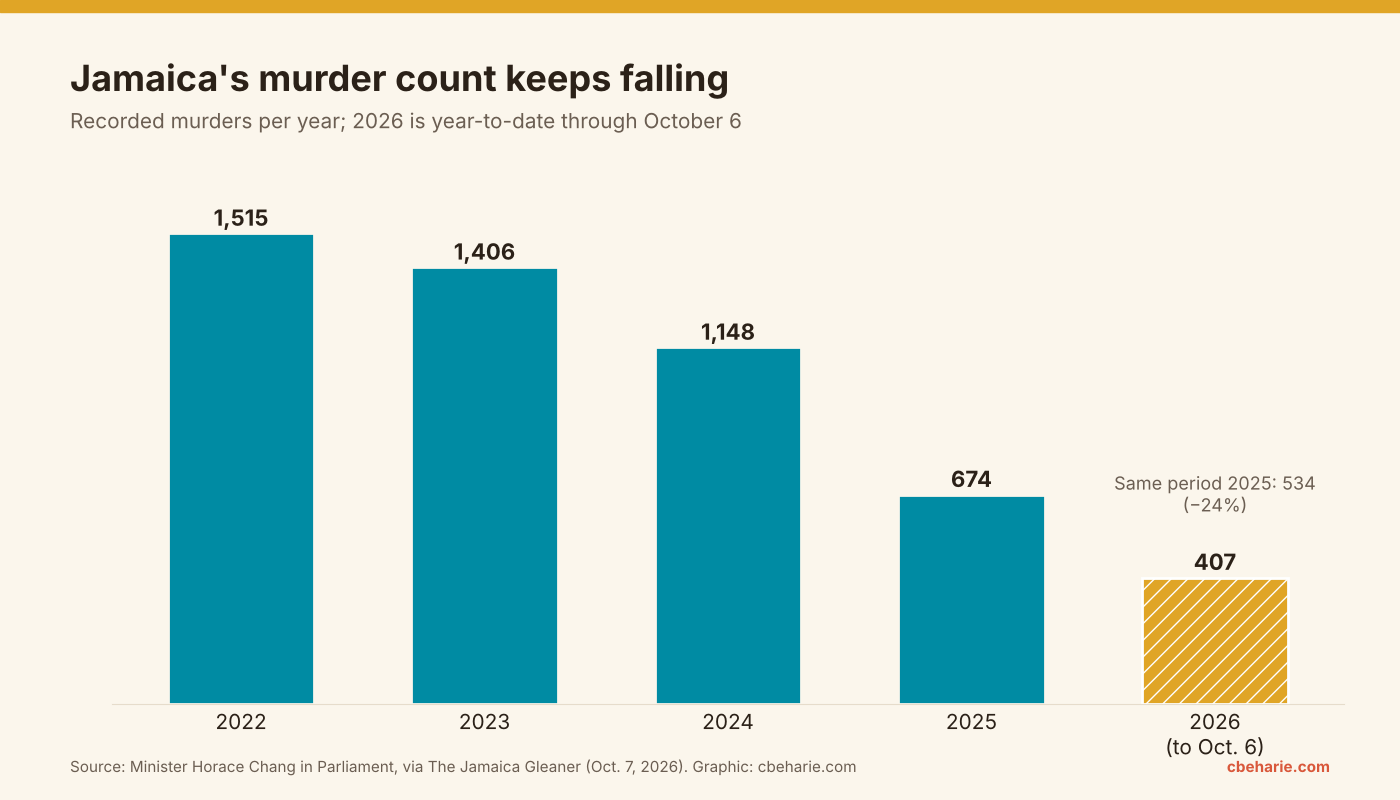
The proposal comes at an unusual moment. Jamaica’s murder numbers are falling fast. National Security Minister Horace Chang told Parliament earlier this month that the country had recorded 407 homicides as of October 6, down 24 percent from 534 over the same period in 2025. The July-to-September quarter saw 123 murders, the lowest quarterly figure in more than three decades. For perspective, Jamaica recorded 1,515 murders as recently as 2022.
Yet the dangers remain stark. On October 16, a confrontation between security forces and gunmen in Mount Moreland, Sligoville, St. Catherine, left two policemen, Corporal Trevoy Shaw and Constable Devoney Rose, dead, along with three alleged gunmen. A 10-year-old girl was critically injured. The NSC has directed the police to bring forward planned operations against what Commissioner Kevin Blake described as organized, heavily armed and well-resourced criminal networks.
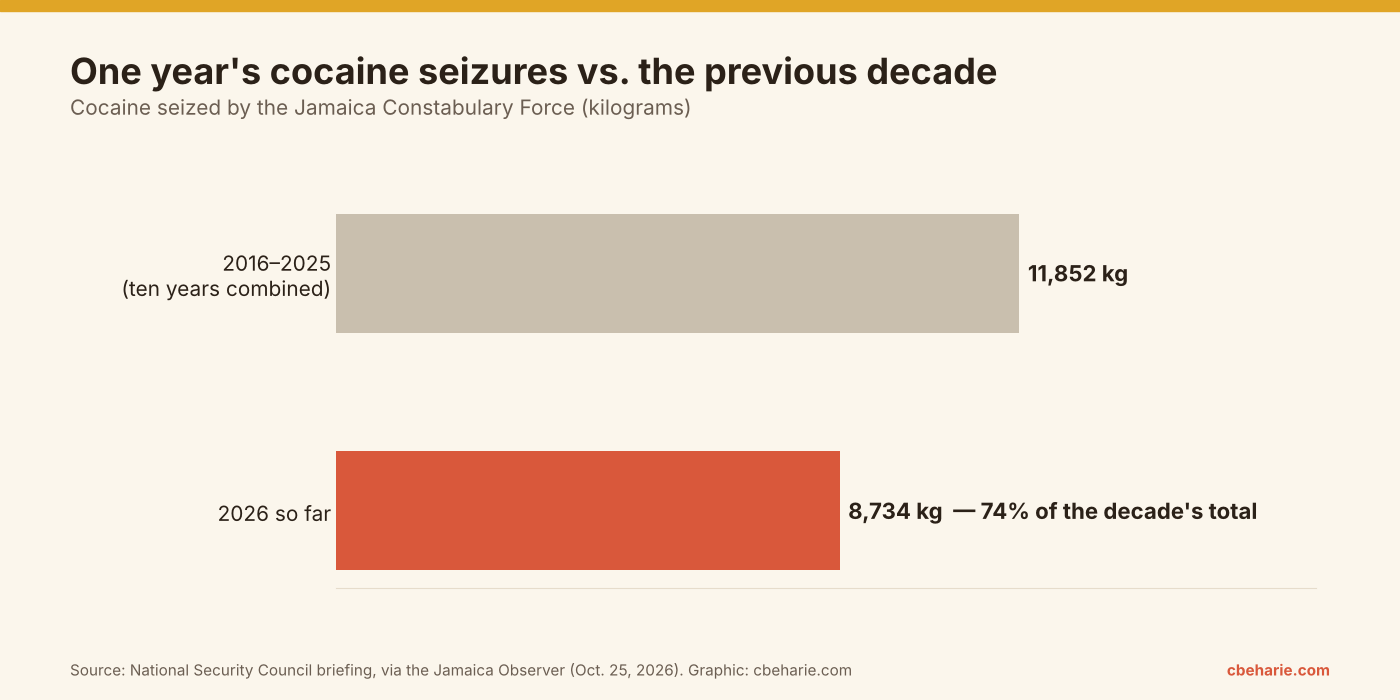
The NSC also heard that police have seized 8,734 kilograms of cocaine so far this year, about 74 percent of everything seized over the entire 2016–2025 decade. With U.S. operations closing other regional routes, officials worry traffickers may try to use Jamaica as a transshipment point. Separately, the council ordered an end to the current dealer and demonstration license plates, which Tax Administration Jamaica says are being misused by scammers and criminals, to be replaced with a tracked, electronically linked system.
The debate
Supporters of tougher minimums argue that illegal guns are the engine of Jamaica’s violence, and that certainty of serious punishment deters people from carrying them and protects witnesses and communities. The fall in murders since the 2022 law, they would say, shows that a firm approach can work alongside better policing.
Critics, including a growing number of defense lawyers, see it differently. A Gleaner report last month described the case of Jason Barrett, a St. James businessman sentenced to 15 years for having a pistol and ammunition that he said was licensed to his wife. The trial judge accepted that the mitigating factors were overwhelming but felt the law left him no lower option. Barrett’s appeal argues that the Act does not remove judicial discretion and that the sentence breaches constitutional protections against inhumane punishment. That case is scheduled to be heard in the Court of Appeal today, October 26. Its outcome could shape how any 20-year minimum is drafted.
There are also questions of accountability on the enforcement side. Opposition Senator Donna Scott-Mottley, who condemned the Sligoville attack and paid tribute to the fallen officers, has called for a thorough, public investigation into how that operation was carried out, after a television report showed visibly shaken pastors at the scene asking whether things could have gone differently.
What to watch next
- The Court of Appeal hearing in the Barrett case, beginning today.
- Draft amendments due by the end of November, followed by public consultation.
- Details of the gun amnesty and buy-back, including how much will be paid and where guns can be surrendered.
- Whether the new offense for grooming children is paired with prevention and rehabilitation programs for at-risk youth.
3. Brazil: Lula wins a historic fourth term, but his rival won’t concede

What happened
Brazil’s President Luiz Inácio Lula da Silva won Sunday’s runoff election against right-wing senator Flávio Bolsonaro, securing an unprecedented fourth, non-consecutive term. Brazil’s electoral court put Lula’s share at about 51.8 percent, a lead of nearly 4.4 million votes, CBS News reported, with Bolsonaro on roughly 48.2 percent. The new term begins January 5, 2027.
It was a genuine comeback. In the first round, Bolsonaro led Lula 47 percent to 45 percent. According to AFP’s reporting carried in the Jamaica Observer, no first-round runner-up had gone on to win a Brazilian runoff since the country’s return to direct presidential elections in 1989. Turnout also improved, with abstention dropping from 21 percent in the first round to 19 percent.
Election day itself was turbulent. Minutes before polls were due to close, Supreme Court Justice Cristiano Zanin extended voting by two hours. Lula’s campaign pointed to bus disruptions in São Paulo and Salvador, while Bolsonaro’s side had cited heavy rain in the south; CBS reported that both campaigns had asked for an extension. Afterward, however, Bolsonaro called the ruling unacceptable, refused to concede and said he would seek to annul the result, Reuters reported. His allies have noted that Zanin was previously Lula’s lawyer.
In his victory speech in São Paulo, Lula pledged to respect all Brazilians regardless of gender or religion and leaned into the theme of national sovereignty that defined his campaign: “This country will not accept being anyone’s backyard.”
Why it matters
Brazil is Latin America’s largest economy, and its direction shapes the whole hemisphere. The result bucks a regional trend: recent elections in Argentina, Chile, Colombia and Peru have moved those countries to the right, a shift that has often enjoyed the backing of U.S. President Donald Trump. Lula’s campaign framed the vote partly as a test of independence from Washington, after the Trump administration imposed steep tariffs on Brazilian exports.
The narrow margin also matters. Almost half the country voted against Lula, and many voters described the choice as the lesser of two evils. Flávio Bolsonaro, 45, the son of former president Jair Bolsonaro, presented himself as a more moderate, approachable figure than his father and spoke to real frustrations over crime, the cost of living and slow growth. His father remains under house arrest for attempting a coup, and Flávio had promised to seek an amnesty for him if elected.
Two fair readings
Lula’s supporters see a defense of democratic institutions and social programs. During his third term, inflation and unemployment fell and millions were lifted out of hunger, and his backers credit those policies for the win. Bolsonaro’s supporters see a country exhausted by insecurity and high prices, and they question the fairness of a last-minute ruling by a judge with past ties to the president. Both perspectives will shape what comes next, and how Brazil’s institutions handle the annulment challenge will be watched closely, given the bitter disputes that followed the 2022 election.
The challenges ahead
Lula turns 81 on Tuesday and would be 85 at the end of this term in 2030, bringing his total time in office to 16 years. He faces a right-leaning Congress, slowing growth that limits spending options, and mounting pressure to tackle criminal factions that dominate many working-class neighborhoods. He also carries the shadow of his own past: he spent more than 18 months in jail on corruption charges that were later annulled on procedural grounds, a history his opponents continue to raise.
The Caribbean angle
For Jamaica and CARICOM, Brazil is the giant of the neighborhood: Latin America’s largest economy and an influential voice for developing nations in hemispheric diplomacy. Caribbean governments, which value good relations with both Washington and Brasília, will be watching whether a fourth Lula term means more friction with the United States, and whether that complicates regional cooperation on trade, security and climate finance.
What to watch next
- Whether Bolsonaro files a formal legal challenge and how Brazil’s courts respond.
- Messages of congratulation, or their absence, from Washington and regional capitals.
- Lula’s early cabinet signals on the economy and security ahead of the January 5 inauguration.
4. Ukraine: a small truce for Oleshky, and a path back to talks
What happened
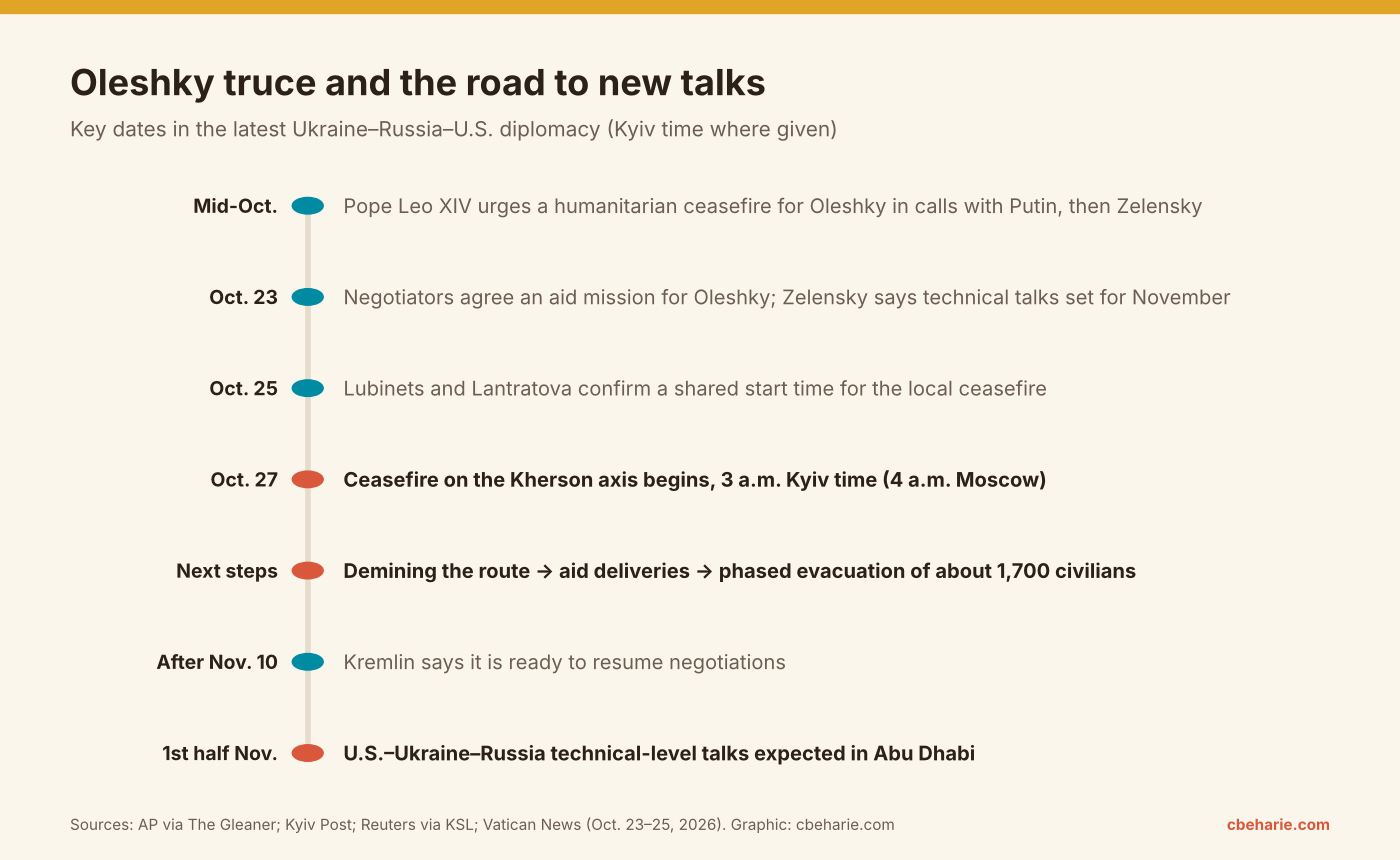
In a war now in its fifth year, even a narrow pause is news. Ukraine and Russia have agreed to a localized ceasefire around Oleshky, a Russian-occupied town on the left bank of the Dnipro River in the Kherson region, to allow an emergency humanitarian mission. According to the Kyiv Post, the truce begins at 3 a.m. Kyiv time on Tuesday, October 27. Russia’s chief of the general staff, Valery Gerasimov, confirmed that Russian forces would cease fire on the Kherson axis from that time.
The plan unfolds in stages, as Ukraine’s human rights ombudsman Dmytro Lubinets described it: first the ceasefire, then clearing mines from the route into Oleshky, then delivering food and medicine, and finally a phased evacuation of civilians. Around 1,700 people are believed to remain in the town, which has received no authorized aid convoys since late May. Residents report shortages of food and medicine, and heating, water and electricity systems are badly damaged as winter approaches.
The initiative was championed by U.S. First Lady Melania Trump, who the White House said took up the cause after learning about Oleshky at an event she hosted during September’s UN General Assembly. Kremlin spokesman Dmitry Peskov thanked her publicly, and Russian ombudswoman Yana Lantratova confirmed the terms. Notably, Pope Leo XIV had appealed for exactly such a humanitarian pause in phone calls with Vladimir Putin and Volodymyr Zelensky about a week earlier, Vatican News reported.
Why it matters
Oleshky is small, but the model may not be. Lubinets suggested the arrangement could serve as a template for future humanitarian missions. Key details remain unclear, however, including how the ceasefire will be monitored and whether evacuees will be taken to Ukrainian- or Russian-held territory. President Zelensky has warned that Russia could use the demining phase to steer departing residents toward Russian-controlled areas.
The truce also sits within wider diplomacy. Zelensky said on Friday that negotiators from Ukraine, Russia and the United States will meet at a technical level in Abu Dhabi in the first half of November, after U.S. envoys Steve Witkoff and Jared Kushner met Putin earlier in the week. The Kremlin has said it is willing to resume negotiations after November 10. A similar meeting expected in October did not take place.
Competing pressures
Zelensky has set out firm conditions: strong security guarantees and ten years of funding for Ukraine’s army, with territorial questions left for leaders. He has said Ukraine is open to a full ceasefire or to narrower deals on energy or shipping if Moscow rejects a broad agreement. He has also criticized moves by Western governments to ease some sanctions on Russia, including President Trump’s recent agreement for Russian diesel exports to the United States and a temporary waiver of parts of a new sanctions law. Ukraine further says its access to Starlink satellite service remains restricted, hampering its drones, despite U.S. assurances.
Supporters of the administration’s approach argue that direct engagement with Moscow, including humanitarian gestures and economic incentives, is the fastest way to stop the killing. Skeptics counter that easing pressure on Russia before a settlement risks rewarding aggression. Both sides agree on one thing: civilians like those in Oleshky have paid the highest price.
Why this matters in Kingston and Oslo
For Jamaican households, distant conflicts often arrive through fuel and food prices. Just this weekend, The Gleaner reported that Knutsford Express saw its profit dip amid an oil price spike. Greater stability in global energy markets, which any durable peace in Europe would support, matters to every bus fare and grocery bill at home. For readers in Norway, where this author lives, the diplomacy is close to home: Zelensky was recently photographed in Oslo alongside Prime Minister Jonas Gahr Støre, Finland’s President Alexander Stubb and U.S. envoy Steve Witkoff.
What to watch next
- Whether the ceasefire holds from Tuesday and aid convoys reach Oleshky.
- How many civilians are evacuated, and where they are taken.
- Confirmation of dates for the Abu Dhabi technical talks in November.
5. Venezuela and Cuba: our neighbors at a crossroads
What happened in Venezuela
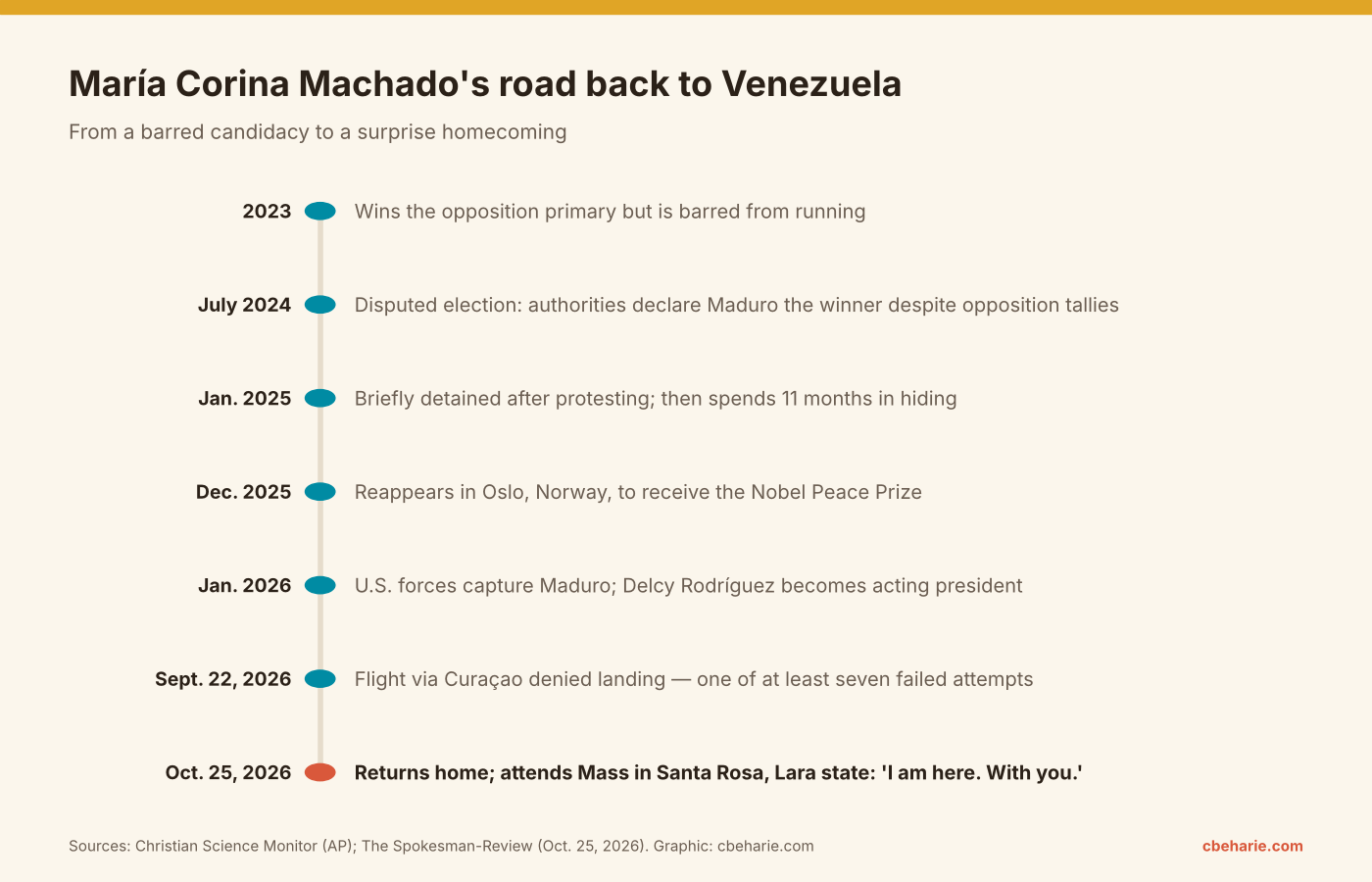
On Sunday, Venezuelan opposition leader and Nobel Peace Prize laureate María Corina Machado made a surprise return to her country after more than ten months abroad. She announced her arrival on social media with a simple message, “I am here. With you,” and attended Mass at a Catholic church in Santa Rosa, Lara state, before heading toward Caracas. Her team has not said how she entered the country or whether authorities had agreed to her return.
Her return had been repeatedly thwarted. Her party says she made at least seven unsuccessful attempts, including a September 22 flight that was denied permission to land in Curaçao, from where she had planned to continue by speedboat. The opposition accuses the government of blocking her; Venezuelan authorities deny it.
The background
Venezuela’s politics have been upended this year. In January, U.S. forces captured Nicolás Maduro in Caracas and flew him to New York to face drug charges, which he denies. Delcy Rodríguez, a longtime Maduro ally, became acting president with the backing of the Trump administration. A court allowed her to serve up to 90 days, extendable by the National Assembly, which never voted on an extension, yet she remains in office. No presidential election date has been set.
Machado’s story is tied to that unfinished business. She won the opposition primary in 2023 but was barred from running, and Edmundo González ran in her place in 2024. The opposition presented evidence that González won by more than two to one, but loyalist election officials declared Maduro the winner, and more than 2,000 people were detained in the crackdown that followed. Machado spent eleven months in hiding before reappearing in Oslo in December 2025 to receive the Nobel Peace Prize.

Competing views on what comes next
Machado and her allies want an election date now, and a September Meganálisis poll suggests why: 60.6 percent said they would vote for her in an immediate election, compared with 3.6 percent for Rodríguez. U.S. Secretary of State Marco Rubio, by contrast, has argued that stabilizing the economy and rebuilding institutions such as the courts and electoral council must come first, and he credited U.S.-supported reconciliation talks for making her return possible. President Trump said he hoped she would be safe. Brian Fonseca, a Venezuela expert at Florida International University, told the Christian Science Monitor the return is very symbolic but means little without institutional change.
Cuba: a Caribbean appeal at the UN
Meanwhile, nine former CARICOM leaders have issued an open letter urging countries to vote this Wednesday, October 28, for the annual UN General Assembly resolution calling for an end to the U.S. embargo on Cuba, which began 66 years ago this month. The signatories include Jamaica’s former prime ministers P.J. Patterson and Bruce Golding, along with Keith Rowley of Trinidad and Tobago, Ralph Gonsalves of St. Vincent and the Grenadines, and others. They argue that recent U.S. sanctions on third parties supplying Cuba with fuel have deepened hardship for ordinary Cubans. Supporters of the embargo, in Washington and among many Cuban Americans, maintain that pressure is necessary to push Havana toward political change, a debate sharpened by U.S. media reports that a Florida judge has signed an arrest warrant for Raúl Castro over the 1996 shootdown of civilian planes.
Why it matters for Jamaica
Venezuela and Cuba are not distant stories for us. Both are near neighbors whose stability affects migration, energy, security and trade across the Caribbean basin. CARICOM governments have long tried to balance their friendship with the United States against a principle of non-intervention and regional solidarity. That Patterson and Golding, leaders from opposite sides of Jamaican politics, signed the same letter says something about how widely that principle is shared here.
What to watch next
- Whether Venezuelan authorities allow Machado to move and campaign freely, and whether Edmundo González follows her home as promised.
- Any movement toward an election date.
- Wednesday’s UN vote on the Cuba embargo, which falls on the same day Jamaica marks the Melissa anniversary.
A closing reflection
Looking across today’s five stories, one word keeps surfacing: return. A battered island returning, slowly, to normal life. A nation weighing how to return safety to its streets without losing sight of justice and mercy. An exiled leader returning home. A town in Ukraine waiting for the return of food, medicine and quiet. And a divided Brazil asked to return to the hard work of governing together.
Returns are rarely tidy. The CAPRI report reminds us that good intentions and generous giving need honest systems to reach the people they are meant for. The gun-law debate reminds us that protecting children and protecting fairness are both moral obligations, not rivals. And the small truce in Oleshky reminds us that even in a long war, a pause for the vulnerable is possible when enough people, from a pope to a first lady to tired negotiators, decide it matters.
The prophet Isaiah spoke of people who would “rebuild the ancient ruins” and be called “Repairer of Broken Walls” (Isaiah 58:12). That is a calling for every one of us, at home and in the diaspora: to keep showing up, keep asking hard questions with grace, and keep giving. As we approach Wednesday’s anniversary, let us remember those who were lost to Melissa, pray for the families still rebuilding, and commit ourselves to being repairers, wherever we are planted.
Thank you for reading. Until tomorrow, walk good.
Sources
- Jamaica Gleaner, “Melissa relief under scrutiny” (Oct. 25, 2026)
- Jamaica Gleaner, “Seaside villa earnings shrink a year after Melissa” (Oct. 25, 2026)
- Jamaica Gleaner, “Terrelonge hails diaspora’s US$3.12b contribution to Jamaica” (Oct. 25, 2026)
- Pan American Health Organization, “Donor Alert: Jamaica – Hurricane Melissa”
- Jamaica Observer, “Hurricane Melissa death toll in Jamaica rises to 45” (Nov. 11, 2025)
- Jamaica Observer, “Jamaica aims to raise minimum gun sentence to 20 years” (Oct. 25, 2026)
- Jamaica Gleaner, “Gun law to face Court of Appeal test” (Sept. 27, 2026)
- Jamaica Gleaner, “Murder rate down 24 per cent as Jamaica records 407 homicides so far this year” (Oct. 7, 2026)
- Jamaica Observer, “Scott-Mottley wants Gov’t to provide answers on deadly Sligoville shooting” (Oct. 25, 2026)
- Jamaica Observer (AFP), “Brazil’s Lula defies odds to clinch poll victory against Flavio Bolsonaro” (Oct. 25, 2026)
- CBS News, “Lula wins fourth term as Brazil’s president, beating Flávio Bolsonaro in runoff” (Oct. 25, 2026)
- The Jerusalem Post (Reuters), “Bolsonaro refuses to concede, seeks to annul Brazil election” (Oct. 26, 2026)
- Jamaica Gleaner (AP), “Ukraine-Russia ceasefire announced ahead of Melania Trump mission” (Oct. 24, 2026)
- Kyiv Post, “Ukraine, Russia agree ceasefire timetable for Oleshky mission” (Oct. 25, 2026)
- KSL (Reuters), “Zelenskyy says Ukrainian, Russian and US negotiators to meet in early November in Abu Dhabi” (Oct. 23, 2026)
- Ukrainska Pravda, “Zelenskyy warns Russia may use demining to direct Oleshky residents towards Russia” (Oct. 25, 2026)
- Vatican News, “Humanitarian truce announced for Ukrainian city of Oleshky” (Oct. 2026)
- Christian Science Monitor (AP), “Venezuela’s Machado returns from exile, as doubts over democracy deepen” (Oct. 25, 2026)
- The Spokesman-Review, “María Corina Machado makes surprise return to Venezuela after months of failed attempts” (Oct. 25, 2026)
- Jamaica Gleaner, “Caribbean ex-PMs call for end to Cuba embargo” (Oct. 25, 2026)
- Jamaica Gleaner, “Knutsford Express profit dips amid oil price spike” (Oct. 25, 2026)
All charts, timelines and graphics in this post are original works created for cbeharie.com from the sourced figures above. Freely licensed photo libraries could not be reached for today’s edition, so no photographs are included.