

Good morning, and welcome to this Sunday edition of Today’s Top Five. If you are reading this in Jamaica, chances are you can hear rain on the roof as you scroll. A trough over the western Caribbean has kept eastern and central parishes under flash-flood alerts all weekend, flooding dozens of homes in St Thomas and sending families to shelter. It is a sobering backdrop as the island approaches the first anniversary of Hurricane Melissa on Wednesday.
That anniversary also frames our second story: a government travel freeze, a promise to cut red tape, and a sharp debate about whether Jamaica is spending its recovery dollars wisely. Then we pause to honor a giant. Derrick Harriott, the singer and producer whose career ran from the Jiving Juniors through rocksteady, reggae and early dub, died on Saturday at 87.
Beyond our shores, France saw another weekend of mass protests that began with high school students and has grown into a nationwide revolt over living costs, overshadowed by a shooting near Paris that President Emmanuel Macron called a racist terrorist attack. And in New York, the race to choose the next United Nations Secretary-General has entered its decisive phase, with a Caribbean candidate, Guyana’s Carolyn Rodrigues-Birkett, still firmly in contention.
One more item worth knowing before we begin: Jamaica Electronic Transfer Services (JETS), which runs the MultiLink debit network, confirmed on Friday that a cyberattack hit part of its internal administrative systems. The company and the Bank of Jamaica say the card and ACH networks were not affected and remain fully operational, but some customer names and historical card numbers may have been exposed. Keep an eye on your bank alerts, and never share a PIN or one-time password with anyone who calls.
Let’s get into it.
1. Rain, landslides and shelters: eastern Jamaica on alert
What happened
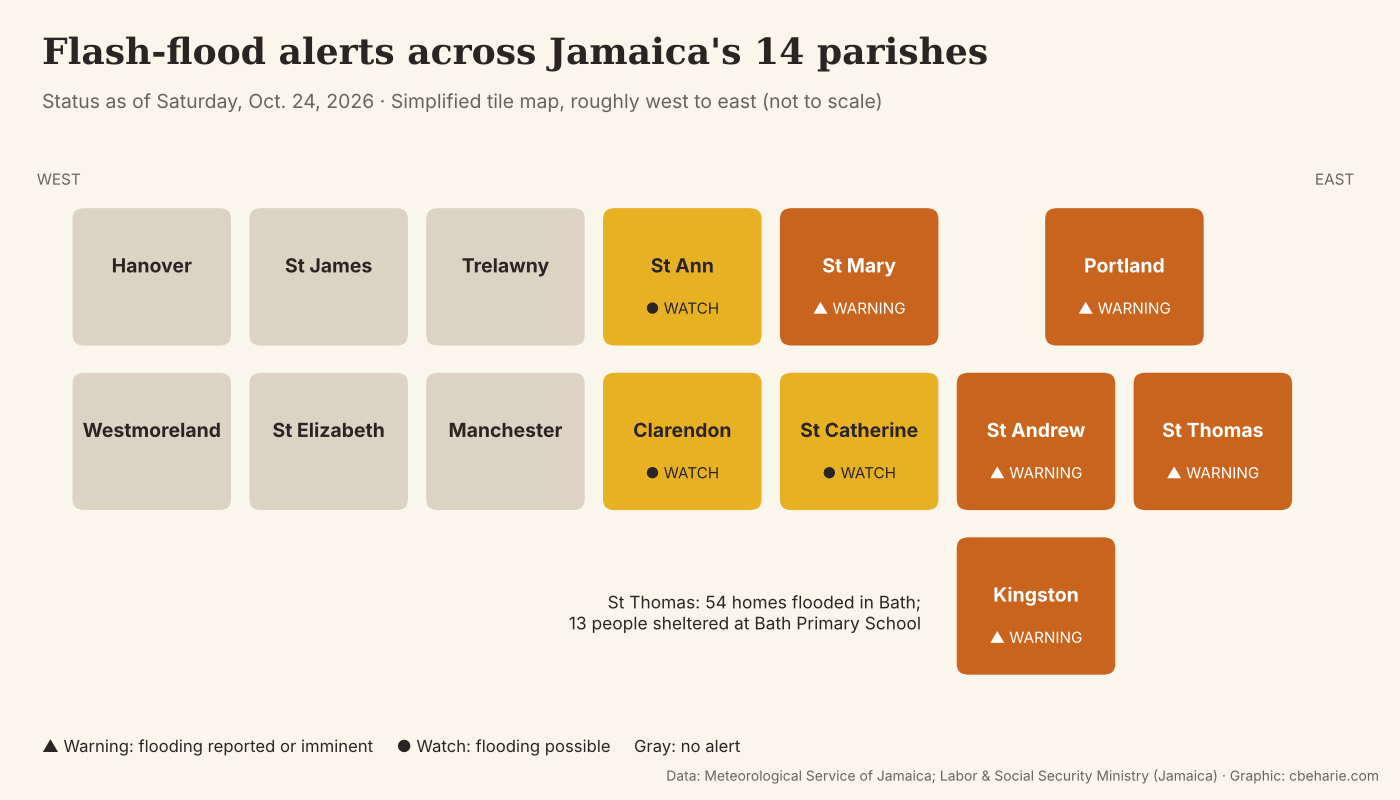
For the third straight day, much of Jamaica is under gray skies and heavy showers. The Meteorological Service of Jamaica traces the unsettled weather to a broad trough across the western Caribbean, which has been producing disorganized showers and thunderstorms over the region since early Friday. On Friday, the Met Service upgraded its flash-flood watch to a warning for low-lying and flood-prone areas of Kingston, St Andrew, St Thomas, Portland and St Mary, while St Catherine, Clarendon and St Ann remained under a watch. Forecasters expect intermittent showers and thunderstorms, mainly over eastern parishes, to continue through Sunday evening.
St Thomas has taken the hardest hit so far. According to the Jamaica Gleaner, a major landslide on Friday blocked the main road near Johnson Mountain Primary School, stranding 15 students and several teachers, who reportedly made their way around the slide before nightfall. The main road at Sunning Hill was also blocked, and the Plantain Garden River swelled and flowed in spate through Bath.
On Saturday, Jamaica’s labor and social security ministry reported that 54 homes in Bath had been flooded and that 13 people were being housed at a shelter at Bath Primary School. Minister Pearnel Charles Jr. said the focus is on getting essential supplies to those affected. The ministry says it has mobilized food packages, drinking water, mattresses, blankets, tarpaulins, cleaning supplies, hygiene kits and diapers, and is working with St Thomas Eastern MP Rosemarie Shaw and the parish disaster coordinator to assess further needs.
Elsewhere, Port Antonio Primary in Portland dismissed students at noon on Friday and postponed its heritage activities, including a march and a concert. The National Works Agency warned motorists to avoid the Bog Walk Gorge in St Catherine after a boulder reduced the road to a single lane, with more rockfalls possible.
Why it matters
Rain events like this rarely make international headlines, but for the families in Bath and the children of Johnson Mountain, they are anything but minor. The Met Service has warned that soils are now saturated, which makes landslides more likely, especially in the hilly eastern parishes. Saturated ground also means that even moderate showers can cause rivers to rise quickly. A flash flood, as the Gleaner reminded readers, is a sudden, rapid rise of water over normally dry land, often with little time to escape.
The timing also matters. Jamaica is still rebuilding from Hurricane Melissa, which struck a year ago this week. Many households, especially in the west, are living under temporary roofs or tarpaulins, and public agencies are stretched across hundreds of reconstruction projects. Even though this weekend’s heaviest rain has fallen mainly in the east, it is another strain on emergency budgets and on the people who staff shelters and clear roads.
The bigger picture
October is historically one of Jamaica’s wettest months, and the eastern parishes, with their steep slopes and fast rivers, are especially exposed. St Thomas in particular has long struggled with fragile roads and communities that are cut off whenever a gully or river comes down. Each event renews calls for better drainage, slope stabilization and early-warning systems that reach rural districts quickly. Those are long-term investments, and they tend to lose urgency once the sun returns.
What to watch
- Whether the Met Service lifts or extends its alerts after Sunday evening’s expiry.
- Updated damage counts from St Thomas, Portland and St Mary once roads are cleared.
- How quickly the NWA reopens the Johnson Mountain and Sunning Hill roads, and whether Bog Walk Gorge returns to two lanes.
- Any additional shelter openings if overnight rain is heavier than forecast.
Staying safe
If you live in a low-lying or flood-prone area, the guidance from officials is simple: do not attempt to cross flooded roads, gullies or rivers, even in a vehicle; strong currents are likely. Watch for rising water, keep your phone charged, and be ready to move to higher ground. Fishers, especially along the south coast, have been asked to stay alert, as seas will be rough near thunderstorms. For our readers in the diaspora, this is a good weekend to check in on family in Portland, St Mary and St Thomas.
2. One year after Melissa: a travel freeze, red tape and a recovery debate
What happened
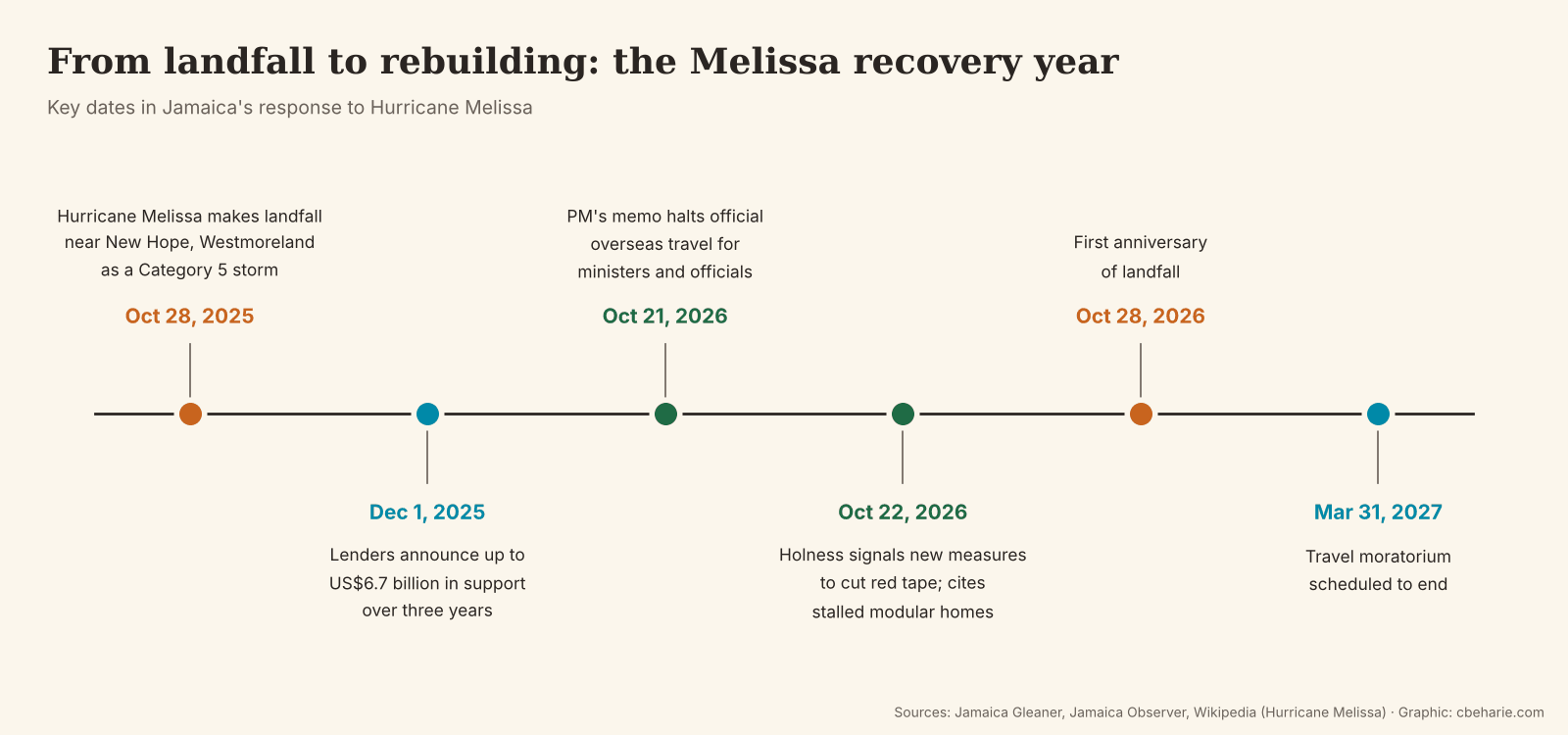
On Wednesday, October 28, Jamaica marks one year since Hurricane Melissa made landfall near New Hope in Westmoreland as a Category 5 storm, with sustained winds of about 185 miles per hour. It is widely recorded as the costliest hurricane in Jamaica’s history, with damage estimates ranging from roughly US$8.8 billion to US$12.2 billion, depending on the assessment. Westmoreland, St Elizabeth, St James, Trelawny and Hanover bore the brunt.
As the anniversary approaches, the government is sending a clear message about money. On October 21, Prime Minister Andrew Holness issued a memorandum halting official overseas travel with immediate effect until March 31, 2027. According to the Gleaner, the moratorium covers ministers and ministers of state, permanent secretaries, heads of agencies, public-sector employees and board members, and it even applies to trips paid for by outside organizations. Previously approved trips must be reviewed.
The prime minister said the hurricane has placed heavy demands on public finances and on the capacity of the public sector, and that the government must now show the highest degree of fiscal discipline. Officials, he said, need to stay focused on reconstruction, economic recovery and service delivery at home.

There are exemptions for travel connected to Melissa reconstruction, national security, standing bilateral and multilateral engagements, essential tourism promotion and emergencies. Requests need written justification, costs and expected outcomes, and must reach the Office of the Prime Minister at least seven business days before departure.
That tourism exemption was quickly put to use. Tourism Minister Edmund Bartlett left on Friday for a five-city tour of Canada, visiting Toronto, Calgary, Edmonton, Winnipeg and Montreal with Director of Tourism Donavan White. The Gleaner reports that he is seeking about 400,000 Canadian airline seats for the coming winter season, as Caribbean destinations compete for Canadian travelers who are visiting the United States less.
Red tape in the spotlight
The travel memo came the same week Holness signaled that his government will soon announce measures to make the bureaucracy work faster. Speaking to private-sector leaders on Thursday at an event hosted by Cabinet Minister Daryl Vaz, he pointed to modular homes that were imported almost six months ago but still have not been rolled out, according to the Jamaica Observer. He blamed logistics, contracting, permitting and procurement, and said it seemed no one was treating the situation as an emergency. Bureaucracy cannot be eliminated, he argued, but it must become sensible and efficient so that help reaches Jamaicans in distress much more quickly.
The opposition’s critique
The People’s National Party is not convinced. Opposition finance spokesman Julian Robinson questioned whether the travel freeze is real cost-cutting or mostly public relations, and argued that it should be judged against the government’s wider spending choices. He singled out the new National Agency for Reconstruction and Resilience (NaRRA), calling for scrutiny of its office space and salaries and for a full accounting of its spending. He also asked the government to say how much the moratorium is expected to save, and questioned why trips funded by international partners should be restricted when Jamaica needs those partners for recovery.
The government responded by calling Robinson’s criticism “superficial, shallow and misguided.”
Weighing both sides
Both arguments have merit, and readers can weigh them. Supporters of the memo will say that symbolism matters: when families are still sleeping under tarpaulins, officials should not be seen flying off to conferences, and every dollar saved can go to roofs and roads. Critics will say that travel is a small slice of the budget, that some international engagement brings in money rather than spending it, and that the bigger test of discipline is how new agencies like NaRRA are run. A clear figure on expected savings, as the opposition requests, would help the public judge.
What both sides seem to agree on is the diagnosis: recovery is moving too slowly for too many people. The prime minister’s own example of idle modular homes says as much.
What to watch
- The specific red-tape measures Holness has promised to announce “in the coming days.”
- Anniversary events and progress reports on October 28, including updates on housing, schools and the tourism season.
- Whether the government publishes projected savings from the travel moratorium or more detail on NaRRA’s budget.
- Results from Bartlett’s Canada tour as winter bookings firm up.
For the diaspora, this anniversary is a reminder that the recovery is far from finished. Many of you sent barrels, money and prayers a year ago. The need has changed shape, from emergency relief to rebuilding, but it has not disappeared.
3. Derrick Harriott (1939–2026): farewell to a builder of Jamaican music
What happened
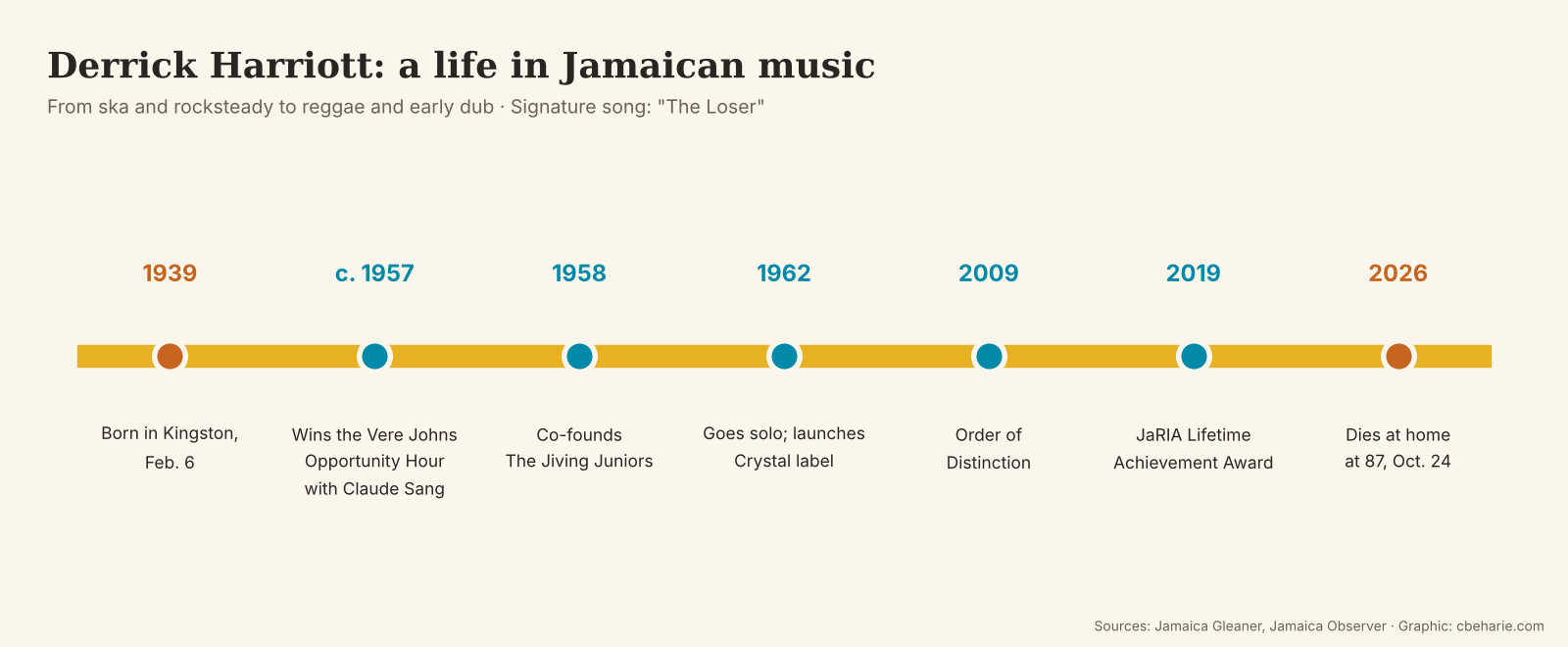
Derrick Harriott, one of the foundational figures of Jamaican popular music, died at his home at about 1 a.m. on Saturday, October 24. He was 87. Dorrel Mattocks, who operates the Derrick Harriott Music Store at Twin Gates Plaza in St Andrew, confirmed the news to the Gleaner, saying Harriott had been ill, in and out of hospital, and had recently returned home. No cause of death was given.
A career that spanned the eras
Born in Kingston on February 6, 1939, Harriott belonged to the generation that turned Jamaica’s love of American rhythm and blues into something entirely its own. As a teenager, he partnered with Claude Sang, and the duo won attention on the Vere Johns Opportunity Hour, the talent show that launched so many Jamaican careers in the 1950s. In 1958 he co-founded the vocal group the Jiving Juniors, whose early local hits included “Lollipop Girl” and “Over the River.”
In 1962, the year Jamaica became independent, Harriott launched a solo career and his own label, Crystal. That timing feels fitting. He was part of a wave of young Jamaicans who were not content simply to perform but who wanted to own and shape the business of music. His solo catalog included “The Loser,” widely considered his signature song, along with “What Can I Do,” “I’m Only Human,” “Walk the Streets” and “Solomon.” Many younger listeners know “The Loser” through Freddie McGregor’s answer song, “The Winner,” which carried Harriott’s melody to a new generation.
The producer behind the voices
Harriott’s influence as a producer may be even greater than his fame as a singer. Through Crystal, he worked with Keith & Tex, the Kingstonians, the Ethiopians, the Chosen Few, Big Youth and a young Dennis Brown. He recorded early sessions at King Tubby’s studio and helped shape the sound of early reggae and dub, a style whose echoes can be heard today in hip-hop, electronic music and pop around the world.
His contributions were formally honored. He received the Order of Distinction in 2009 for his role in developing Jamaican music, and a Lifetime Achievement Award from the Jamaica Reggae Industry Association (JaRIA) in 2019.
Tributes
Tributes began quickly. Opposition spokesperson on culture Nekeisha Burchell described Harriott as one of the architects of Jamaica’s musical legacy and said he and his generation helped build an industry and shape national identity, according to the Observer. She urged Jamaicans to preserve his work, tell his stories and teach young people the foundations of the industry.
Why it matters
Jamaica’s music is one of the most powerful exports any small nation has ever produced, and it did not appear by accident. It was built by people like Derrick Harriott: singers who became producers, producers who became label owners, and entrepreneurs who ran record shops long after the hits stopped climbing the charts. The music store that still carries his name is a quiet testament to that.
For many in the diaspora, these songs are more than nostalgia. They are the soundtrack of parents’ living rooms in Brixton, the Bronx, Toronto and Birmingham, and a thread that ties the second and third generations back to the island. When a pioneer of this era passes, a living link to the birth of modern Jamaican culture goes with him.
What to watch
- Funeral and thanksgiving service arrangements, which had not been announced at the time of writing.
- Whether there are calls for an official tribute, archive or reissue project to preserve the Crystal catalog.
- Tributes from the artists he produced and the generations he influenced.
This weekend, take a few minutes to play “The Loser” or one of his productions for someone younger in your household, and tell them where it came from.
4. France on edge: mass protests and a shooting that shook the suburbs
What happened
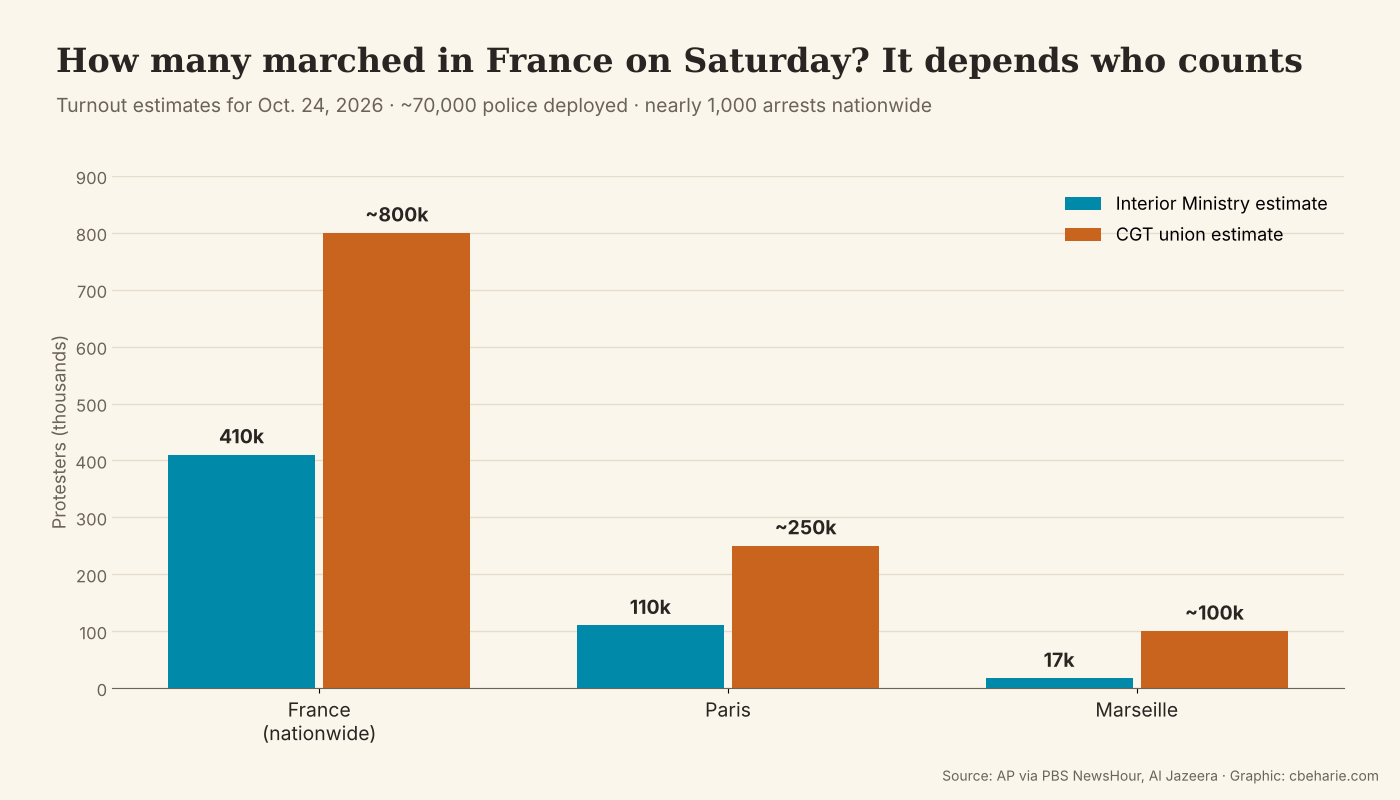
For a second straight Saturday, hundreds of thousands of people marched across France. The Interior Ministry put nationwide turnout at 410,000, including 110,000 in Paris, down from about 550,000 the previous weekend. The CGT union, one of the organizers, estimated nearly 800,000. The ministry counted 289 separate protests, according to the Associated Press via PBS NewsHour.
The day began largely peacefully, but clashes broke out near the end of the Paris march, where masked protesters threw objects and fireworks and police responded with tear gas, sound grenades and water cannons. There were street fires in Marseille and Lyon and tear gas in several other cities. Police reported nearly 1,000 arrests nationwide, and Interior Minister Laurent Nuñez said that number would rise. About 70,000 police officers and gendarmes were deployed, roughly 20 percent more than the week before, and the Louvre and Musée d’Orsay closed for the day.
How it started
This movement began in mid-September with high school students blockading their schools over crumbling buildings, teacher shortages and what they see as an unfair university admissions system known as Parcoursup. It has since grown into a broad coalition of students, unions, teachers, nurses, environmentalists and veterans of the 2018 “Yellow Vest” movement, as Al Jazeera reports. The common thread is the cost of living. National statistics show energy prices in September were 21.3 percent higher than a year earlier, with inflation at 3.1 percent.
The previous Saturday, October 17, more than half a million people marched, and the day was marred by looting and clashes, with more than 2,000 people taken into custody and thousands of businesses damaged. That explains this week’s heavy security and the decision to ban marches in several city centers, which unions criticized as an attack on free expression.
On Friday, Macron met student representatives for the first time and promised more teachers and a deep overhaul of Parcoursup. Students said that was not enough and announced another day of protest for Saturday, October 31.
The Trappes shooting
The protests unfolded in the shadow of a shooting on Friday in Trappes and neighboring La Verrière, working-class towns west of Paris. A gunman opened fire on a vehicle, killing Pengo Bossio Wangi, a 26-year-old rising mixed martial arts fighter of African origin, and wounding several others, including a 12-year-old girl who was hit eight times and is in critical condition, the Observer reported, citing AFP. Most of the victims were from immigrant backgrounds.
A 39-year-old suspect was arrested with a submachine gun in his car, and investigators say his apartment was booby-trapped with gas bottles wired to a timer. France’s anti-terrorism prosecutors have taken the case, and Macron called it a racist terrorist attack. Marine Le Pen of the National Rally called for a thorough investigation and said a racist motive would be shameful, while lawmakers on the left blamed the far right for stoking intolerance. The victim’s family has asked whether authorities had properly monitored a man they say was already known to the authorities.
Why it matters
France is about six months from a presidential election. Macron cannot run again, and recent polls show Le Pen as the leading contender. A movement driven by young people and the cost of living, combined with a racially motivated attack, is a volatile mix in a polarized campaign. Each side is reading the weekend differently: the far right points to disorder and argues the government has failed to protect the public; the left points to heavy-handed policing and rising hostility toward minorities; the government says firmer security worked better than last week.
The Caribbean connection
These questions are not abstract for Caribbean people. France’s overseas departments of Martinique and Guadeloupe are our neighbors, and both have seen unrest over living costs in recent years. There is also a large Caribbean and African diaspora in the Paris suburbs, the very communities a shooting like Trappes targets. And energy-price shocks that squeeze French households squeeze import-dependent island economies too.
What to watch
- The planned October 31 protests, and whether the government’s offer on schools and admissions calms tensions.
- The investigation into the Trappes suspect’s path to radicalization and whether authorities missed warning signs.
- How the presidential candidates position themselves on security, inequality and the cost of living.
5. Who will lead the United Nations? A Caribbean candidate in the final stretch
What happened
The race to succeed António Guterres as United Nations Secretary-General has entered what Euronews calls a decisive phase. This week a new contender joined: Lana Nusseibeh of the United Arab Emirates, who served as her country’s UN ambassador from 2013 to 2024 and was formally nominated on Wednesday, October 21. She joins a field that already includes Rebeca Grynspan of Costa Rica, Rafael Grossi of Argentina, and Guyana’s Carolyn Rodrigues-Birkett, alongside María Fernanda Espinosa and Ivonne A-Baki of Ecuador and Olara Otunnu of Uganda.
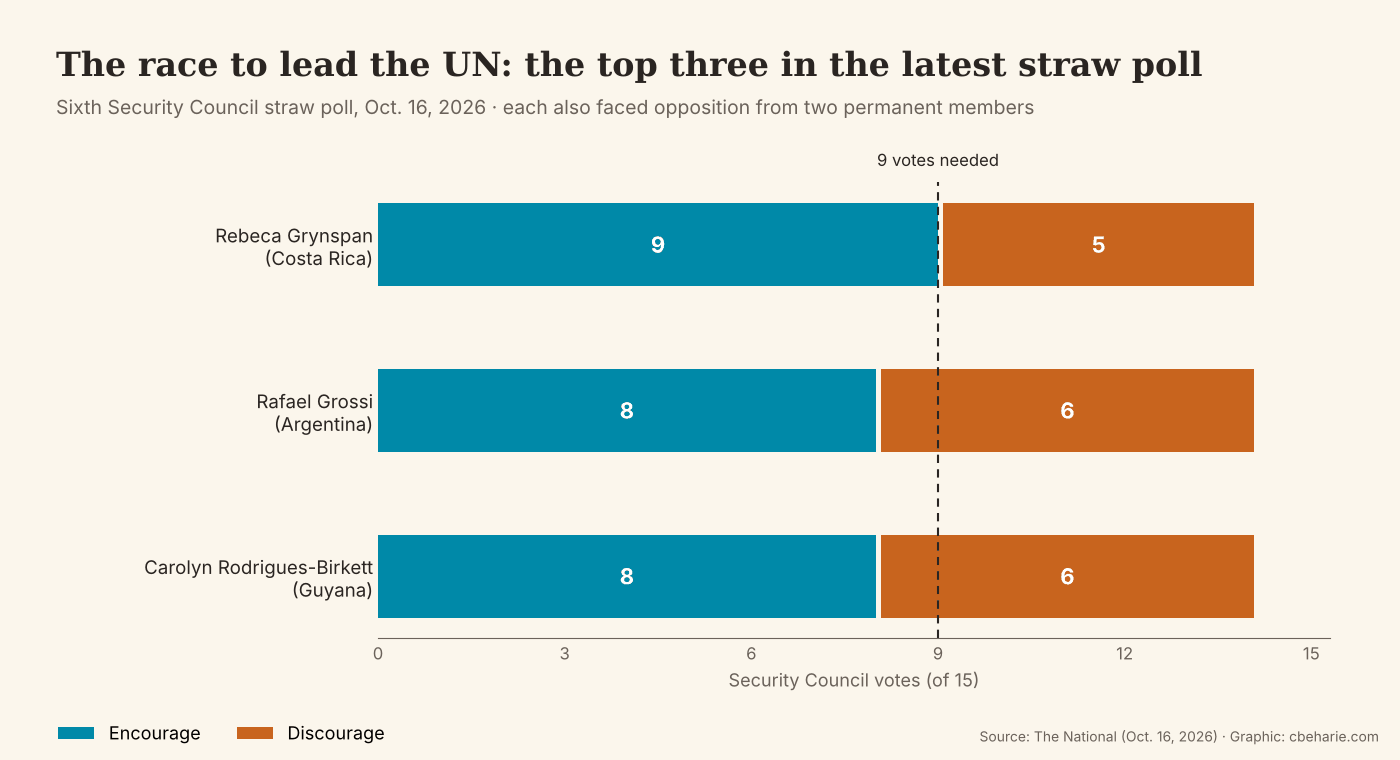
In the sixth informal straw poll on October 16, Grynspan, the head of the UN trade and development agency UNCTAD, received nine encouraging votes, the minimum needed, and five discouraging ones, according to The National. Grossi, head of the International Atomic Energy Agency, and Rodrigues-Birkett tied with eight encouraging and six discouraging votes. Crucially, each of the three faced opposition from two of the five permanent members of the Security Council: the United States, the United Kingdom, France, China and Russia. Any one of those five can block a candidate.
Why the Caribbean is watching
Carolyn Rodrigues-Birkett is Guyana’s permanent representative to the UN and a former foreign minister and Minister of Amerindian Affairs. She has worked with the Food and Agriculture Organization and led Guyana’s delegation during its 2024–2025 term on the Security Council. CARICOM heads of government gave her their full endorsement in July, as Kaieteur News reported. If chosen, she would be the first woman and the first Caribbean national to lead the UN. She led the August straw poll and has stayed in the top tier since.
There are headwinds. The Caribbean National Weekly, citing the New York Times, reported that the Trump administration opposes her candidacy, partly because she has described Israel’s actions in Gaza as genocide. Guyana’s President Irfaan Ali disputes that Washington has formally signaled a veto, and the United States has not publicly endorsed any candidate. US Ambassador Mike Waltz has said Washington wants the most qualified candidate, focused on the UN’s core mission of peace and security, rather than one chosen by regional rotation or gender.
A historic moment either way
No woman has led the UN in its 81-year history. Five of the seven remaining candidates are women, and four of those five come from Latin America and the Caribbean, the region many observers see as next in line under the informal practice of rotating the post among regions, as The Week notes. Nusseibeh’s entry adds a different profile. She has strong Gulf backing and campaigns on reform and urgency for peace, but she has faced criticism over the UAE’s normalization of ties with Israel and its alleged role in Sudan’s war, according to an AFP report.
How the choice is made
The process is less a public election than a negotiation. The 15-member Security Council holds a series of secret straw polls. A candidate needs at least nine votes and no veto from a permanent member. The council then recommends one name to the General Assembly, which makes the appointment. The council has until the end of December, and the new Secretary-General takes office on January 1, 2027.
Why it matters
For small island states, the UN is not a distant institution. It is where countries like Jamaica argue for climate finance, debt relief and disaster resilience, the very issues our first two stories are about. A Secretary-General who understands the realities of hurricanes, rising seas and small economies could shape how the world responds to them. And the global South has long argued that the UN’s leadership should better reflect the majority of its members.
What to watch
- The next straw poll, and whether the permanent members’ objections to the front-runners soften or harden.
- How Nusseibeh performs in her first poll, and whether any candidates withdraw.
- Whether CARICOM and the wider Latin American and Caribbean group continue to rally around Rodrigues-Birkett as the field narrows.
Closing reflection: holding steady when the waters rise
Looking across today’s five stories, a common thread appears. In St Thomas, families are bailing water from their homes. In Westmoreland and St Elizabeth, people are still rebuilding a year after Melissa, and leaders are arguing over how best to spend scarce money. In France, young people are asking whether their country has a place for them, while a family in Trappes mourns a son taken by hatred. And at the UN, the world is choosing someone to steward its fragile peace.
None of these stories has a tidy ending yet. That is often how life feels: we are asked to act faithfully in the middle of things, long before we know how they turn out.
Scripture speaks to that middle place. Through the prophet Isaiah comes a promise that when we pass through the waters, we will not be overwhelmed. It is not a promise that the waters never come. It is a promise of presence within them. For people of faith, that changes how we respond: not with panic or despair, but with steady, practical love. A shelter volunteer in Bath, a neighbor who checks on an elderly couple, a public servant who cuts one more unnecessary form, a young person who protests peacefully for a better school, a diplomat working for peace: each is a small sign that we are not abandoned to the flood.
And as we remember Derrick Harriott, we can give thanks for gifts that outlive us. He sang about loss, yet he spent his life building something that still brings joy. May we do the same with whatever time and talent we have been given.
Wherever you are reading this, in Kingston or Toronto, London or Oslo, may you find peace this Sunday, and may you be a source of it for someone else.
Sources
- Jamaica Gleaner: 8 parishes on alert as rains trigger landslides, flooding (Oct. 24, 2026)
- Jamaica Gleaner: 54 homes flooded in St Thomas, 13 people now in shelter (Oct. 24, 2026)
- Jamaica Gleaner: Rains to continue until tomorrow, Met Service (Oct. 24, 2026)
- Jamaica Observer: Flash flood warning in effect for eastern parishes (Oct. 23, 2026)
- Jamaica Observer: Money worries, on the JETS/MultiLink cyberattack (Oct. 24, 2026)
- Jamaica Gleaner: Grounded: PNP questions fiscal restraint amid travel ban, NaRRA spending (Oct. 24, 2026)
- Jamaica Gleaner: Bartlett takes flight on five-city Canada campaign (Oct. 24, 2026)
- Jamaica Observer: Holness signals imminent changes to tackle red tape (Oct. 24, 2026)
- Wikipedia: Hurricane Melissa (background on landfall and damage estimates)
- Jamaica Gleaner: Derrick Harriott, pioneering reggae singer and producer, has died (Oct. 24, 2026)
- Jamaica Observer: Derrick Harriott, celebrated singer and producer, dead at 87 (Oct. 24, 2026)
- Jamaica Observer: Burchell pays tribute to Jamaican music pioneer Derrick Harriott (Oct. 24, 2026)
- PBS NewsHour (AP): More than 400,000 protest across France as Paris clashes erupt (Oct. 24, 2026)
- Al Jazeera: Hundreds of thousands protest in France amid heightened police security (Oct. 24, 2026)
- Jamaica Observer (AFP): 12-year-old shot eight times in France terror attack (Oct. 24, 2026)
- Euronews: UN chief race enters decisive phase as new contender arrives (Oct. 23, 2026)
- The National: Grynspan stays ahead in sixth UN secretary general vote (Oct. 16, 2026)
- The Week: The world’s top diplomatic job: is it finally her turn? (Oct. 23, 2026)
- Daily Tribune (AFP): UAE diplomat eyes UN’s top job (Oct. 24, 2026)
- Caribbean National Weekly: Guyana urges UN members to back Rodrigues-Birkett (Sept. 2026)
- Kaieteur News: CARICOM backs Rodrigues-Birkett for UN Secretary-General (July 14, 2026)
Note on images: All graphics in this post are original works created for cbeharie.com from the sourced data above. No news-agency photos are used.