

Good morning from Norway, and welcome to today’s briefing. This Saturday, October 24, 2026, finds Jamaica just four days from the first anniversary of Hurricane Melissa, and the storm’s long shadow falls across almost every story on today’s list. At home, the government has frozen official overseas travel for the rest of the fiscal year, while heavy rain has put eight parishes under a flash flood watch and sent some families in St. Thomas fleeing rising water. Next door in Haiti, the international force sent to confront the gangs, which includes Jamaican soldiers and police, is facing its most serious test yet after four Salvadoran service members disappeared in an ambush.
Farther afield, the war involving the United States, Israel and Iran has pushed oil to a six-month high, with reports of tankers struck in the Strait of Hormuz. That matters at every Jamaican gas pump and in every household budget. And in Europe, where I make my home, scientists have put a sobering number on this past summer’s heat: more than 50,000 deaths in the cities they studied, roughly two-thirds of them linked to a warming climate.
These five stories are different on the surface, but they share a common thread. Each one asks how communities and nations prepare for shocks they cannot fully control, and who carries the cost when the shocks arrive. As always, I have tried to set out the facts plainly, present the main viewpoints fairly, and point you to the original reporting at the end. Grab your coffee or your cup of mint tea, and let’s walk through the day together.
1. Jamaica Freezes Official Overseas Travel Until March 2027
What happened
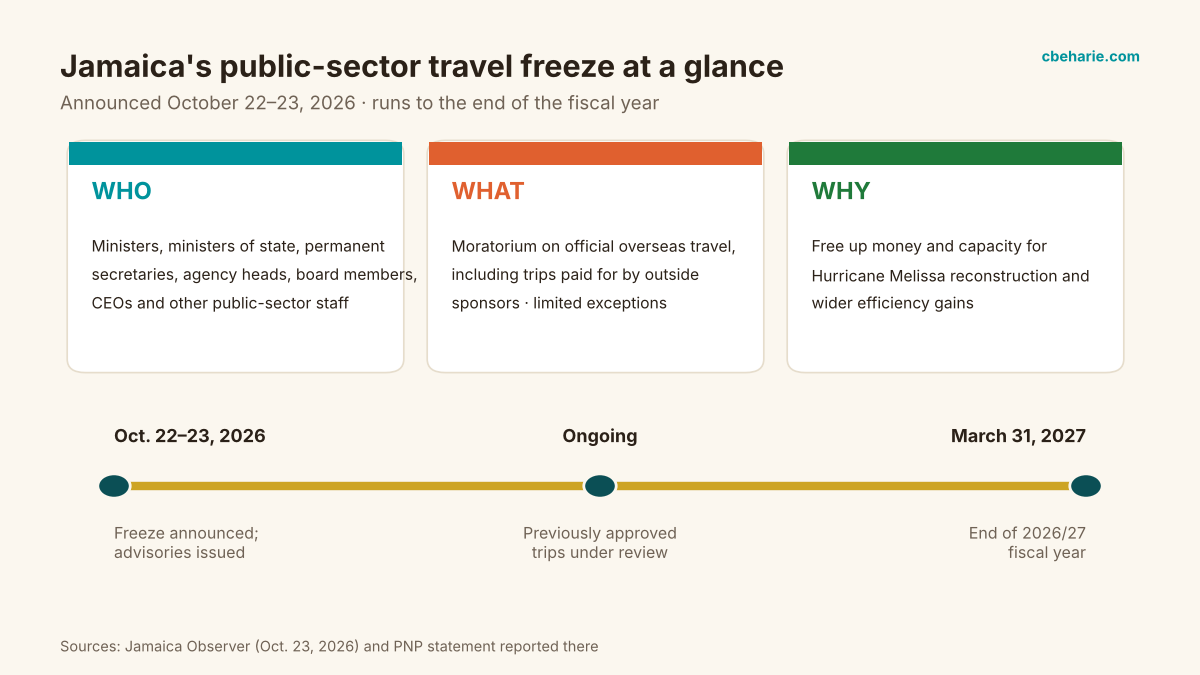
The Government of Jamaica has placed an immediate moratorium on official overseas travel across the public sector, and it will stay in place until March 31, 2027, the end of the current fiscal year. According to the Jamaica Observer, Prime Minister Andrew Holness advised his ministers of the decision on Thursday, and Cabinet Secretary Audrey Sewell sent a similar advisory to permanent secretaries.
The reach of the order is wide. It covers Cabinet ministers, ministers of state, permanent secretaries, senior public officers, heads of agencies, board members, chief executive officers and other public-sector employees. It applies to ministries, departments, statutory bodies, executive agencies and public enterprises. Notably, it applies even when a trip would be paid for by an outside organization or sponsor rather than by taxpayers. Trips that were approved earlier but have not yet happened will be reviewed, and earlier approval does not guarantee an exemption. The memorandum allows for limited exceptions, but those exceptions have not been spelled out publicly.
The government’s case
The memorandum points directly to what it calls the unprecedented destruction caused by Hurricane Melissa, which it says has strained both public finances and the capacity of the public service. The stated goal is to contain spending and redirect resources to reconstruction, economic recovery and the delivery of services, with government setting an example of restraint.
Senator Abka Fitz-Henley, minister of state in the Office of the Prime Minister, framed the move as part of a broader efficiency and productivity drive the prime minister has been signaling for some time. He noted that Jamaica has absorbed a long run of shocks, from COVID-19 to Hurricanes Beryl and Melissa, and argued that the country must now shift from stability toward strong growth, beginning with careful use of public resources. He described the travel freeze as among the first of several steps to come, building on a ministerial travel quota introduced a few years ago.
The opposition’s questions
The People’s National Party welcomed the principle of managing travel carefully but questioned whether the measure is substance or public relations. Opposition finance spokesman Julian Robinson said the government has not disclosed how much it expects to save, what the exceptions will be, or why trips sponsored by outside partners, which cost taxpayers nothing, should be blocked when Jamaica needs international partners for its recovery.
The PNP also tied the issue to spending at the National Reconstruction and Resilience Authority (NaRRA), the body created to coordinate post-Melissa rebuilding. Robinson pointed to costs for office space and what he called a top-heavy salary structure, and argued that real fiscal discipline should begin with the largest areas of spending rather than the most visible ones. The party is calling for projected savings to be published and for a full accounting of NaRRA’s spending. Fitz-Henley, for his part, has dismissed the criticism as misguided.
Why it matters
On its own, overseas travel is a small slice of a national budget. Its importance is partly symbolic: when families in Westmoreland, St. Elizabeth and elsewhere are still rebuilding roofs and replanting farms, visible restraint at the top can build trust. But both sides have a point worth weighing. Supporters see a sensible signal of shared sacrifice. Critics worry that a blanket ban could keep officials away from the very donor meetings, investment talks and technical conferences that bring money and know-how into a recovering country.
The broader economic picture is also part of the story. Speaking in Montego Bay this week, NCB Capital Markets chief executive Angus Young described NaRRA’s program as the largest infrastructure spend in Jamaica’s history. He noted that the country’s debt-to-GDP ratio has fallen from about 147 percent to somewhere between 60 and 70 percent, and that net international reserves now exceed US$7 billion. That hard-won stability is exactly what the government says it is trying to protect.
What to watch next
Watch for three things: whether the government publishes savings estimates, how the “limited exceptions” are defined and reported, and what the other promised efficiency measures turn out to be. For the diaspora, the question is practical too. Many partnerships between Jamaican institutions and overseas communities depend on officials traveling to meet them. How the exceptions are handled will show whether those bridges stay open.
2. Heavy Rain, a Flood Watch and a Recovery Still in Progress
What happened
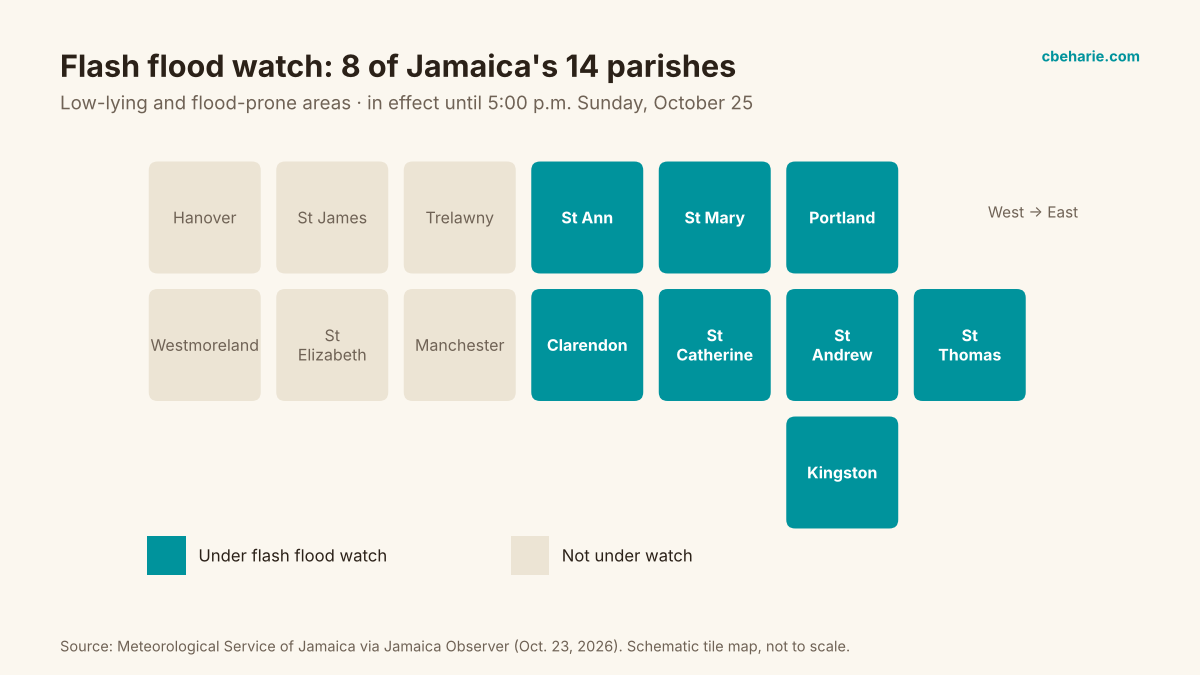
The Meteorological Service of Jamaica has issued a flash flood watch for low-lying and flood-prone areas of eight parishes: St. Ann, St. Mary, Portland, St. Thomas, Kingston, St. Andrew, St. Catherine and Clarendon. The watch remains in effect until 5:00 p.m. on Sunday, October 25. Forecasters attribute the weather to a broad trough over the western Caribbean that is producing a large, loosely organized area of showers and thunderstorms. Rain, at times heavy, is expected to continue through Sunday evening, mostly over eastern and central parishes, and fishers on the south coast have been urged to take care in rough seas near the storms. The public can call 116 for weather information.
In Bath, St. Thomas, the rain has already turned into real hardship. Residents told the Jamaica Observer that the Plantain Garden River overflowed its banks and sent water toward their homes, forcing some families to leave. One resident said sediment that had built up in the river was simply washed back into the community, putting them back to square one. Residents said they could not get a firm timeline from the National Works Agency on when the river would be cleared. The weather also forced the postponement of schoolboy football matches.
One year after Melissa
These rains come at a delicate moment. On Wednesday, October 28, Jamaica marks one year since Hurricane Melissa made landfall near New Hope in Westmoreland as a Category 5 storm with sustained winds of about 185 miles per hour. It was the strongest hurricane on record to strike the island. Damage in Jamaica is commonly estimated at around US$12 billion, and a Gleaner editorial this week put the loss of infrastructure and economic activity at over 57 percent of GDP. The storm’s name has since been retired.
When ground is already scarred, drains are still clogged with debris and some roofs remain temporary, even an ordinary rainy spell can do outsized damage. That is why a flood watch in late October feels different this year.
Schools: real progress, real gaps
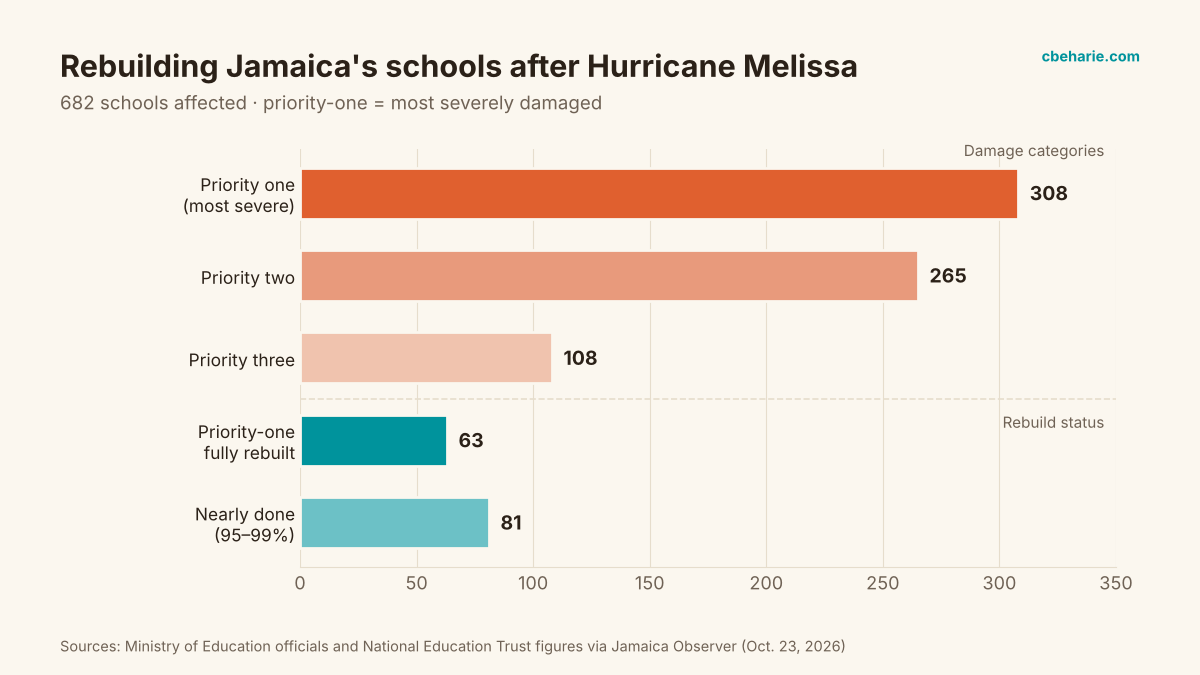
Education offers a clear snapshot of where recovery stands. The Ministry of Education reported this week that 682 schools were affected by Melissa. Of the most severely damaged, 63 have been fully rebuilt and 81 more are 95 to 99 percent complete. Junior Education Minister Rhoda Moy Crawford said the ministry is choosing resilient rebuilding over speed, with stronger roofs, better windows and ventilation, higher ceilings and wheelchair access. About J$9.2 billion has been spent on school rehabilitation so far. Officials also named the obstacles: shortages of skilled labor, difficulty getting building materials, and problems with contractors.
The human side of those numbers showed up at Holland Primary in St. Elizabeth, where temporary wooden classrooms are now being built seven weeks into the school year. Last month, staff complained that young students were learning in tents in scorching heat, with some seeking shade under a mango tree. During bad weather, the principal has had to cover furniture and books with a tarpaulin because of a leaking roof.
Tourism pushes ahead
The recovery is also an economic race. Tourism Minister Edmund Bartlett is leading a promotional tour across Canada, from Toronto to Calgary, Edmonton, Winnipeg and Montreal, aimed at turning roughly 400,000 available airline seats into bookings for the winter season. He has stressed that strong visitor numbers support not only hotels but farmers, craft vendors, transport operators and entertainers.
What to watch next
Keep an eye on Met Service bulletins through Sunday evening, particularly if a watch is upgraded to a warning. Next week’s anniversary will bring official reflections and, likely, fresh progress reports. The questions worth asking are simple: How many families are still without a permanent roof? How quickly are rivers and drains being cleared before the next storm season? And are smaller local businesses getting a fair share of the reconstruction work?
3. Haiti: Ambush on International Force Tests a Fragile Mission
What happened
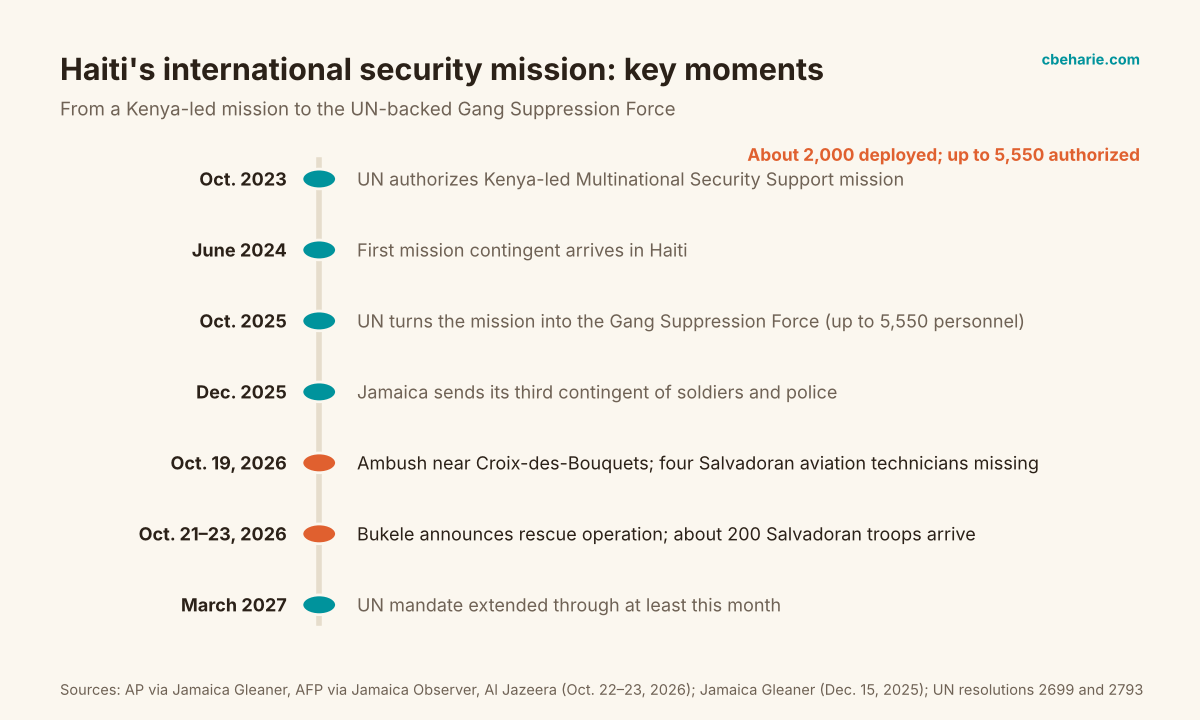
On Sunday, October 19, gunmen attacked an armored vehicle carrying Salvadoran personnel serving with the UN-backed Gang Suppression Force (GSF) in Haiti. The attack happened in the Santo area of Croix-des-Bouquets, on the edge of Port-au-Prince, as the vehicle was returning to base. Four Salvadoran aviation technicians fled the burning vehicle and have been missing since. U.S. Ambassador to the UN Mike Waltz said the attackers used hundreds of rounds and explosives, and officials believed the four had survived the initial assault. No group has claimed responsibility, and it was not clear at last report whether Haitian authorities had confirmed the men were alive.
El Salvador’s President Nayib Bukele announced on Wednesday that his country had launched a military operation to rescue them. He stressed that the Salvadoran contingent consists of pilots and technical staff whose main job is medical evacuation, not combat, and he warned the gangs that any failure to return the men alive would bring a much stronger response. According to a security source cited by AFP, about 200 Salvadoran soldiers arrived in Port-au-Prince on Thursday and Friday to support search operations in the Plaine du Cul-de-Sac area. Haiti’s government called the men’s release an absolute priority.
Why it matters
This is described as the first major attack on the force since it began operating. The GSF, which grew out of the earlier Kenya-led Multinational Security Support mission, was authorized by the UN Security Council in 2025 for up to 5,550 personnel, yet only about 2,000 are on the ground from six contributing countries. Its mandate now runs through at least March 2027. Gangs reportedly control an estimated 70 percent of Port-au-Prince, and several armed groups operate in the area of the ambush, including two whose leaders are under UN and U.S. sanctions.
A successful rescue could strengthen confidence in the mission. A failure, or an escalation that harms civilians, could do the opposite. Some critics have cautioned against a direct confrontation with the gangs, and AFP notes that Bukele’s crackdown at home has involved about 92,000 arrests, many of them without charge, a record that draws strong criticism. Supporters counter that Haitians have endured years of gang terror and need a force willing to act. Both concerns deserve a hearing, because Haitian lives are at stake either way.
The Jamaican connection
For Jamaicans, this is not a distant story. Jamaica is one of the contributing nations. In December 2025, the Jamaica Defence Force and Jamaica Constabulary Force deployed their third contingent to Haiti, bringing Jamaica’s total to 26 security personnel supporting the force’s headquarters with operational, strategic and logistical work. An attack on any part of the force raises questions about the safety of all who serve.
There is also a regional dimension. Instability in Haiti affects migration, trade and security across the Caribbean. Many Jamaicans also feel a deep historical kinship with Haiti, and a sense that the region cannot fully thrive while a close neighbor suffers.
The political backdrop
Haiti has not held national elections since 2016, and its last president was assassinated in 2021. Elections had been expected in December, but according to AFP, Haitian authorities have now postponed them indefinitely. Without stronger security, a credible vote is hard to imagine, and without legitimate elected leadership, lasting security is equally hard to build.
Who is in the force
The force draws personnel from El Salvador, Chad, Jamaica, Guatemala and other partners. Its earlier incarnation was led by Kenya, which supplied the largest police contingent, with smaller teams from the Bahamas and Belize alongside Jamaica. The force has told residents in the ambush area to stay indoors while operations continue. For families in the affected neighborhoods, that means more days of disrupted markets, schools and movement.
What to watch next
The immediate question is the fate of the four Salvadorans. Beyond that, watch whether other contributing countries add troops to close the gap between authorized and actual strength, how the force adjusts its rules of engagement, and whether a new election timetable emerges. Please keep the people of Haiti, and the Jamaican personnel serving there, in your thoughts and prayers.
4. Oil Hits a Six-Month High as Hormuz Tensions Flare
What happened
Oil prices jumped again this week as the war that began on February 28 with U.S. and Israeli strikes on Iran entered a dangerous new phase. Iranian state television, citing the Revolutionary Guard navy, reported that seven oil tankers were damaged or set on fire in the Strait of Hormuz, attributing the damage to Iranian strikes or naval mines. The Associated Press could not independently confirm those claims, and President Donald Trump has accused Tehran of inventing attacks to push up prices. Separately, Yemen’s Houthi movement attacked targets in Saudi Arabia, and U.S. diplomats were ordered to send nonessential embassy staff out of Saudi Arabia and other Gulf states.
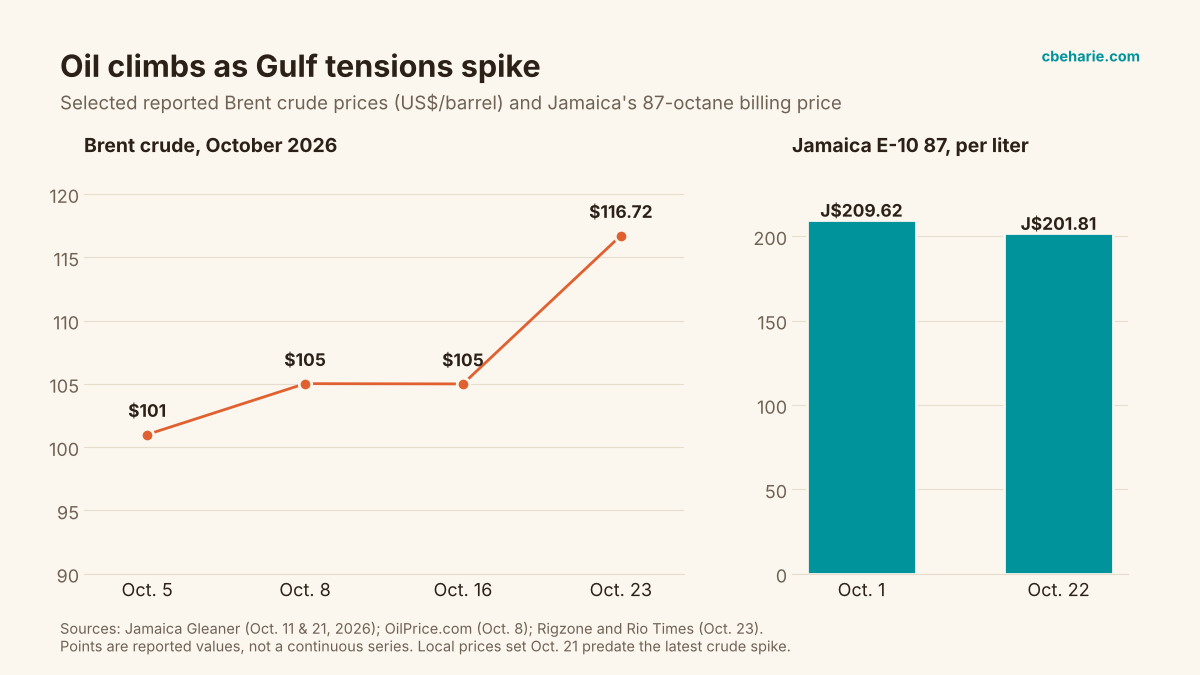
Markets reacted quickly. Brent crude, the international benchmark, settled at about US$116.72 per barrel on Friday, up roughly 3 percent on the day and its highest level in about six months, according to market reports. U.S. crude rose above US$100. Brent was around US$105 just a week earlier. The Houthi strikes reportedly hit targets including Aramco’s Shaybah oilfield and the Dammam airport, killing four people and wounding eight, and Aramco evacuated its Dhahran headquarters, according to market and news reports. Earlier this month, the International Energy Agency said it would soon decide how to release 100 million barrels of crude and fuel agreed by the G7, part of a larger emergency plan announced in March. Traders largely treated that release as already priced in.
Why it matters
The Strait of Hormuz is one of the most important shipping lanes on Earth, a narrow passage for a large share of the world’s seaborne oil. According to the UK Maritime Trade Operations center, October has seen the most reported attacks on commercial ships since the war’s opening weeks in March. Iran’s latest proposal would end the war and fully reopen the strait within a week if the United States meets several conditions, including lifting its blockade of Iranian ports. A deal along similar lines collapsed within days in June.
Politics adds to the uncertainty. Israel votes on Tuesday, October 27, and the U.S. midterm elections follow on November 3. U.S. Ambassador Mike Waltz has suggested the conflict could last another year, and the U.S. is sending a third aircraft carrier to the region. Iran’s foreign minister says Tehran remains open to diplomacy while ready to defend itself. Analysts quoted by Rigzone see a possible move toward US$120 if security worsens, or a pullback if diplomacy gains ground.
What it means for Jamaica
Jamaica relies on fossil fuels for nearly 90 percent of its energy consumption, so global oil prices flow into transport fares, electricity bills and food costs. For now, there is a lag. Petrojam’s billing price for E-10 87 gasoline actually fell this week, by J$4.50 to J$201.81 per liter, though diesel, kerosene and cooking gas rose. This week’s local prices were set before the latest jump in world crude, so the real test will come in the weeks ahead.
Petrojam general manager Danville Walker said earlier this month that he expects stable supplies through the end of the year, noting that Jamaica sources most of its fuel from outside the Middle East and that there will be no fuel shortage. Economist Keenan Falconer cautioned at the same forum that the full inflation effects of this year’s energy shocks may not show up until December or early 2027. Inflation stood at 7.9 percent through August. For a country rebuilding after Melissa, every extra dollar spent on fuel is a dollar not spent on roofs, roads and schools.
The diaspora angle
Jamaican families abroad feel this too. Higher fuel costs in North America and Europe squeeze household budgets, which can affect the remittances so many Jamaican homes rely on. Shipping a barrel home also gets more expensive when freight and fuel rise together.
What to watch next
Watch Tuesday’s Israeli election and any sign of a major new strike on Iran, the U.S. midterms, and whether mediators can restart formal talks. Closer to home, watch Petrojam’s weekly price announcements over the coming weeks and any government move to cushion consumers, such as adjustments to the fuel tax or targeted support.
5. Europe’s Deadliest Summer: 50,000 Heat Deaths in the Cities Studied
What happened
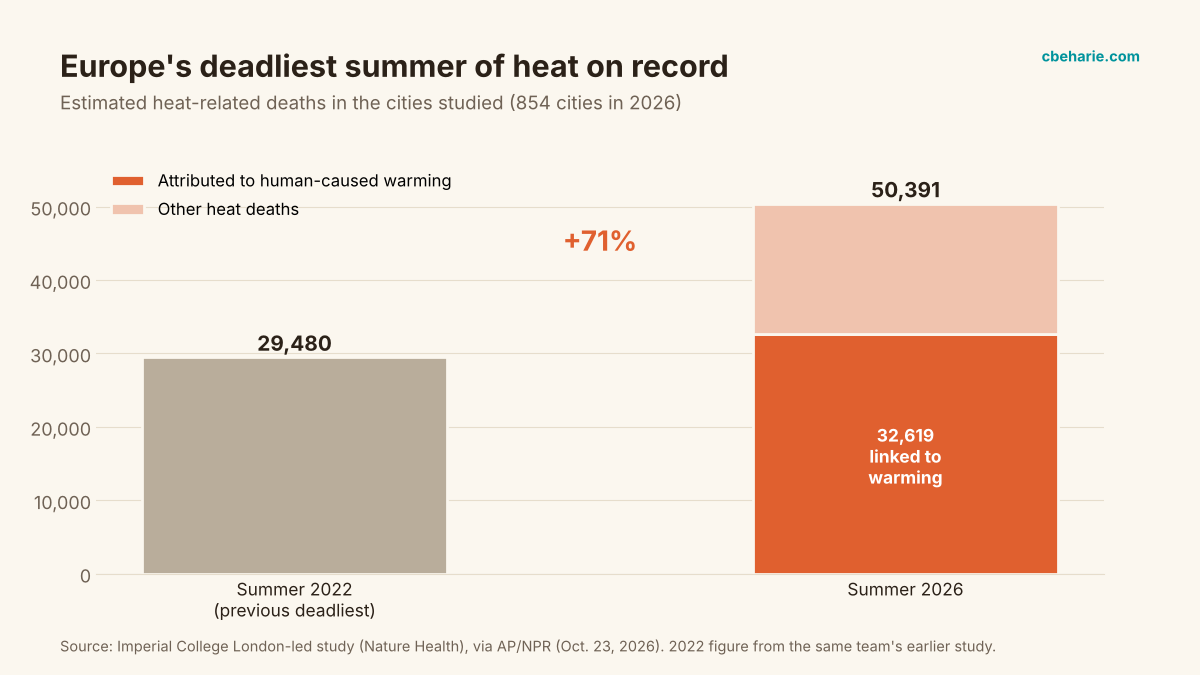
A new study led by researchers at Imperial College London estimates that heat waves across Europe this past June, July and August killed 50,391 people in the 854 cities analyzed. Of those deaths, 32,619, or about two-thirds, are attributed to the extra heat caused by burning fossil fuels. The study is due to appear in the journal Nature Health.
That toll is 71 percent higher than the previous deadliest summer recorded by the same team, 2022, when they estimated 29,480 heat deaths. The researchers say the true number is likely higher still, because the analysis excludes a deadly heat wave in May and covers only about 40 percent of Europe’s population, mostly in cities. Italy, France, Spain and Germany recorded the highest tolls, and some cities ran as much as 12 degrees Celsius (21.6 degrees Fahrenheit) above normal at times this summer. In the team’s earlier work covering 2000 to 2025, Rome had the highest heat death total of any European capital. Europe as a whole is now about 2.5 degrees Celsius warmer than in pre-industrial times. About a third of the deaths came during a single heat wave from June 17 to July 1, when temperatures ran 5.3 degrees Celsius (9.5 degrees Fahrenheit) above normal.
How scientists reached the number
Heat rarely appears on a death certificate, so researchers rely on statistical models that compare how many people die on hot days with what would be expected at a city’s ideal temperature for each age group. To measure the role of climate change, they simulated the same summer in a world without human-caused warming and compared the results. They checked their method against official data: for UK heat waves in May and June, they estimated about 2,700 excess deaths, close to the 2,800 reported by the UK Health Security Agency.
The study found that the share of heat deaths linked to warming has risen from about 45 percent in the early 2000s to about 65 percent now. More than half of those who died were 85 or older, but more than 800 were working-age adults between 20 and 44.
Different perspectives
Attribution science has become far more rigorous over the past decade, and this team’s methods have been used in peer-reviewed work before. Still, it is fair to note that these are modeled estimates rather than counted deaths, and that the exact figures depend on assumptions about baseline temperatures. The policy debate that follows such studies usually has two emphases. One stresses cutting emissions, since warming drives the rising share of deaths. The other stresses adaptation, from early-warning systems and cooling centers to better housing and checking on older people living alone, which can save lives whatever happens to emissions. In practice, most governments will need both.
Why it matters for Jamaica
Europe is warming faster than any other continent, but the lesson travels. Jamaica contributes only about 0.02 percent of historic global carbon emissions, yet it lives with coastal erosion, drought and storms like Melissa. A Gleaner editorial this week welcomed the government’s pledge to pass climate accountability legislation, while noting that the Auditor General found progress too slow. Renewables currently supply roughly 12 to 15 percent of Jamaica’s electricity, against a goal of 50 percent by 2030.
Heat is also a growing health risk in the Caribbean, especially for the elderly, outdoor workers and children in hot classrooms, as the parents at Holland Primary know well. For Jamaicans living in European cities, the study is a reminder to check on older relatives and neighbors when the next heat wave comes.
What to watch next
The next round of UN climate negotiations, regional climate finance discussions and Jamaica’s own climate accountability bill will show whether words turn into action. Small island states will once again argue that those who did least to cause the problem should not bear the heaviest cost.
Also on Our Radar
- Cuba at the UN: The General Assembly is expected to vote on October 27–28 on its annual resolution calling for an end to the U.S. embargo on Cuba, which passed 165 to 7 last year. Cuba’s foreign minister accuses Washington of pressuring countries with visa and trade threats; U.S. Ambassador Mike Waltz has urged members to vote no or abstain.
- Serbia votes Sunday: About 150,000 people rallied in Belgrade against longtime leader Aleksandar Vučić ahead of parliamentary elections that could decide whether his ruling party keeps control.
- Kenya and Ebola: Kenya has reported a second Ebola death, a story worth following closely.
Closing Reflection: Building on the Rock
Looking across today’s five stories, I keep coming back to a simple image that many of us learned in Sunday school: the wise builder and the foolish builder. Both houses faced the same rain, the same rising streams and the same winds. The difference was not whether the storm came, but what each house was built upon.
Jamaica knows storms. We have seen Melissa tear roofs from homes, and this week we watched the Plantain Garden River spill into Bath once more. Haiti knows a different kind of storm, the slow and grinding storm of insecurity. The world’s oil markets and Europe’s cities are facing storms of their own. None of us gets to choose whether hard times arrive. What we can choose is how we build, how we lead and how we care for those most exposed.
That is true for governments weighing travel budgets and reconstruction contracts, and it is true for each of us. Wise building looks like honesty about costs, patience with recovery done properly, and attention to the elderly neighbor in a heat wave or the child learning under a tarpaulin. It looks like generosity from the diaspora and steady prayer for those serving in dangerous places, including the four missing Salvadoran technicians and the Jamaicans serving alongside them in Haiti.
People of good faith will disagree on policy, and that is healthy. But we can agree that the foundation matters. As we approach the anniversary of Melissa this week, may we build, as families, communities and nations, on something that holds when the rain falls.
Walk good, and God bless. I will see you in the next briefing.
Sources
- Gov’t halts overseas travel for public officials until March 2027 – Jamaica Observer
- Moratorium on non-essential travel part of efficiency drive – Fitz-Henley – Jamaica Observer
- Opposition demands answers on Gov’t spending following ban on overseas travel – Jamaica Observer
- Western businesses urged to get aboard NaRRA train – Jamaica Gleaner
- Flash flood watch issued for eight parishes until Sunday – Jamaica Observer
- Residents in Bath, St. Thomas forced to evacuate following heavy rains – Jamaica Observer
- 63 schools rebuilt, 81 nearing completion, ministry reports – Jamaica Observer
- Temporary wooden classrooms under construction at Holland Primary – Jamaica Observer
- Bartlett leads Canada marketing blitz to convert 400,000 winter seats into bookings – Jamaica Observer
- Hurricane Melissa – Wikipedia (background facts)
- President launches mission to rescue four soldiers kidnapped in Haiti (AP) – Jamaica Gleaner
- El Salvador sends troops to Haiti to find 4 missing soldiers (AFP) – Jamaica Observer
- El Salvador’s Bukele threatens Haitian gangs over abducted soldiers – Al Jazeera
- JDF, JCF contingent deployed to Haiti to support fight against gangs – Jamaica Gleaner
- War fears grow as tankers hit in Strait of Hormuz (AP) – Jamaica Gleaner
- Oil hits $114 intraday – Rigzone
- Brent crude settles at US$116.72 – Rio Times
- WTI oil rises beyond $100 amid fresh concerns of supply disruptions – FXStreet
- Democracy Now! headlines, October 23, 2026
- Oil jumps as Iran steps up attacks on Hormuz tankers – OilPrice.com
- Gang Suppression Force – Wikipedia (background)
- Showdown as US and Cuba clash in UN headquarters – PassBlue
- Cuba accuses the US of threats ahead of UN embargo vote (Reuters) – BusinessDay
- Kenya reports second Ebola death – Jamaica Observer
- Gas prices down – Jamaica Gleaner
- Petrojam sees stable fuel prices through year-end – Jamaica Gleaner
- Europe’s heat claims 50,000 lives; climate change blamed for two-thirds of deaths (AP via NPR/KCSM)
- Editorial: Climate accountability – Jamaica Gleaner
All charts and graphics in this post are original works created for cbeharie.com. Wikimedia Commons could not be reached when this post was prepared, so no photographs are included.