
Good morning, and welcome to today’s briefing. It is Tuesday, October 27, 2026, and tomorrow marks one full year since Hurricane Melissa roared ashore in Westmoreland as a Category 5 storm. That anniversary frames much of what is happening at home: a hard-hitting new report on how relief money was handled, a public-sector travel freeze, and a prime minister due to speak to the nation’s press about spending discipline and getting things done faster.
But Jamaica’s week is bigger than one storm. The government has proposed raising the minimum sentence for illegal gun possession from 15 to 20 years, just as the country sits before a United Nations human rights panel in Geneva. Next door, Antigua and Barbuda is days away from hosting the Commonwealth Heads of Government Meeting, where Caribbean leaders want reparatory justice front and center while King Charles III is in the room.
Abroad, two stories dominate. In Washington, President Donald Trump says he is nearing a choice on Iran: a deal, or a return to large-scale strikes. Oil prices, and therefore what Jamaicans pay at the pump, hang on the answer. And in Brazil, Luiz Inácio Lula da Silva has won a historic fourth term after trailing in the first round, while his opponent, Flávio Bolsonaro, challenged the result.
Here are today’s top five, with the context you need, what to watch next, and what each story may mean for Jamaica and the diaspora.
1. Hurricane Melissa, one year on: rebuilding, relief and a hard look at delivery
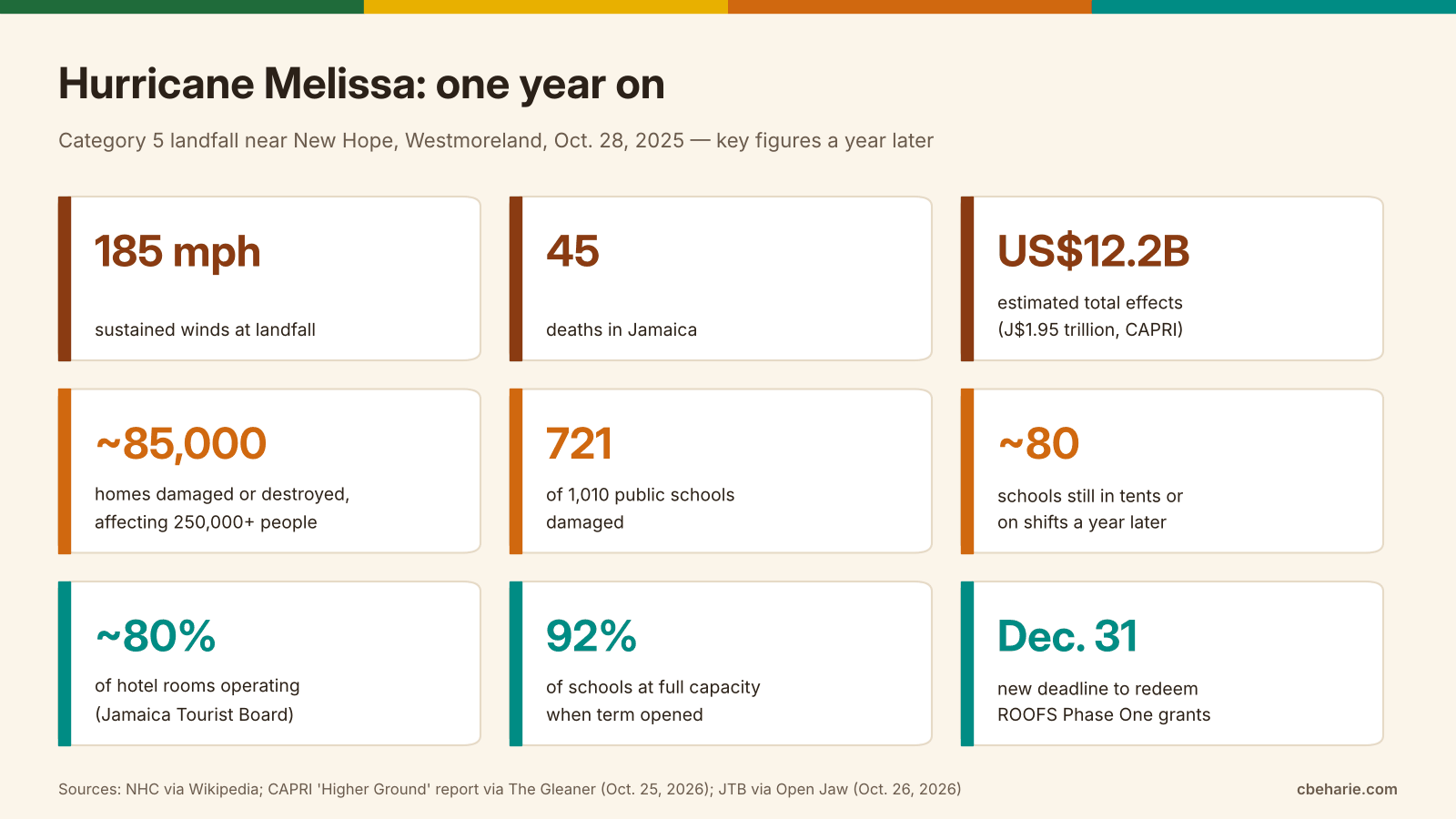
One year ago tomorrow, on October 28, 2025, Hurricane Melissa made landfall near New Hope in Westmoreland with sustained winds of about 185 mph, according to the U.S. National Hurricane Center’s figures as compiled on Wikipedia. Forty-five people died in Jamaica. Entire communities in the west and south lost roofs, crops, schools and livelihoods in a single afternoon.
What happened this week
As the anniversary approaches, the conversation has shifted from survival to scrutiny. The Caribbean Policy Research Institute (CAPRI) is launching a report titled Higher Ground: Lessons from Hurricane Melissa for Resilience, Relief, and Recovery on the anniversary itself at the Montego Bay Civic Centre. As The Gleaner reported, the think tank estimates Melissa’s total effects at J$1.95 trillion (about US$12.2 billion), making it the costliest disaster in Jamaica’s recorded history. Housing alone accounts for roughly J$687 billion in physical damage, with about 85,000 homes damaged or destroyed and more than 250,000 people affected.
CAPRI’s central argument is not that Jamaica failed to plan. In fact, the country’s disaster financing was well prepared. The problem, the report says, was speed: the systems needed to move money from the treasury to the people who needed it, such as reliable beneficiary records and vulnerability registers, either did not exist or did not work well enough.
The numbers behind the criticism
The most striking figure concerns cash donations. Of about J$1.4 billion received by the Office of Disaster Preparedness and Emergency Management (ODPEM), only J$26.2 million, or 1.8 percent, had been spent four months after the storm, and that figure was unchanged by early April. ODPEM has said it needed Ministry of Finance approval before spending; CAPRI notes that the agency did not seek approval for about J$500 million in shelter repairs until February 4, 2026.
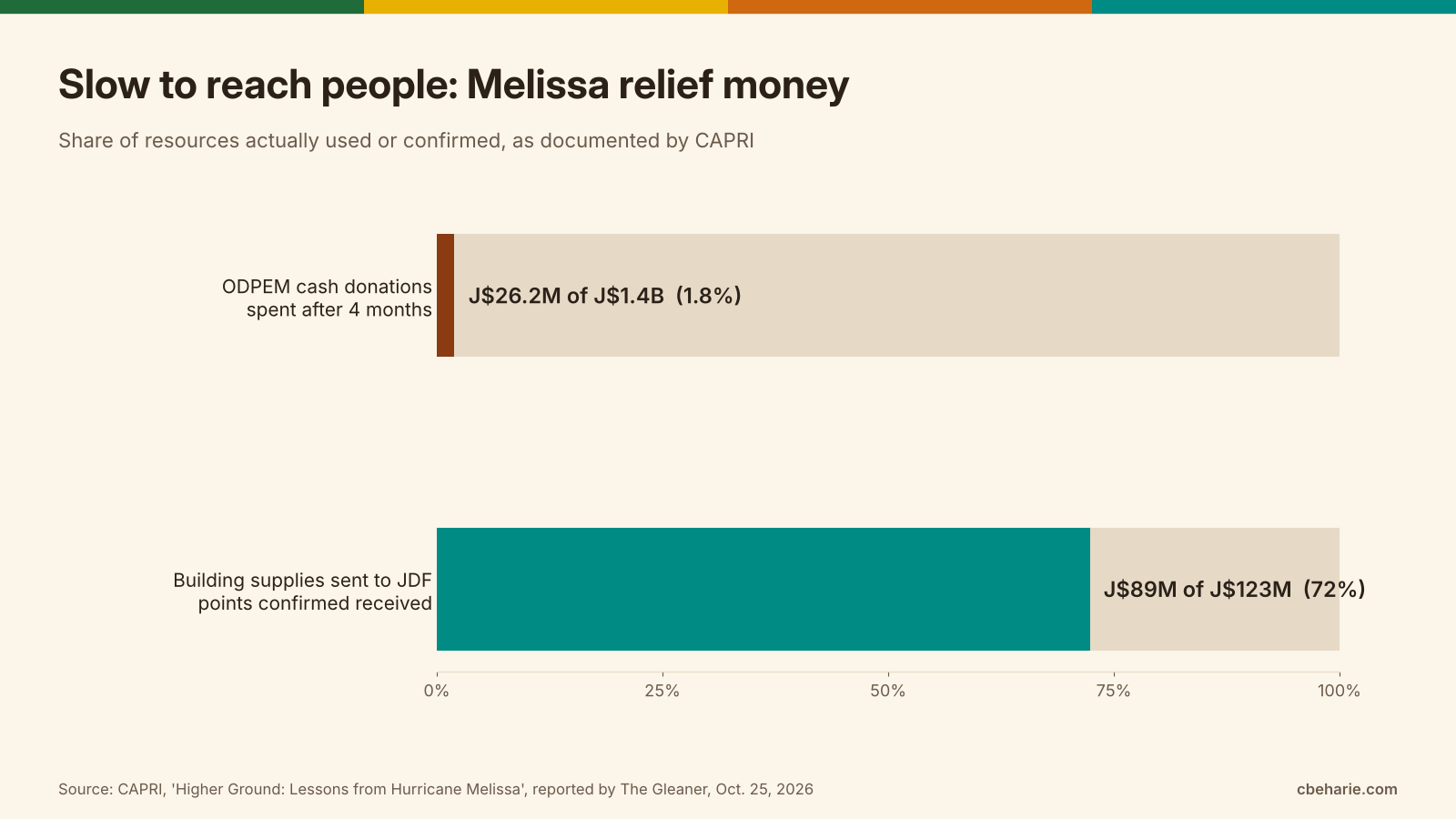
The report also raises procurement and accountability questions. Three of four roofing-materials contracts worth a combined J$167 million went to suppliers without valid procurement registration or current tax compliance certificates, reportedly justified under emergency rules. Of J$123 million in building supplies sent to Jamaica Defence Force distribution points, only J$89 million was formally confirmed as received. And while ODPEM reported 421 roofs repaired, the Auditor General’s Department could not obtain documents to verify that number.
The government’s flagship housing grant, the ROOFS program (Restoration of Owner-Occupied Family Shelter), has had its Phase One redemption deadline extended to December 31, 2026. The Ministry of Labour and Social Security says it has recorded 118,365 household assessments and identified 106,350 people needing support, including 49,002 ROOFS beneficiaries. What remains unclear is how many of those grants have actually been collected and turned into finished roofs.
Schools, churches and the tourism engine
Melissa damaged 721 of Jamaica’s 1,010 public schools. The Ministry of Education reports that 92 percent of schools were operating at full capacity when the new school year opened, yet CAPRI says roughly 80 schools are still running in tents or on shift schedules. At the peak of the crisis, more than 532,000 Jamaica Public Service customers, about 77 percent, lost electricity.
Faith communities are carrying their own burdens. The Gleaner’s “Melissa 365” report found that 54 United Church congregations were damaged and eight sanctuaries destroyed. Rev. Norbert Stephens told the paper the denomination has deliberately placed rebuilding church buildings last, behind farmers, families and livelihoods, with congregations worshipping in halls and on verandas in the meantime. He also highlighted a quiet barrier to recovery: many survivors cannot qualify for housing help because family land is still registered to relatives who died generations ago.
Tourism, the island’s economic engine, is recovering faster. The Jamaica Tourist Board says about 80 percent of hotel rooms are operating, more than 2.34 million stopover and cruise visitors arrived from January through August, and 400,000 airline seats are scheduled from Canada this winter, as Open Jaw reported. Tourism Minister Edmund Bartlett told travel advisors in Toronto that Jamaica is “bouncing forward.”
Why it matters, and what to watch
The government is also tightening its own belt. Late last week, it imposed a moratorium on non-essential official overseas travel across the public sector until March 31, 2027, with exceptions for Melissa recovery, national security, essential tourism promotion and genuine emergencies, according to the Jamaica Observer. Prime Minister Andrew Holness is scheduled to brief the press today on efficiency and faster delivery of national priorities, as Irie FM noted.
Supporters will see the travel freeze as a sign that the government hears public frustration and is redirecting resources to recovery. Critics will ask whether the deeper problems CAPRI describes, such as slow approvals, weak records and unclear accountability, can be fixed by cutting trips. Both questions are fair. Watch for three things in the coming days: what the prime minister announces today, how the government responds to CAPRI’s findings, and whether the ROOFS grant numbers become public. For families in St. Elizabeth and Westmoreland, and for the diaspora members who sent money and materials home, transparency about where help went is not a political point. It is a matter of trust.
2. Tougher gun laws meet a UN human rights review
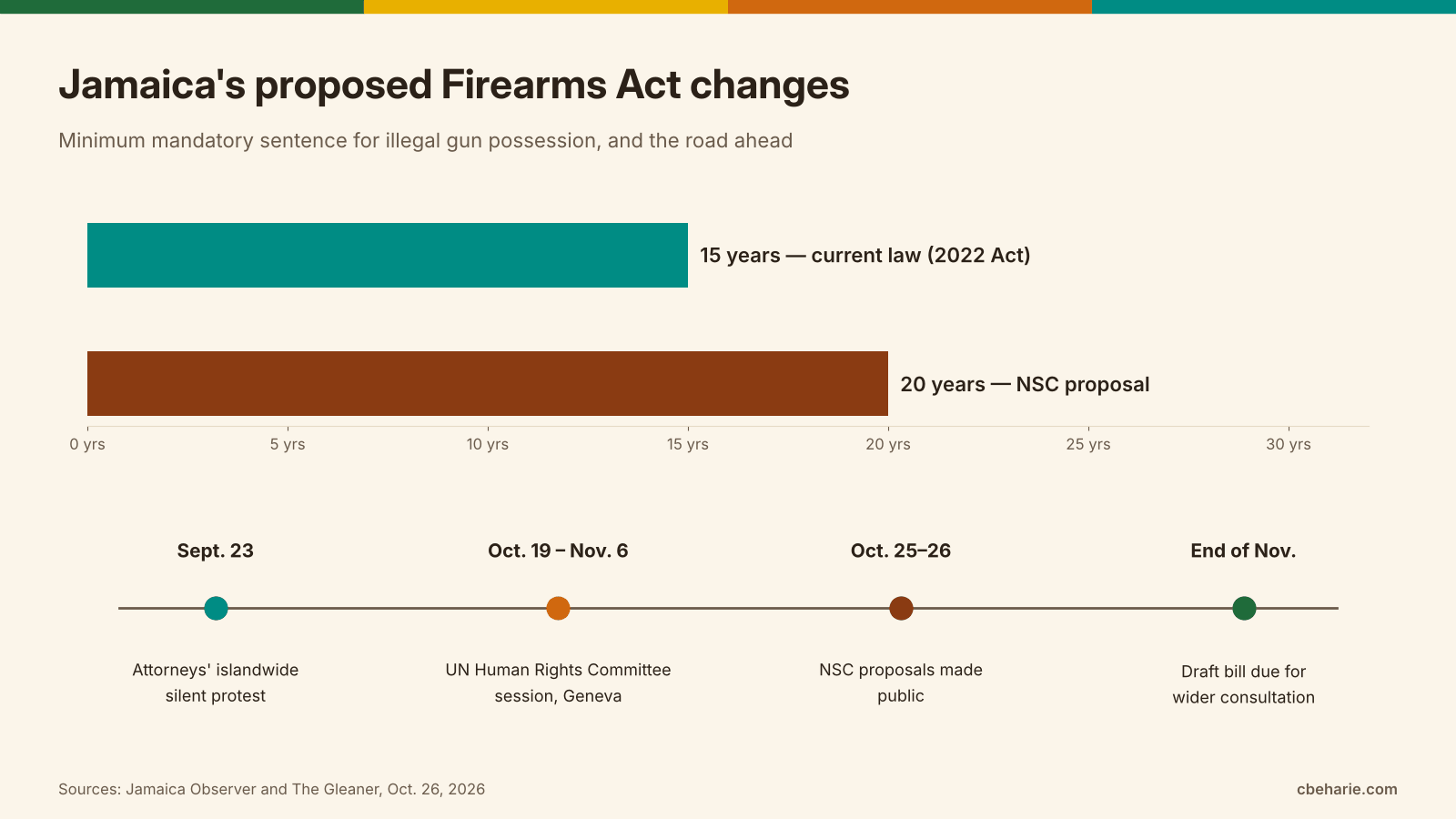
Jamaica’s National Security Council (NSC) has recommended raising the mandatory minimum sentence for illegal possession of a firearm from 15 years to 20 years, the Jamaica Observer reported on Monday. The package also proposes a brand-new criminal offense targeting adults who groom children to use, store, transport or acquire illegal guns, closing a gap that gangs have exploited to recruit minors.
What the government proposes
Beyond the longer sentence and the child-grooming offense, the NSC wants further thought given to how cases involving children found with guns are handled, clearer rules distinguishing toy guns from realistic imitation firearms, and a review of firearms whose licenses have expired. Before any new penalties take effect, the government plans a gun amnesty and cash buy-back program so people holding illegal weapons can surrender them. The Ministry of National Security has been told to have draft legislation ready by the end of November for wider consultation.
Prime Minister Holness, who chairs the NSC, said the changes would strengthen the law while keeping it fair, and that the government will not allow criminals to put guns in children’s hands. Justice Minister Delroy Chuck said in September that mandatory minimums would be reviewed but were unlikely to be repealed, because security forces credit the 2022 Firearms Act with a sharp fall in murders and shootings.
The case against
The Advocates’ Association of Jamaica sees it differently. As The Gleaner reported, the association’s president, Tamika Harris, argues the proposal raises serious constitutional concerns. She points to the Privy Council’s Tafari Morrison decision, which recognized that mandatory sentences can in some cases be inhumane or degrading, and to the Charter of Fundamental Rights and Freedoms, which bars such punishment. Her association wants any mandatory minimum to include a “fail-safe” clause preserving a judge’s discretion in exceptional cases.
Defense attorneys also say rigid minimums discourage guilty pleas, because accused persons see little benefit in pleading early. Attorneys held an islandwide silent protest on September 23 and scaled back services over the issue. Government senator Charles Sinclair has publicly rejected the claim that the Firearms Act leaves no room for plea bargaining, and child advocacy group Fi We Children has urged a child-centered approach to the amendments, according to separate Observer reports.
Harris was careful to say attorneys are not downplaying gun crime. Their concern, she explained, is that real firearms and imitation firearms should be treated separately, so that children at play are not swept into the criminal system, and that courts need room to tell a hardened gunman from a first-time, low-level offender. The wider debate is also touching licensed guns: one private investigator has called for psychiatric evaluations of firearm license applicants, the Observer reported, a sign of how broad the conversation about gun safety has become.
The Geneva backdrop
The timing is notable. Jamaica is under review by the UN Human Rights Committee, whose 146th session runs in Geneva from October 19 to November 6; the country was last reviewed in 2016. Jamaicans for Justice and five other groups have asked the committee to press Jamaica to let judges depart from mandatory minimums when justice requires it.
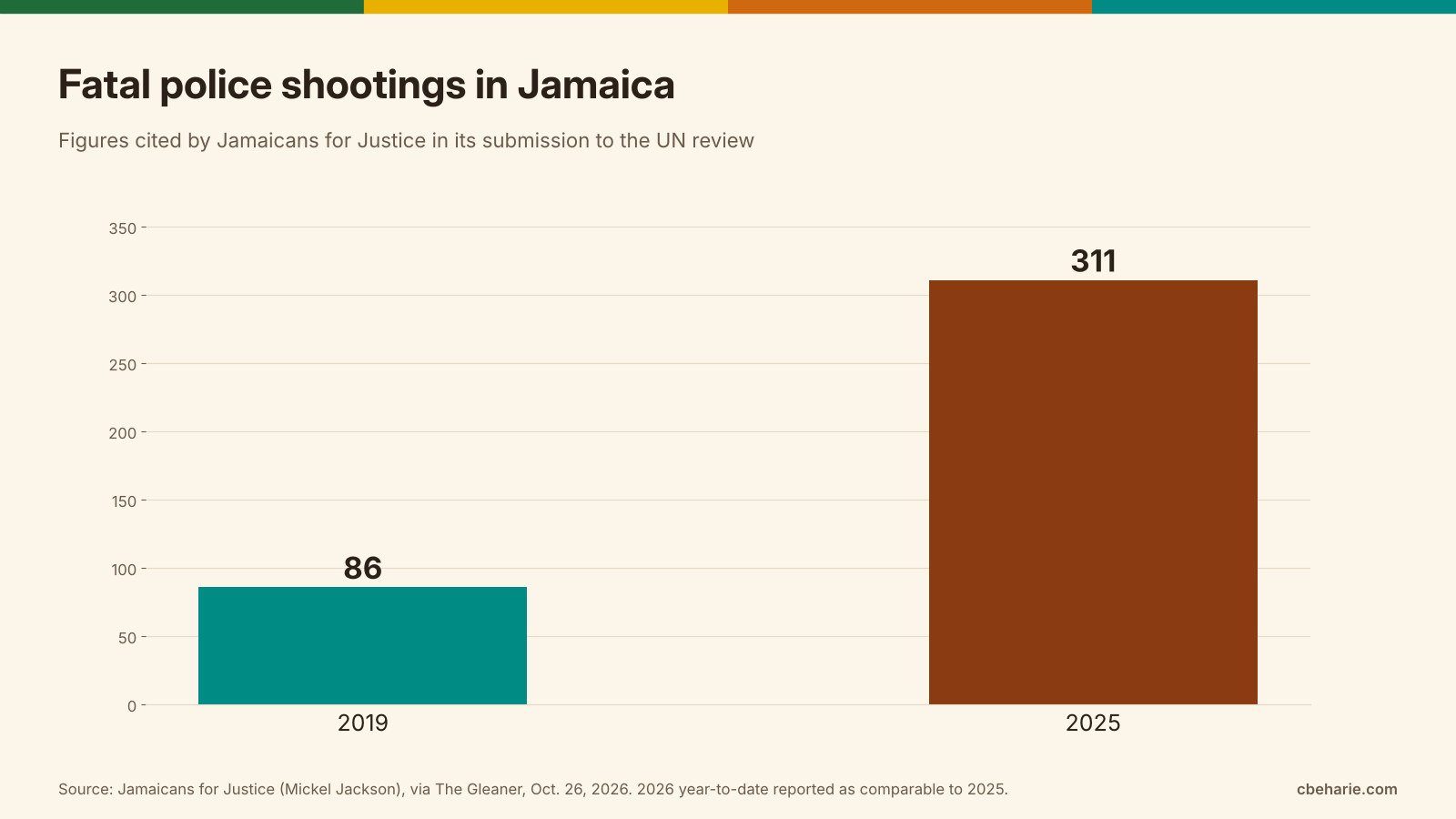
The groups also raised police use of force. Jamaicans for Justice executive director Mickel Jackson said fatal police shootings fell to 86 in 2019 but rose to 311 in 2025, with 2026 on a similar pace so far. He stressed that the groups are not claiming every fatal encounter was unlawful, but they want body-worn cameras and stronger accountability. The coalition also renewed a call, first made in 2016, to fully fund the Office of the Public Defender and expand it into a national human rights institution, something the government had committed to examine. Jackson also credited real progress since 2016, including the Integrity Commission Act, the child diversion law and falling homicides.
Why it matters
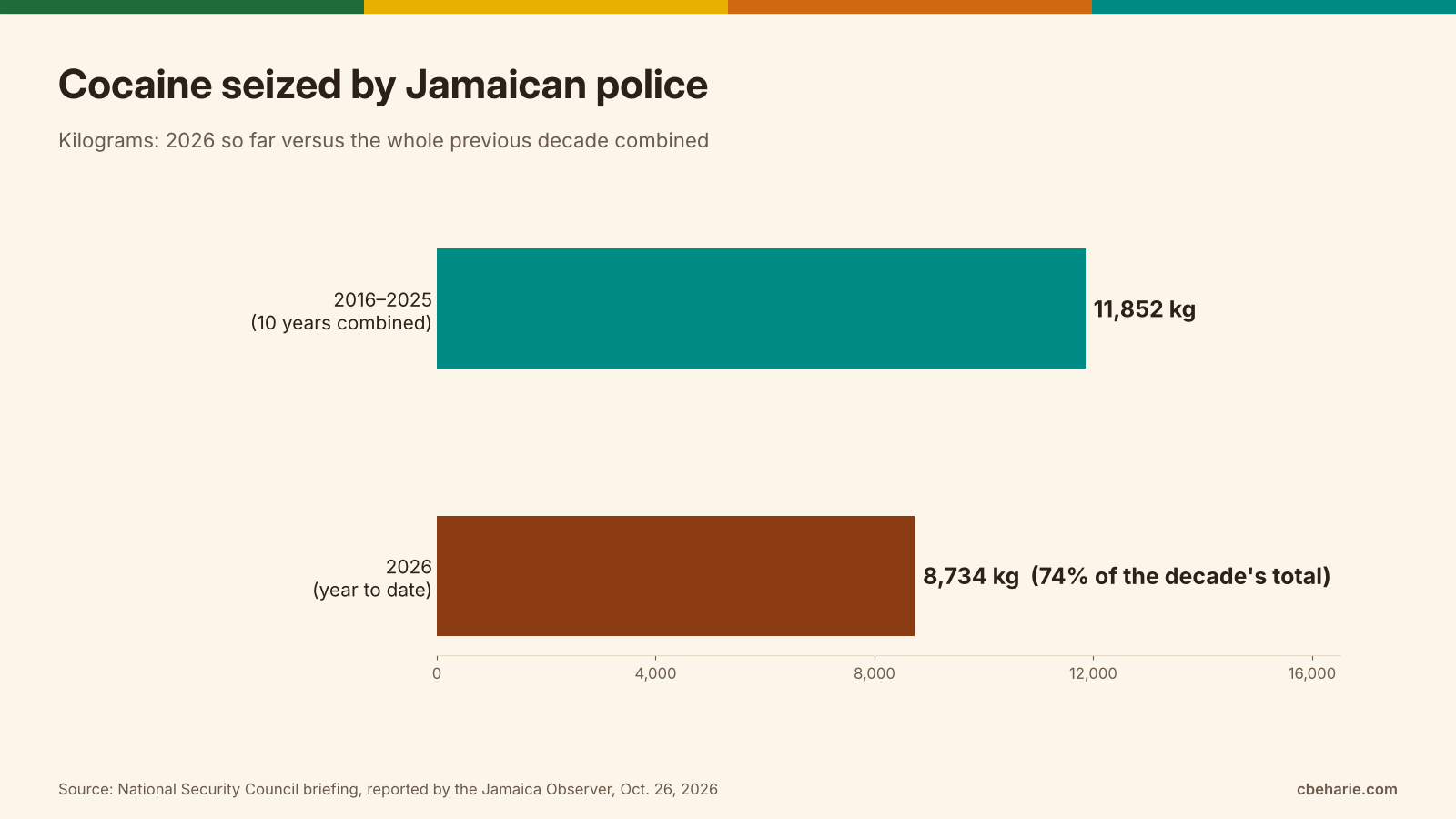
Behind the legal debate sits a real security picture. The police have seized 8,734 kilograms of cocaine so far in 2026, equal to 74 percent of everything seized in the previous ten years combined, and the NSC warned that U.S. operations closing other routes in the region could push traffickers toward Jamaica as a transshipment point. Drugs and guns travel together.
This is the heart of the dilemma. Many Jamaicans, especially in communities that have buried young people, want the strongest possible deterrent. Others, including lawyers and rights advocates, worry about innocent or marginal defendants, overcrowded prisons and the loss of judicial discretion. Both sides want fewer guns on the streets. What to watch: the draft bill at the end of November, the UN committee’s concluding observations after its session ends on November 6, and whether a judicial safety valve makes it into the final law.
3. CHOGM in Antigua: reparations and the Caribbean’s moment on the world stage
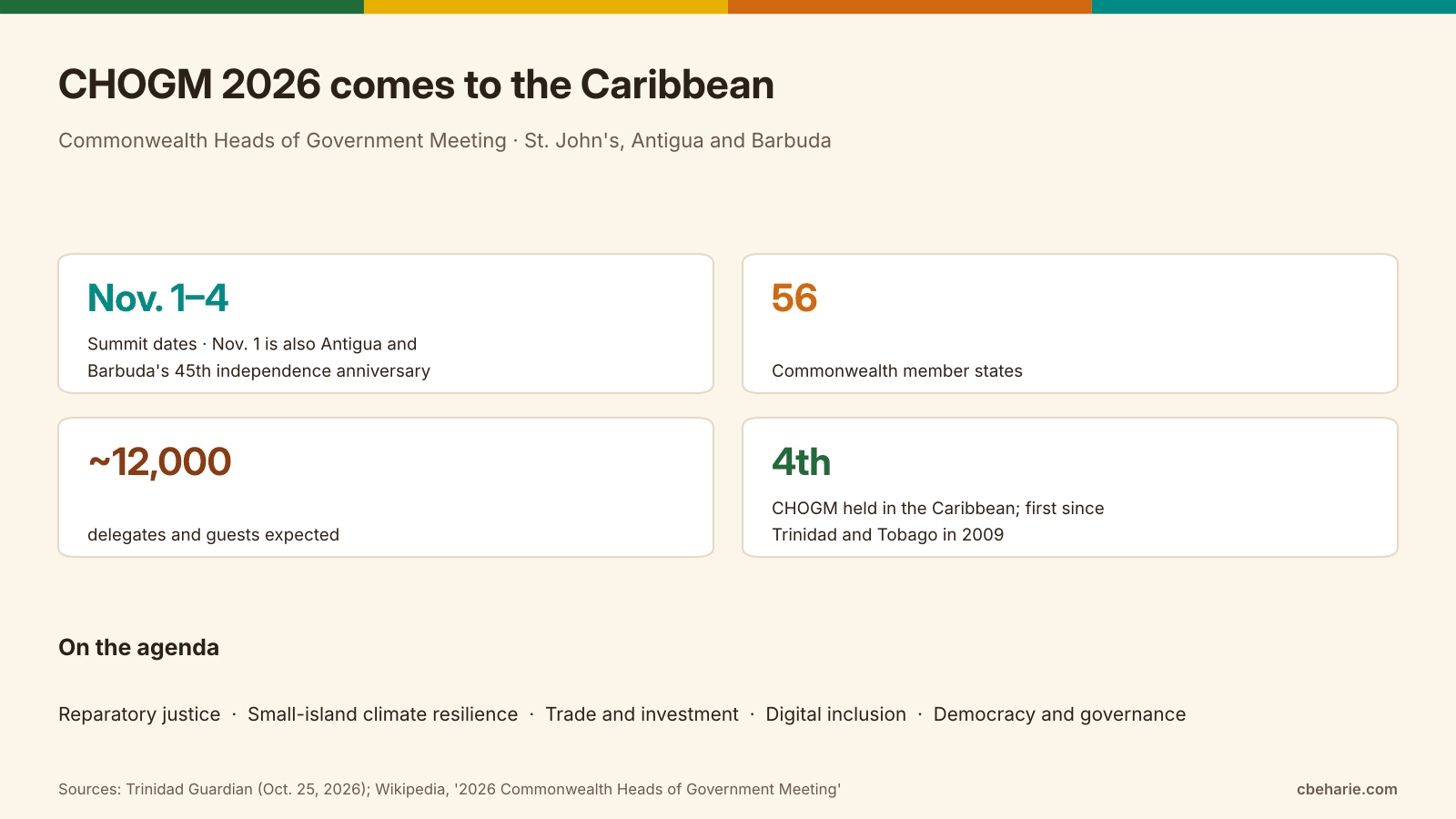
From November 1 to 4, St. John’s, Antigua and Barbuda, will host the Commonwealth Heads of Government Meeting, known as CHOGM. Leaders and representatives of the Commonwealth’s 56 member states are expected, along with King Charles III and Queen Camilla. It is the fourth CHOGM held in the Caribbean and the first since Trinidad and Tobago hosted in 2009, according to the Trinidad Guardian. Opening day also marks Antigua and Barbuda’s 45th anniversary of independence.
What is on the table
The official theme is “Accelerating Partnerships and Investment for a Prosperous Commonwealth.” The agenda covers climate resilience for small island developing states, trade and investment through the Commonwealth Business Forum, digital inclusion, and democracy and governance. It is also the first summit for Secretary-General Shirley Ayorkor Botchwey of Ghana, who took office in April 2025. Organizers expect about 12,000 delegates and guests, roughly four times the crowd at the 2024 small-island states conference Antigua hosted. Foreign Minister Chet Greene has been holding televised town halls on traffic, flights and emergency planning.
For Antigua and Barbuda, the summit is also an economic bet. The government says it wants benefits that outlast the week, beyond the immediate boost to hotels, restaurants and taxi operators. Alongside the leaders’ sessions, the program includes business, youth, women’s and people’s forums, giving civil society and entrepreneurs from across the Commonwealth a seat near the table. The King’s Caribbean itinerary will also take him to The Bahamas and to Guyana for a state visit, according to Elizabeth Morgan’s column in The Gleaner.
Reparations at the center
For the Caribbean, the headline issue is reparatory justice. CARICOM leaders have pushed since the 2024 summit in Samoa to put reparations for transatlantic slavery firmly on the agenda, and Caribbean and African representatives endorsed a 19-point reparations plan in June, according to the summit’s Wikipedia entry. Sir Hilary Beckles has asked King Charles to support reparations talks; Buckingham Palace has said the King will not issue a formal apology for Britain’s role in the slave trade. CARICOM’s Reparations Commission has also urged the decolonization of territories still governed from abroad.
Host prime minister Gaston Browne has called for a framework to address reparations, and Gleaner columnist Elizabeth Morgan notes he may have a delicate balancing act as both host and advocate. Morgan also reports that UK Prime Minister Andy Burnham will attend his first CHOGM. Another sensitive matter may surface privately: Canada, Australia and New Zealand have backed removing Andrew Mountbatten-Windsor from the line of succession, though that was not among the summit’s announced priorities.
Jamaica’s angle
Jamaica is one of 15 Commonwealth realms with King Charles as head of state, and it hosted CHOGM in 1975. Prime Minister Holness spoke about reparatory justice in his Heroes Day address earlier this month. There is one open question at home: the new travel moratorium allows standing multilateral engagements, and the Observer’s summary said Jamaica will be represented, but its sources also suggested CHOGM may not fall under the exceptions. Clarity on Jamaica’s delegation is worth watching, perhaps at today’s press briefing.
The Commonwealth tie runs deep in Jamaican life beyond politics. The island hosted the Commonwealth Games in 1966, and Jamaican athletes won 19 medals at this year’s Games in Glasgow. For many in the diaspora, especially in Britain and Canada, the Commonwealth is less an abstraction than a family map: grandparents who sailed to England, cousins in Toronto, and shared institutions from the courts to the classroom. How the summit handles reparations will be watched closely in those communities, too.
Why it matters: for small states, CHOGM is one of the few rooms where they sit as equals with Britain, Canada, India and Australia. Supporters of reparations see a historic opening, with the summit on Caribbean soil and the monarch present. Opponents of reparations have long argued that today’s governments and taxpayers should not be held liable for historic wrongs, and some prefer development partnerships to compensation. Expect careful diplomatic language in the final communiqué. Whether it contains a concrete process, such as a dialogue mechanism or a timetable, will tell us how far the conversation has moved since Samoa.
4. Trump’s Iran “decision time” and what it could mean at the pump
The United States and Iran are again at a crossroads. In a Fox News interview on Sunday, President Trump said it is “getting to be decision time” on whether to make a deal with Tehran or resume attacks, according to a 24NewsHD report. He framed the choice as finishing the job or reaching an agreement, said the U.S. now controls the Strait of Hormuz, and called higher gasoline prices a small price to pay to keep Iran from getting a nuclear weapon.
How we got here
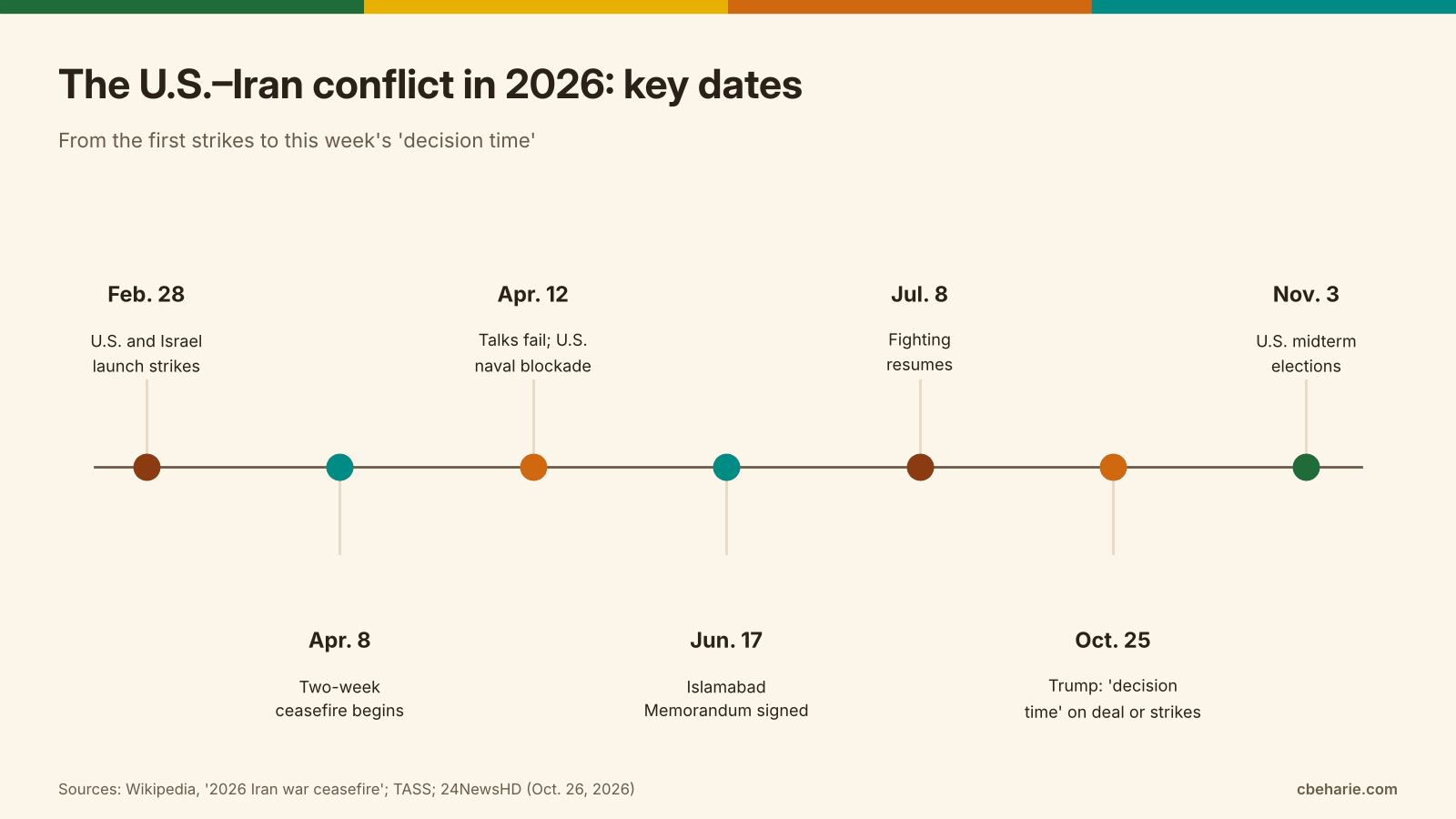
The war began on February 28, when the United States and Israel launched airstrikes on Iran. A two-week ceasefire took effect on April 8; after talks in Islamabad collapsed on April 12, Washington imposed a naval blockade on ships entering and leaving Iranian ports. On June 17 the two sides signed the Islamabad Memorandum, setting a 60-day window to negotiate a final deal, but fighting resumed on July 8 amid renewed attacks, according to the Wikipedia timeline and TASS. The Strait of Hormuz, a chokepoint for roughly a quarter of the world’s oil supplies, remains effectively closed.
The latest moves
Pressure is building on both sides. Trump has hinted at renewed strikes after the November 3 U.S. midterm elections and has sent more military assets to the region, including a third carrier group. Market newsletter Newsquawk summarized a CNN report that U.S. forces could launch major strikes within 96 hours of an order, with an expanded target list that includes energy and economic infrastructure. A U.S. intelligence memo reportedly found that Iran has stepped up efforts to target American diplomats, and the State Department is reducing staff at several embassies in the region.
Diplomacy is not dead. Qatari mediators arrived in Tehran on Sunday, and officials from Saudi Arabia, Turkey and Pakistan were expected there on Monday. Iran’s foreign minister, Abbas Araghchi, has floated a seven-day plan to reopen Hormuz, conditional on an end to U.S. military action and sanctions, while a parliamentary spokesman said talks are meaningless until Iran’s seven conditions are met. Tehran also denied reports that it had offered to reopen the strait in exchange for lifting the blockade. Trump, for his part, told reporters on Saturday that a strike might come as soon as the next day, while also holding out the possibility of a large agreement. He also claimed the U.S. has destroyed every Iranian fighter jet and sunk 259 ships, figures that have not been independently verified. Meanwhile, Israeli Prime Minister Benjamin Netanyahu has said Israel will strike Iran again, and Yemen’s Houthis claimed new attacks on Saudi oil infrastructure, claims Saudi Arabia had not confirmed.
The Jamaica connection: oil, prices and the household budget
Jamaica imports its fuel, so a war thousands of miles away shows up in Kingston’s taxi fares and electricity bills. On Monday morning, the Brent benchmark for January delivery traded around $109 to $111 a barrel, down slightly on the day, with U.S. crude near $101 to $103; a separate Brent quote cited by Bloomberg slipped below $116 after hitting a six-month high last week.
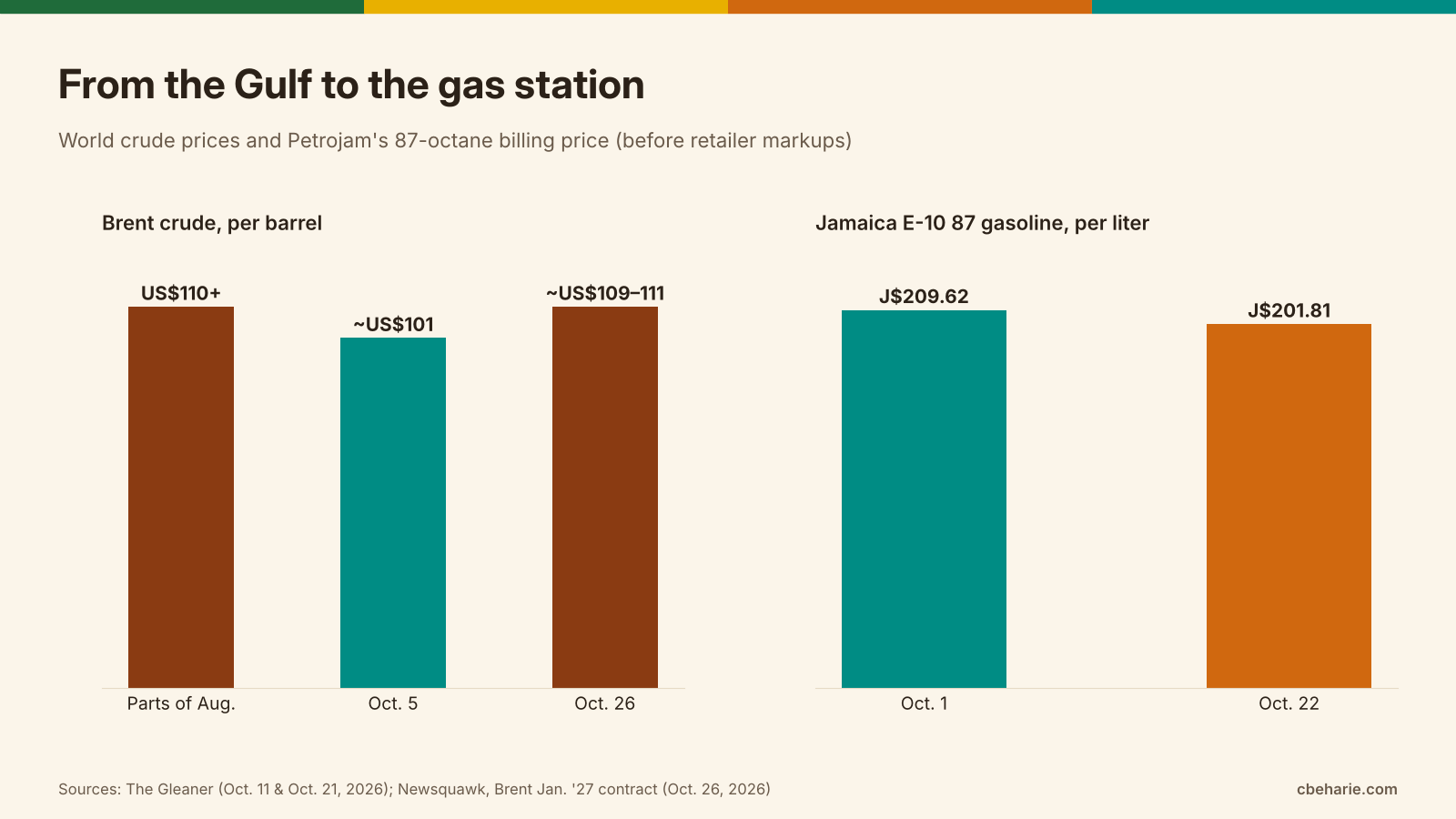
There is some cushion. Petrojam general manager Danville Walker told a business conference earlier this month that he expects stable supplies and contained price movements through year-end, barring major new unrest in the Middle East, as The Gleaner reported. Petrojam’s billing price for E-10 87 gasoline fell to J$201.81 per liter last week, though diesel and cooking gas rose. But economist Keenan Falconer cautioned that the full inflationary effects of the spring shock may surface between December and early 2027, and inflation had already reached 7.9 percent in August.
The longer view is sobering. International Energy Agency chief Fatih Birol sees no credible path for energy markets to return to pre-war levels in 2027, according to Newsquawk’s summary, and European natural gas prices are climbing toward 100 euros per megawatt-hour as winter approaches. For import-dependent island economies, that means fuel, freight and food costs are likely to stay elevated for some time, whatever happens in the next few weeks.
Why it matters: a deal could reopen Hormuz and ease prices worldwide; renewed strikes, especially on energy infrastructure, could send them sharply higher. Hawks argue that only maximum pressure will stop Iran’s nuclear ambitions; critics warn of a wider regional war and a heavy toll on civilians and on the global economy. What to watch: any announcement from the White House after the midterms, the outcome of the mediation in Tehran, and next week’s Petrojam price notice.
5. Brazil’s Lula wins a fourth term in a historic comeback
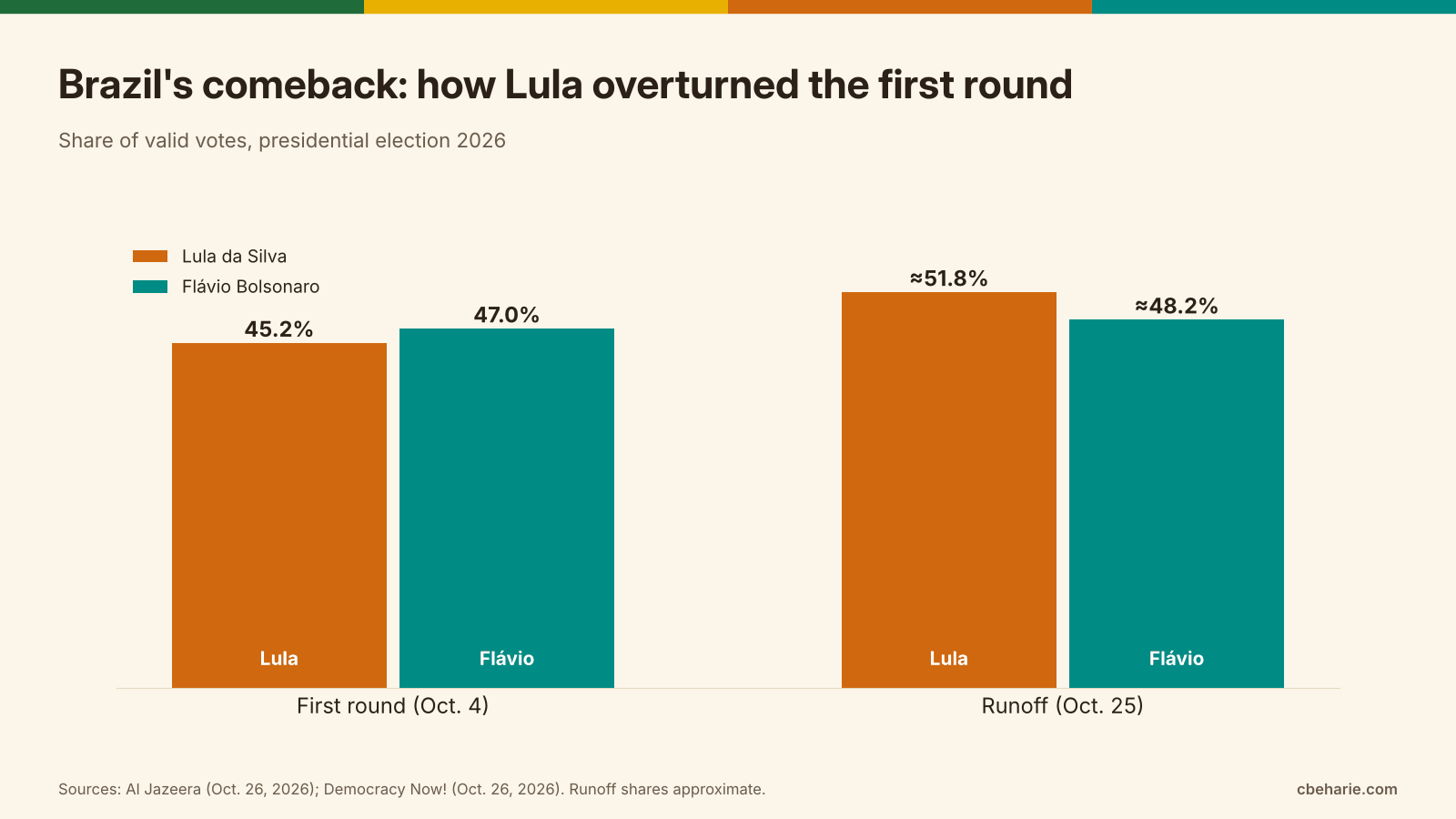
Luiz Inácio Lula da Silva has been elected president of Brazil for a fourth, non-consecutive term, defeating Senator Flávio Bolsonaro, son of former president Jair Bolsonaro, in Sunday’s runoff. With all votes counted, Lula led by nearly 4.4 million votes, PBS NewsHour reported, taking roughly 51.8 percent of the vote according to Democracy Now!. His new term begins on January 5, 2027.
A comeback with no modern precedent
Three weeks earlier, Lula had trailed. In the October 4 first round, Flávio Bolsonaro took 47.03 percent to Lula’s 45.16 percent, a gap of about 2.2 million votes, according to Al Jazeera. No modern Brazilian candidate had finished second in the first round and then won the runoff. About 21 percent of eligible voters stayed home in the first round, and pollster Andrei Roman of AtlasIntel suggested lower abstention in the runoff helped Lula. Lula’s team refocused on young voters, the cost of living, a promise of free weekend public transport, and a message about defending Brazil’s sovereignty against outside pressure, including U.S. tariffs.
Lula, now 80, is a former union leader who founded the Workers’ Party, served two terms from 2003 to 2010, spent 580 days in prison on a corruption conviction that was later annulled, and narrowly defeated Jair Bolsonaro in 2022. This is expected to be his final campaign.
A disputed night
Election day was messy. Supreme Court Justice Cristiano Zanin extended voting by two hours minutes before polls were due to close, after requests from both campaigns: Lula’s side cited bus disruptions in São Paulo and Salvador, and Bolsonaro’s side cited heavy rain in the south. Some polling stations had already closed. Flávio Bolsonaro then said he could not recognize the result and pledged to seek its annulment, accusing Zanin, a former Lula lawyer, of changing the rules mid-game. By Monday, The Washington Post was reporting that he had effectively conceded. Federal police are separately investigating alleged transport disruptions in five states. In Minas Gerais, 349 polling locations lost power, though voting machines ran on backup batteries, and a court in Salvador ordered the arrest of the city’s transport secretary. Bolsonaro has also called for court reform and constitutional changes, framing his challenge as a fight over the judiciary’s role in Brazilian democracy.
The world reacts
Congratulations came quickly from Mexico’s Claudia Sheinbaum, Chile’s José Antonio Kast, Canada’s Mark Carney, the European Commission, China and Russia, among others, Al Jazeera reported. Cuba’s Miguel Díaz-Canel called the result historic. President Trump did not name a preferred candidate during the race, saying only that Washington was watching, while Donald Trump Jr. criticized the extended voting hours. Al Jazeera also cited a Reuters report that some State Department officials had pushed for sanctions against Brazil to weaken Lula during the campaign, a reminder of how closely Washington was watching.
Why it matters for the region
Brazil, with a roughly $2.6 trillion economy, is Latin America’s largest, and the result breaks a recent run of right-leaning, Trump-aligned victories across the hemisphere. Lula’s supporters see a defense of democratic institutions and social programs; his critics see an aging leader, unresolved corruption questions and a judiciary they believe tilted the playing field. Both views are widely held in a deeply divided country.
Lula’s to-do list is long: the cost of living, the future of his signature social programs, relations with a Trump administration that has imposed tariffs on Brazil, and the task of governing a country in which nearly half the electorate voted against him. He joins Trump and Nicaragua’s Daniel Ortega, both also 80, as the oldest presidents in the Americas.
For the Caribbean, a stable Brazil matters: it is the hemisphere’s southern giant and a direct neighbor to CARICOM members Guyana and Suriname. What to watch: whether any court challenge goes forward, how Washington formally responds, and whether Lula’s fourth term brings closer South-South ties with CARICOM.
Closing reflection: building back lives, not just roofs
Read together, today’s stories share a common thread: the gap between what is promised and what is delivered. A year after Melissa, many Jamaicans still wait for the roof, the grant or the classroom. Lawmakers promise safer streets, and advocates ask that justice remain just. Commonwealth leaders will speak of partnership and repair. Superpowers weigh war and peace while ordinary families feel it in the price of bread and bus fare. And a divided Brazil has chosen its leader, with half the country disappointed.
The prophet Micah’s question still cuts through the noise: what does the Lord require, but to do justice, to love mercy and to walk humbly? Those three words, justice, mercy and humility, do not belong to any one party. They ask public officials to account honestly for every dollar given in love, and they ask all of us to hold firm convictions while listening to those who see things differently.
Rev. Norbert Stephens put his church’s buildings last on the rebuilding list, behind people. That is a quiet sermon in itself. As we mark the anniversary tomorrow, let us remember the 45 lives lost, pray for the families still rebuilding, support the organizations doing the slow work in our communities, and keep asking the hard questions with grace. Jamaica bent; it did not break. The work now is to make sure no one is left behind as we rise.
Walk good, and God bless.
Sources
- Jamaica Observer: Government clarifies travel ban (Oct. 24, 2026)
- Irie FM: PM Holness to address government efficiency, spending controls at press briefing Tuesday (Oct. 23, 2026)
- The Gleaner: Melissa relief under scrutiny (Oct. 25, 2026)
- The Gleaner: Melissa 365, “We want to build back lives” (Oct. 26, 2026)
- Open Jaw: Jamaica “bouncing forward” after Hurricane Melissa (Oct. 26, 2026)
- Wikipedia: Hurricane Melissa
- Nationwide 90FM: Melissa tested, but didn’t break Jamaicans, PM says (Oct. 20, 2026)
- Jamaica Observer: Tougher gun laws (Oct. 26, 2026)
- The Gleaner: Jamaica faces UN scrutiny; advocates say proposed gun sentence hike a step in the wrong direction (Oct. 26, 2026)
- Jamaica Observer: Sinclair rejects claims that plea bargaining is absent from Firearms Act (Oct. 26, 2026)
- Jamaica Observer: Fi We Children urges child-centered approach to proposed Firearms law amendments (Oct. 26, 2026)
- Trinidad Guardian: Antigua CHOGM big on small states’ concerns (Oct. 25, 2026)
- Wikipedia: 2026 Commonwealth Heads of Government Meeting
- The Gleaner: Elizabeth Morgan, Major upcoming events (Oct. 14, 2026)
- Jamaica Observer: Holness talks reparatory justice, Melissa recovery and NaRRA in Heroes Day address (Oct. 19, 2026)
- 24NewsHD: Trump says “deal or finish it off” decision nearing on Iran (Oct. 26, 2026)
- TASS: Trump says choosing between making deal with Iran and “finishing it off” (Oct. 25, 2026)
- Newsquawk: Daily US Opening News (Oct. 26, 2026)
- Wikipedia: 2026 Iran war ceasefire
- The Gleaner: Petrojam sees stable fuel prices through year-end (Oct. 11, 2026)
- The Gleaner: Gas prices down (Oct. 21, 2026)
- PBS NewsHour: Lula beats Bolsonaro in Brazil runoff, securing fourth presidential term (Oct. 25, 2026)
- Democracy Now!: Headlines for October 26, 2026
- Al Jazeera: Brazil election results 2026, key takeaways from Lula’s historic win (Oct. 26, 2026)
- Al Jazeera: World reacts to Lula’s victory (Oct. 26, 2026)
- The Washington Post: Brazilian challenger effectively concedes defeat day after election (Oct. 26, 2026)
All charts and graphics in this post are original works created for cbeharie.com.