

Good morning, and welcome. It is Thursday, October 22, 2026, and the stories shaping our day stretch from a palace outside St. Petersburg to a flooded cul-de-sac in Montego Bay. As always, we have sifted the headlines to bring you the five that matter most for Jamaica, the Caribbean and the wider world, with the context you need to make sense of them.
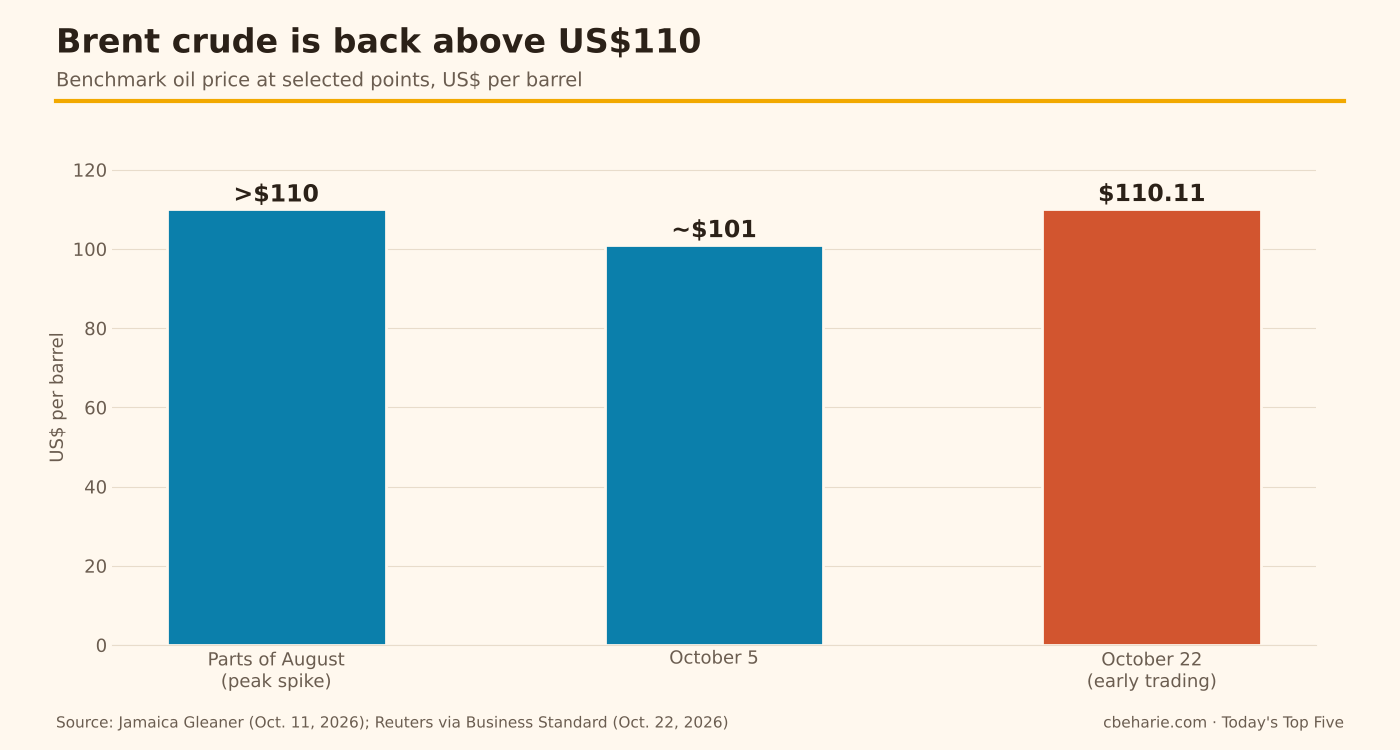
Globally, two wars dominate. In Europe, a fresh push to end Russia’s war in Ukraine gathered pace after talks in Oslo, Norway, on Tuesday and a three-hour meeting between U.S. envoy Steve Witkoff and Vladimir Putin on Wednesday. In the Middle East, the nearly eight-month war between the United States, Israel and Iran is rattling Saudi Arabia and pushing oil back above US$110 a barrel, with consequences that reach all the way to the pump in Half Way Tree.
At home, the National Water Commission has asked regulators for a 51% rate increase over five years, opening a debate about how much Jamaicans should pay for a utility that loses most of the water it treats. In St. James, a single hour of heavy rain on National Heroes Day flooded communities still recovering from Hurricane Melissa, just days before the storm’s first anniversary. And as Jamaica prepares to stress-test its cyber defenses next week, a new regional report warns that Latin America and the Caribbean risk being left behind in artificial intelligence.
Let’s walk through each one together.
1. Putin agrees in principle to new three-way Ukraine talks after Oslo push
What happened
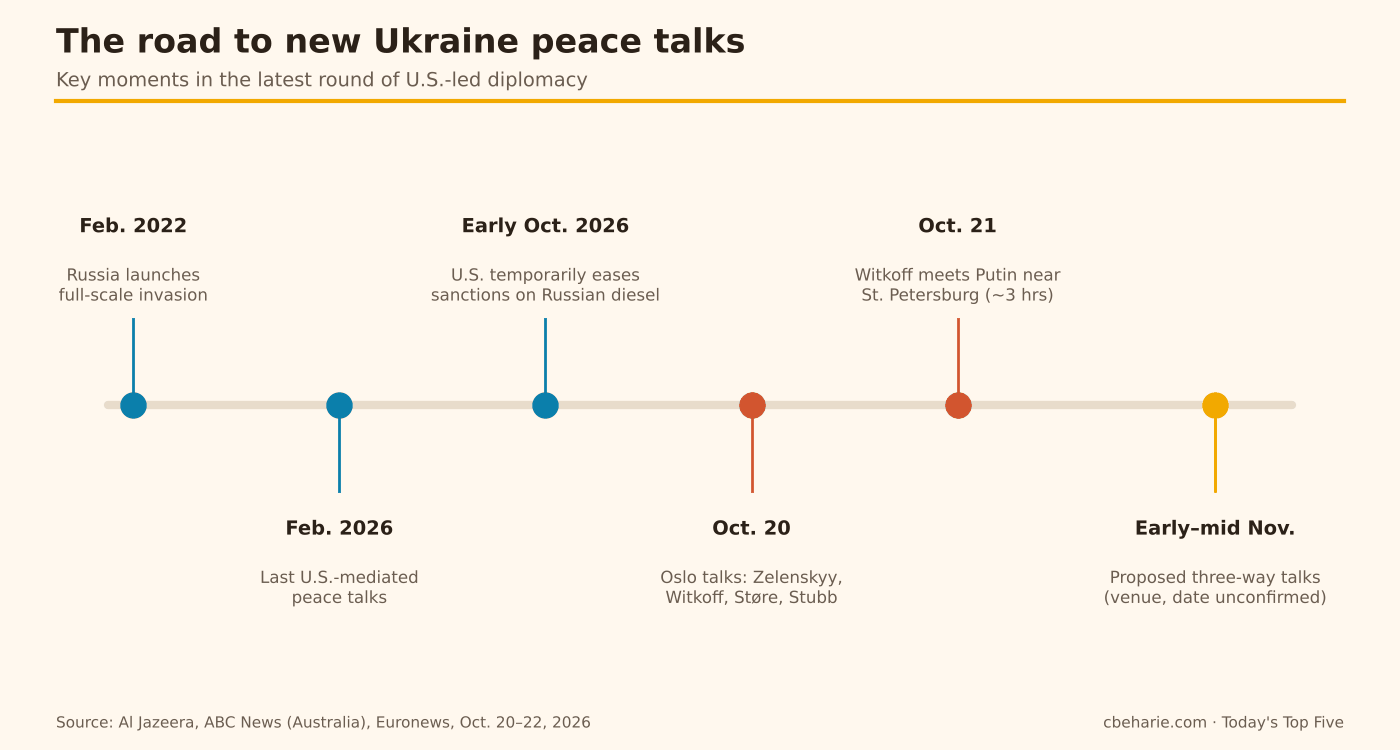
After a busy 48 hours of diplomacy that began in Norway’s capital, the Kremlin said on Wednesday that President Vladimir Putin is ready in principle to resume three-way negotiations with the United States and Ukraine aimed at ending the war. The signal came after Putin hosted U.S. special envoy Steve Witkoff for roughly three hours at the Konstantin Palace in Strelna, just outside St. Petersburg. Kremlin foreign policy aide Yuri Ushakov and Russian envoy Kirill Dmitriev sat in, while Jared Kushner joined by video link, according to reporting carried by ABC News in Australia.
Ushakov suggested the talks could take place as soon as mid-November, and Russian state television floated Abu Dhabi as a possible venue. Ukrainian President Volodymyr Zelenskyy, speaking to reporters on his way home from Norway, said he wants the meeting held no later than early November and that Russia had indicated support for a trilateral session at the level of negotiating teams. No date or venue has been confirmed.
The meeting opened with a goodwill gesture: Russia freed Stephen Hubbard, a 74-year-old American and retired English teacher who had been imprisoned for more than four years on charges of fighting as a mercenary for Ukraine. According to Al Jazeera, it was Witkoff’s ninth in-person meeting with Putin. The Russian leader also thanked President Donald Trump for his peace efforts, offered help on Iran and floated large fertilizer sales to the United States.
The Oslo connection
The week began in Oslo on Tuesday, where Norway and Finland co-hosted talks bringing together Zelenskyy, Norwegian Prime Minister Jonas Gahr Støre, Finnish President Alexander Stubb and Witkoff, with Kushner participating remotely and representatives from the European Union, NATO and the so-called E4 (the United Kingdom, France, Germany and Poland) expected to attend. Støre said Kyiv had specifically asked for the two American envoys to take part, and that the goal was to put diplomacy on a more constructive path.
Zelenskyy left with at least one concrete win: he said U.S. intelligence sharing, which had been halted, has been restored, including early warning of ballistic missile attacks. He also pressed Washington on air-defense interceptors and on restrictions to Starlink and Starshield, the SpaceX satellite services his forces depend on. Euronews reported that he proposed pausing Ukrainian strikes on Russian oil facilities in exchange for more U.S.-made Patriot interceptors.
For those of us in the Jamaican diaspora here in Norway, it was a striking reminder of the country’s long tradition of quiet peacemaking. Oslo has hosted difficult conversations before, and this week it again offered neutral ground where adversaries’ allies could at least sit in the same room.
Why it matters
The last U.S.-mediated talks took place in February, before the United States and Israel launched their war against Iran and drew Washington’s attention elsewhere. Since then, relations between Kyiv and Washington have frayed. Earlier this month President Trump announced a deal that temporarily lifted U.S. sanctions on Russian diesel sales, a move Kyiv viewed with alarm, and on Tuesday he warned that it was time to end the war or face what he called “a very bad thing.”
Supporters of the administration’s approach argue that pressure on both sides, combined with economic incentives for Moscow, is the fastest route to ending a war now well into its fifth year since Russia’s full-scale invasion in February 2022. Critics counter that rewarding Russia with sanctions relief before a settlement weakens Ukraine’s hand and invites future aggression. Russian officials, for their part, described the European and Ukrainian proposals from Oslo as containing little of substance, though Ushakov later called them a step in the right direction.
Why should a reader in Kingston or Mandeville care about talks in a Russian palace? Because Caribbean economies that import much of their fuel and food feel distant wars at the gas station and the grocery checkout. Any credible path to peace in Ukraine, especially one that touches energy and fertilizer trade, eventually shows up in household budgets far from the front lines. It is also worth noting that Putin offered to help on Iran, a sign that the two wars are increasingly being discussed as part of one larger bargain.
The fighting goes on
Diplomacy has not paused the violence. Ukraine’s emergency service said a Russian strike on a high-rise in Kyiv’s Sviatoshynskyi district killed two people, and ABC reported that ballistic missiles struck Kyiv again on Wednesday evening, injuring six. Russian authorities said they downed most of about 630 drones headed toward Moscow overnight, while a Ukrainian drone attack in the Bryansk region killed at least one person.
What to watch next
- Whether a firm date and venue for three-way talks are announced, and whether Abu Dhabi is confirmed.
- Any movement toward an “energy ceasefire,” which Zelenskyy says Kyiv supports.
- A possible Trump–Xi Jinping meeting in China next month, which the Kremlin says was also discussed.
- The state of U.S.-Ukraine relations, including continued intelligence sharing and air-defense supplies.
2. Iran war spills into Saudi Arabia as oil tops US$110
What happened
The war that began on February 28, when U.S. and Israeli strikes hit Iran and killed Supreme Leader Ali Khamenei, is again widening. On Wednesday, Saudi officials said an attack on King Fahd International Airport in Dammam killed one person and injured eight, and debris from an intercepted drone aimed at the Shaybah oil field killed two foreign workers. Iran-backed Houthi forces in Yemen have repeatedly targeted Saudi military and oil facilities this month, and Saudi Arabia has assembled an international coalition to counter them.
Washington responded cautiously. The State Department ordered non-emergency employees and their families to leave Saudi Arabia, several U.S. embassies moved to restricted operations, and U.S. officials told CBS News the military has been quietly repositioning personnel at Middle East bases. U.S. Central Command declined to discuss specific movements, saying it routinely moves forces for readiness.
Talks stalled, not dead
Diplomacy remains on life support. The two countries signed a memorandum of understanding in June aimed at ending the war, but have exchanged strikes since, ABC News reported. Iran’s Foreign Minister Abbas Araghchi said indirect talks continue, with Pakistan and Qatar facilitating, over a ceasefire proposal Tehran presented in September and President Trump rejected last month. Iran’s plan would end the U.S. naval blockade of its ports, lift sanctions on Iranian oil sales, reopen the Strait of Hormuz and release frozen assets. Araghchi accused Washington of trying to add new clauses.
The rhetoric on all sides remains sharp. Trump said the U.S. was doing very well and must decide whether to win “the nice way or the not nice way.” Israeli Prime Minister Benjamin Netanyahu said he had directed his military and intelligence services to work toward toppling Iran’s government. A Revolutionary Guard official threatened to target undersea internet cables in the Strait of Hormuz if Iranian infrastructure is struck again. At the same time, a Financial Times report cited by CBS said Trump had blocked an Israeli plan for a multiday strike to avoid escalation before the U.S. midterm elections.
Why it matters: the oil shock
Markets noticed. Brent crude, the global benchmark, rose about 1.2% to US$110.11 a barrel in early Asian trading on Thursday, while U.S. West Texas Intermediate climbed to US$98.12, according to Reuters. Data from analytics firm Kpler showed at least 18 attacks on shipping over the past two weeks, and LSEG analysts warned that Iran appears to be targeting tankers beyond the Strait of Hormuz, into the Gulf of Oman. In the United States, the Energy Department has offered to lend heating oil from its emergency reserve to ease diesel shortages.
Just over two weeks ago, the picture looked calmer. Brent traded near US$101 on October 5, and Petrojam general manager Danville Walker told The Gleaner he expected stable supplies and contained price moves for the rest of the year, noting that Jamaica sources most of its fuel from outside the Middle East and that there would be no shortage.
The Jamaican angle: your fuel bill
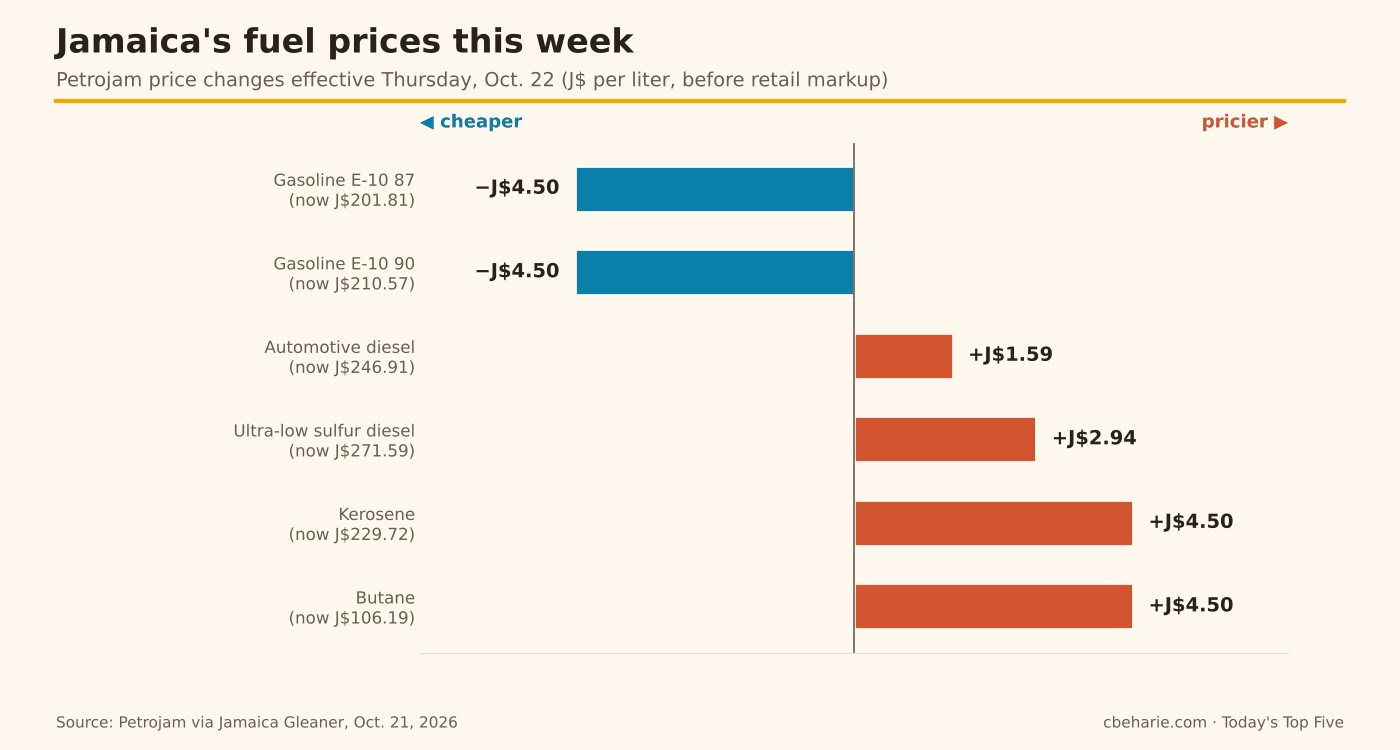
For now, the pain at the pump is mixed. Petrojam’s prices effective today cut both grades of gasoline by J$4.50 a liter, taking E-10 87 to J$201.81 and E-10 90 to J$210.57 before retailers add their markups. But automotive diesel rises J$1.59 to J$246.91, ultra-low sulfur diesel climbs J$2.94 to J$271.59, and kerosene and butane each rise J$4.50. Because Jamaica’s wholesale prices follow world markets with a lag, this week’s jump in crude has not yet fully worked its way through.
Diesel matters especially, because it moves trucks, buses and farm equipment, and its cost feeds into the price of almost everything on a supermarket shelf. Economist Keenan Falconer has warned that the full inflationary effect of this year’s energy shocks may not be visible until December through early 2027, after Jamaica’s annual inflation rose to 7.9% in August from 7.5% in July. For families still rebuilding after Hurricane Melissa, and for diaspora members who send money home to cover rising bills, that is not abstract.
What to watch next
- Whether the Pakistan- and Qatar-facilitated talks produce a revised ceasefire text.
- Further Houthi attacks on Saudi infrastructure and on shipping lanes in the Gulf of Oman.
- Petrojam’s next weekly price notice, especially for diesel and cooking gas.
- Jamaica’s September and October inflation readings.
3. NWC seeks a 51% rate increase as its debts mount
What happened
The National Water Commission, which serves about 500,000 customers, has asked the Office of Utilities Regulation (OUR) to approve a 51% increase in water and sewerage rates over five years, covering the 2026/27 to 2030/31 period. The application was filed on Friday, October 16, and senior NWC managers confirmed it before Parliament’s Public Accounts Committee (PAC) on Tuesday. The OUR has confirmed receipt.
The utility wants annual revenue to grow from roughly J$40 billion to about J$60 billion over five years so that it can cover its operating costs and fund investment. Acting President Kevin Kerr told legislators that the NWC’s investment plan is tied to the tariff request. Chief Financial Officer Fabian Christie warned that if the increase is not approved, the commission will have to revise that plan. The NWC’s last increase, an interim tariff, came in 2019, and Kerr said the COVID-19 pandemic then weakened its cash flow.
The numbers behind the request
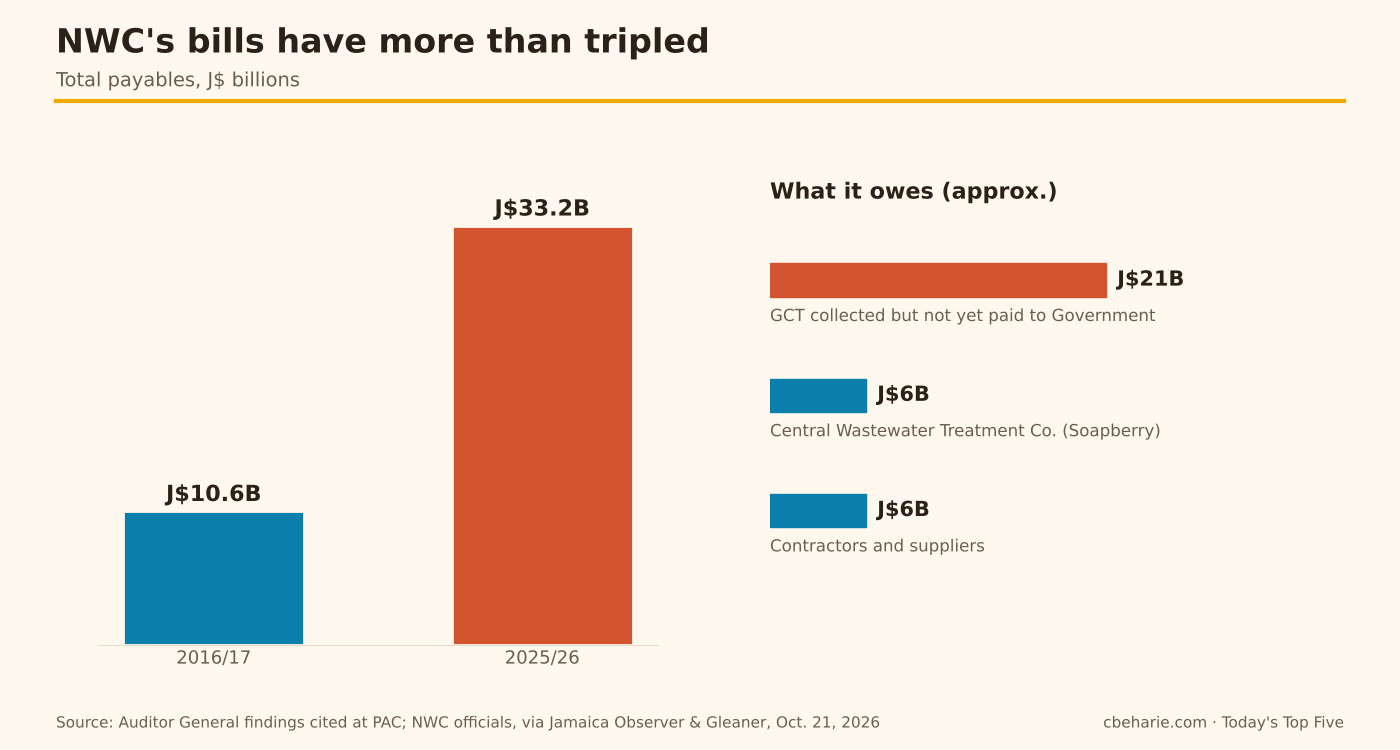
The figures presented to the PAC are sobering. Citing the Auditor General’s findings, PAC Chairman Julian Robinson noted that the NWC’s payables climbed from J$10.6 billion in 2016/17 to J$33.2 billion in 2025/26, more than tripling. (The Gleaner reported a total of J$32.2 billion.) Roughly J$21 billion of that is General Consumption Tax the NWC collected but has not yet passed on to the government; Christie acknowledged the money has been used to meet day-to-day cash needs. Another J$6 billion or so is owed to the Central Wastewater Treatment Company, which treats much of Kingston’s sewage at Soapberry, and about J$6 billion to contractors and suppliers, some of it more than 90 days overdue.
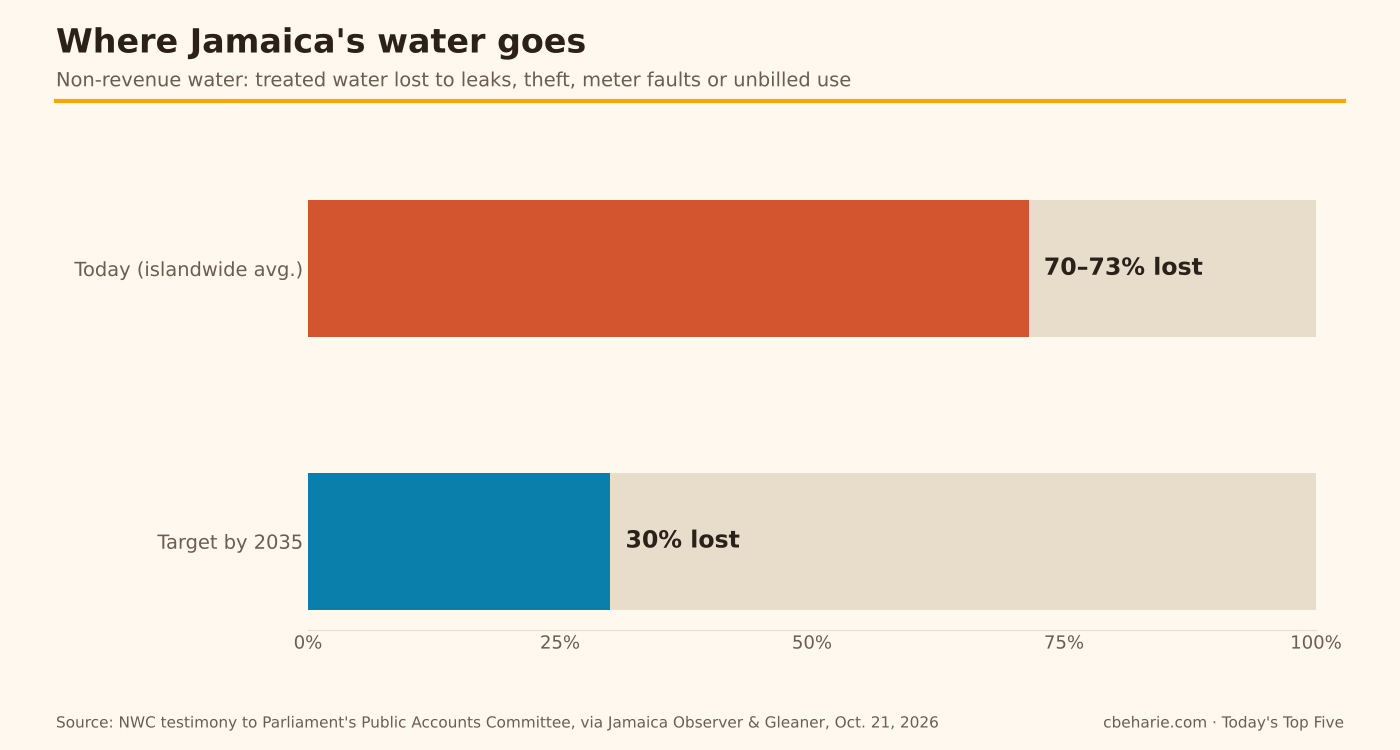
Then there is the leak in the bucket, quite literally. Kerr said non-revenue water, meaning treated water that earns no income because of leaks, theft, faulty meters or unbilled use, averages 70% to 73% islandwide. In plain terms, for every 10 liters the NWC cleans and pumps, it is paid for about three at most. The target is to cut losses to 30% by 2035. An islandwide reduction program is in the final procurement stage, with work set to begin in towns including Spanish Town, Old Harbour, May Pen, Mandeville, Montego Bay, Negril, Lucea, Ocho Rios and Port Antonio, before moving to Kingston and Portmore.
The regulatory process is only beginning. The OUR will first check whether the application meets its requirements for form and content and may ask the NWC for more information. It is then expected to decide within 10 days whether to formally accept the application for review. Kerr told legislators that the public will be invited to take part in a consultation during that review, which means customers, businesses and community groups will have a chance to weigh in before any new rates are set.
Two sides of a hard question
The NWC’s case is that it cannot fix pipes, build resilience or pay its bills on rates set seven years ago, especially after Hurricane Melissa, when it wrote off unpaid bills for customers left without water. Christie also noted that droughts and natural disasters can cut revenue by 10% to 15% in a bad year. Without new money, the argument goes, service will only deteriorate.
The counterargument, voiced in part by Robinson at the hearing, is that customers should not be asked to pay for inefficiency. He pressed the utility on how it would improve cash flow beyond higher tariffs, stressing the need to cut losses and collect what customers already owe. Ordinary households, many of whom endure irregular supply, will reasonably ask why they should pay half again as much for water that often does not reach their taps. For illustration only, if a 51% increase were applied evenly, a J$5,000 monthly bill would rise to roughly J$7,550 by the end of the period; the actual impact will depend entirely on what, if anything, the OUR approves and how it is structured.
The government appears to recognize that tariffs alone will not solve the problem. Wayne Robertson, permanent secretary in the Ministry of Water, Environment and Climate Change, told the committee that a Cabinet submission proposing a holistic overhaul of the NWC’s financing is coming shortly.
What to watch next
- Whether the OUR formally accepts the application for review, a decision expected within 10 days.
- The public consultation process, where customers can make their voices heard.
- The Cabinet submission on reforming the NWC’s finances.
- The selection of contractors for the non-revenue water program, expected by the end of the financial year.
4. One hour of rain floods MoBay as Melissa’s anniversary nears
What happened
On Monday evening, as Jamaica marked National Heroes Day, a downpour lasting about an hour sent floodwaters through several Montego Bay communities. The Jamaica Observer reported that parts of the Estuary Housing Scheme were left under at least four feet of water. Firefighters cleared roads in Johns Hall, fallen trees and landslides blocked the roadway in Latium, floodwaters swept away cars and inundated shops in Tucker, and Catherine Hall flooded once again because its drains could not cope.
By Tuesday, some Estuary residents had had enough. The Observer described a mother packing her children, her dog and her belongings into her car to leave. She had stayed after Hurricane Melissa on the promise that the area’s drainage would be fixed. During the latest flood, one woman was trapped in her home and had to be rescued by neighbors. Equipment for drain repairs was on site, and residents were told the work should be finished by December, though the scale of the job makes that timeline uncertain.
The government’s response
On Wednesday, Robert Morgan, the minister with responsibility for works, toured flood-affected areas including Catherine Hall. He said a drainage study being done as part of the Montego Bay Perimeter Road project will examine the North and South Gullies, the Montego River and other waterways, and that results are expected in December. He cautioned that there is no implementation date yet, said the new road is part of the solution but not the whole of it, and urged residents to be patient. Project manager Gounghang Gui briefed the touring party on the bypass drainage system.
Residents and officials are looking at the same problem from different vantage points. For families who watched water rise again, patience is in short supply after a year of waiting. For engineers and planners, a city-wide drainage fix that is not properly studied risks simply moving floodwater from one neighborhood to another. Both concerns are legitimate, and the December study will be an important test of whether the two can be brought together.
Why it matters: a year after Melissa
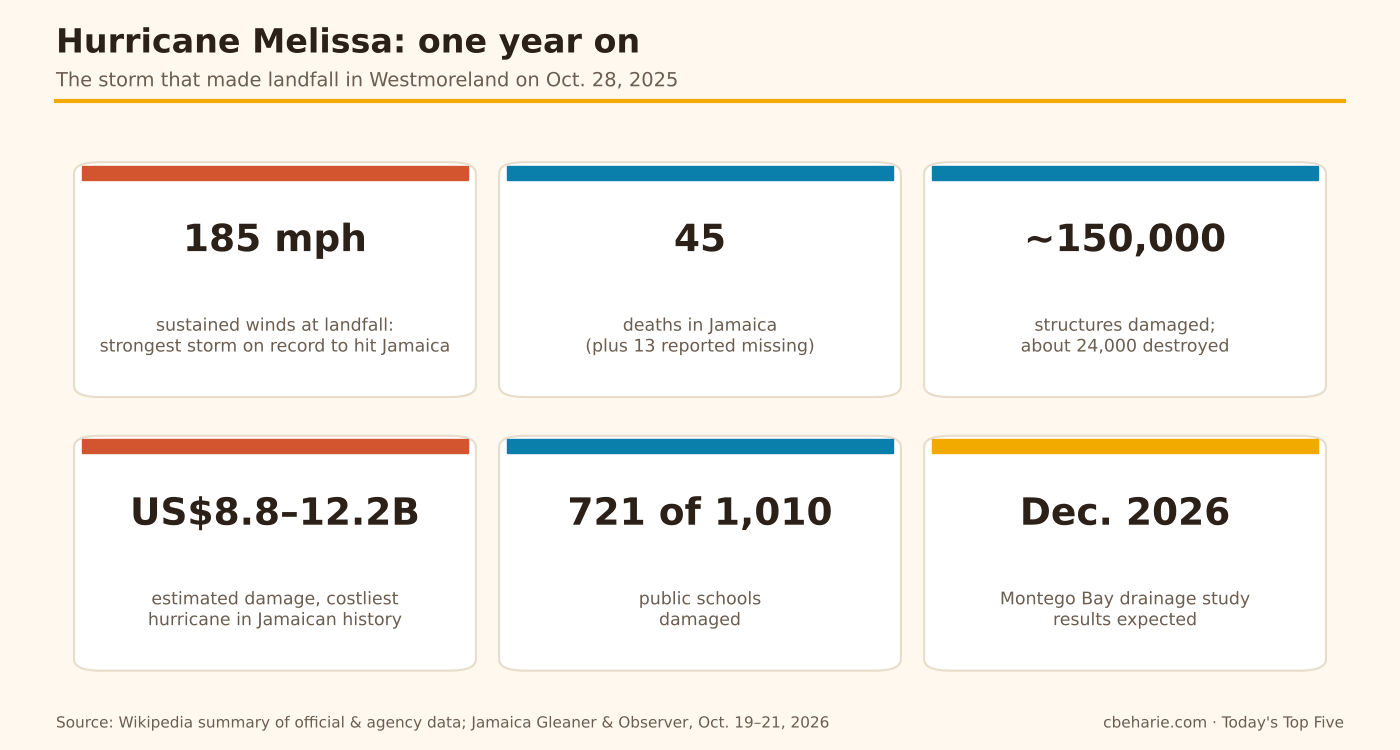
Next Wednesday, October 28, marks one year since Hurricane Melissa made landfall near New Hope, Westmoreland, as a Category 5 storm with sustained winds of about 185 miles per hour, the strongest hurricane on record to strike Jamaica. It claimed 45 lives in Jamaica, damaged roughly 150,000 structures and caused damage estimated between US$8.8 billion and US$12.2 billion, depending on the assessment. St. Elizabeth, Westmoreland, St. James, Trelawny and Hanover bore the worst of it, and much of Montego Bay flooded, including the airport terminal.
This week’s Heroes Day ceremonies carried that memory. In Sam Sharpe Square, Montego Bay Mayor Richard Vernon led a moment of silence for those St. James lost and urged residents to make the neighborliness shown during the storm a permanent way of life. Among those honored was the late Courtney Campbell of Westgreen, who contracted leptospirosis while rescuing neighbors from floodwaters and later died; his medal was awarded posthumously. In Black River, St. Elizabeth Mayor Richard Solomon said his parish, where up to 80% to 90% of roofs were destroyed in some areas, is slowly picking up the pieces. The national theme, “Resilient People with a Proud Heritage,” could hardly have been more fitting.
Solomon also noted the storm’s toll on farms in St. Elizabeth, one of Jamaica’s main food-producing parishes, where damaged fields threatened livelihoods well beyond the coast. Rebuilding homes and restoring incomes remain the priorities there, he said, a reminder that recovery is measured not only in roofs replaced but in harvests and paychecks restored.
Monday’s flood is a reminder that resilience cannot only be a matter of spirit. It must also be built into drains, gullies, roads and building approvals.
What to watch next
- Anniversary observances across the western parishes on October 28.
- Completion of the Estuary drain repairs and the December drainage study.
- Any relocation assistance for families in repeatedly flooded areas.
- Weather for the remainder of the Atlantic hurricane season, which runs through November 30.
5. Jamaica braces for a cyber stress test as region is urged to own its AI future
What happened
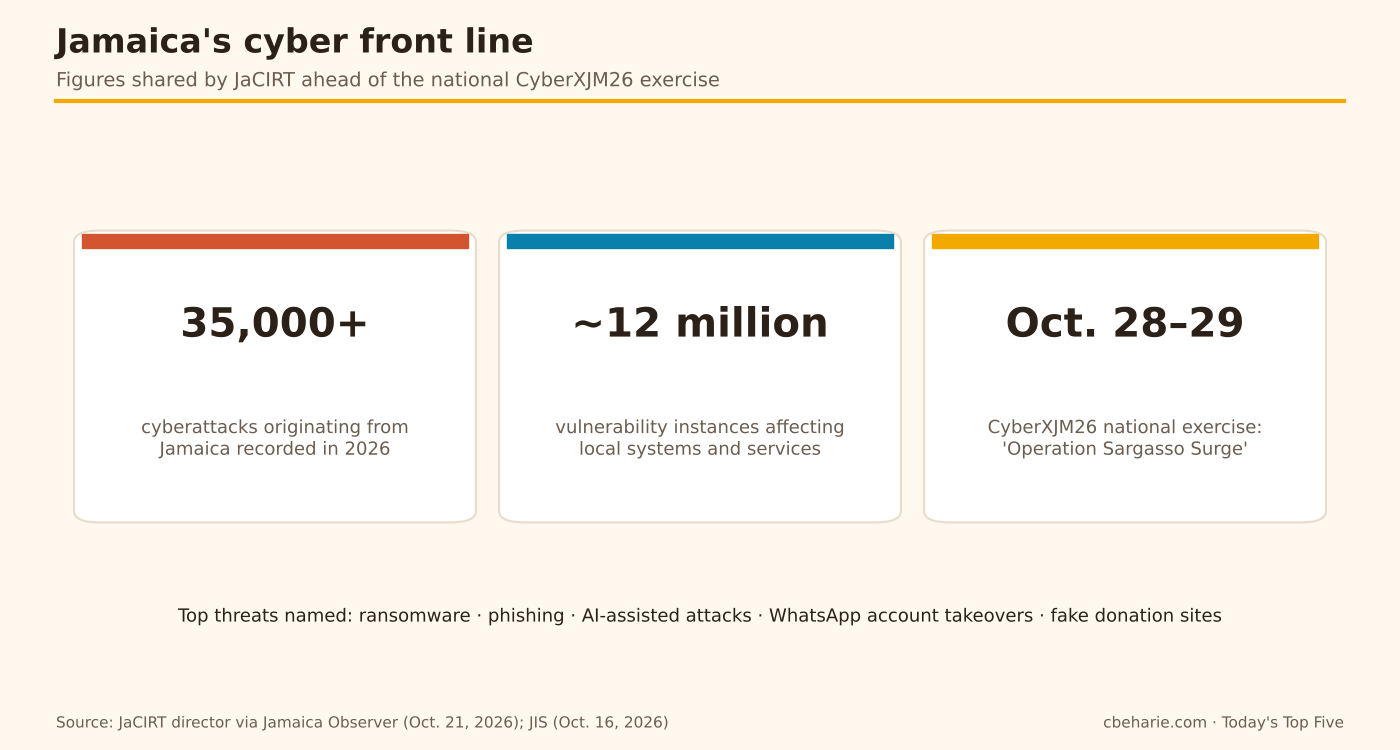
Two stories this week point to the same frontier. First, the Jamaica Cyber Incident Response Team (JaCIRT) announced that it will run CyberXJM26, the country’s first full national test of its ability to coordinate a response to a major cyber incident, on October 28 and 29. Dubbed “Operation Sargasso Surge,” the exercise will simulate a single incident that starts small and escalates into a multi-sector national crisis.
Participants will include government ministries and agencies, banks, telecom providers, critical infrastructure operators, universities and private companies, along with schools, ethical hackers and professional incident-response teams. According to the Jamaica Information Service, the exercise combines an open capture-the-flag competition with a national interoperability simulation, with teams of three to five competing in four divisions. Notably, its design was shaped by lessons from Hurricane Melissa, when infrastructure disruptions and reliance on satellite connectivity tested the country’s systems.
The threat picture
JaCIRT director Lt. Col. (Ret.) Godphey Sterling told the Jamaica Observer that more than 35,000 cyberattacks originating from Jamaica have been recorded since January, and that around 12 million vulnerability instances have affected local systems and services. The leading threats are ransomware, phishing and AI-assisted attacks, along with opportunistic fraud such as the fake donation websites that sprang up after Melissa. For individuals, phishing and WhatsApp account takeovers are the most common harms; for organizations, ransomware and credential theft pose the greatest risk, especially over the holidays, when staffing is thin.
There has been progress. The Cybercrimes Act was amended in February, a national cybersecurity standards framework and incident response plan have been finalized, a national coordinating council is headed to Cabinet, and a Cyber Reserve drawing on students, professionals and security force members is being set up. Capacity-building is supported by the Strengthening Cybersecurity in Jamaica project, backed by the Inter-American Development Bank and running through March 2031. Sterling also called for stronger legal powers so that JaCIRT can require compliance with standards and timely reporting of incidents, a proposal that will need to balance security with privacy and the burden on smaller businesses.
The AI warning
Meanwhile, in Santiago, Chile, the UN Economic Commission for Latin America and the Caribbean (ECLAC) and Chile’s National Center for Artificial Intelligence released the fourth Latin American Artificial Intelligence Index, covering 20 countries in the region and, for the first time, comparing them with Germany, Spain, Estonia, Portugal and Singapore. The biggest gaps, the report found, are in computing capacity, business adoption and actually implementing national strategies. Some 85% of countries have an AI strategy in force or in development, but only Brazil and Colombia have explicitly allocated AI budgets.
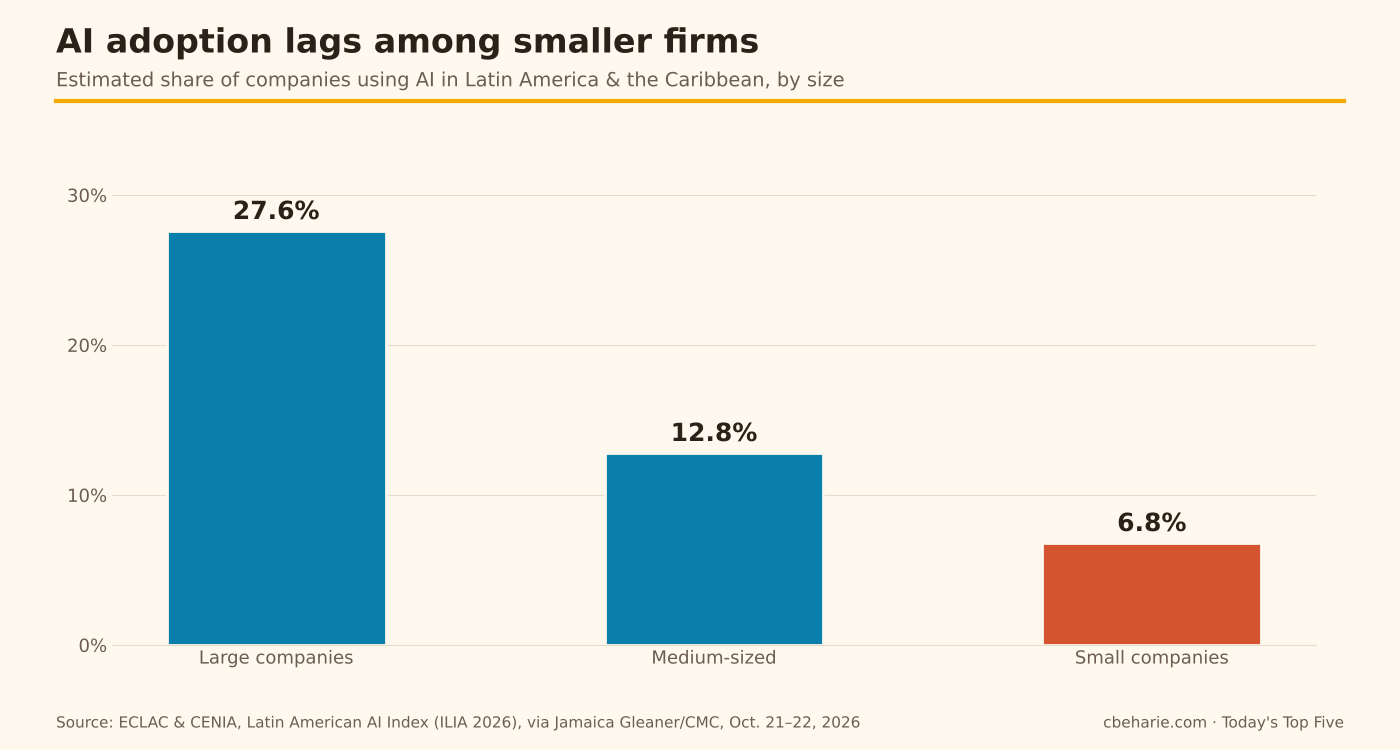
Adoption falls sharply with company size: an estimated 27.6% of large firms use AI, compared with 12.8% of medium-sized firms and just 6.8% of small ones. ECLAC Executive Secretary José Manuel Salazar-Xirinachs warned that passive adoption could deepen the region’s dependencies and widen existing inequalities, and urged countries to cooperate on computing power, research and talent.
Why it matters for Jamaica
Jamaica’s economy runs on small businesses, from cook shops and hardware stores to tour operators and remittance agents. They are both the least likely to benefit from AI and among the most exposed to AI-assisted scams. The same tools that can help a small hotel manage bookings can help a fraudster craft a convincing fake message. Building digital skills, secure systems and public trust together, rather than one at a time, may be the region’s best path. For diaspora professionals in technology and cybersecurity, these are also natural openings to contribute expertise back home.
What to watch next
- Results and lessons from the CyberXJM26 “hotwash” review after October 29.
- The national cyber exposé on October 29 recognizing volunteers and contributors.
- Cabinet action on the national cybersecurity coordinating council.
- Holiday-season fraud warnings ahead of Black Friday and Christmas.
A closing reflection
Read side by side, today’s stories share a quiet thread: the gap between what we hope for and what we build. Leaders in Oslo and St. Petersburg speak of peace while missiles still fall on Kyiv. A water utility asks for more money while most of its water vanishes into the ground. A city promised better drains watches the water rise again. A region drafts AI strategies but funds few of them.
Scripture has a word for people who close that gap. Jesus called the peacemakers blessed, not the peace-wishers, and the prophet Jeremiah told exiles far from home to seek the welfare of the city where they lived, because in its welfare they would find their own. That is a calling for Jamaicans at home and for those of us scattered across the world. It is not partisan, and it does not belong to any one government. It asks for honest stewardship of what we have been given, from public money to clean water, and for patience that is matched by follow-through.
As the first anniversary of Hurricane Melissa approaches, let us remember the 45 Jamaicans who did not survive it, honor ordinary heroes like Courtney Campbell, and pray for the families in Estuary, Tucker and Catherine Hall who are once again drying out their homes. Let us pray, too, for the people of Ukraine, Russia, Iran, Israel, Yemen and Saudi Arabia, whose suffering is real regardless of the politics.
Faith does not ask us to ignore the headlines. It asks us to read them with open eyes and a soft heart, and then to do the next right thing within our reach. Walk good, and may God keep you and yours today.
Sources
- Al Jazeera: Putin and Zelenskyy back three-way US peace talks on Ukraine (Oct. 21, 2026)
- ABC News (Australia): Putin agrees to resume three-way talks on Ukraine war (Oct. 22, 2026)
- Euronews: Zelenskyy calls for trilateral talks after meeting with US delegation in Oslo (Oct. 20, 2026)
- Democracy Now!: Headlines for October 21, 2026
- CBS News: Iran war live updates (Oct. 21, 2026)
- ABC News (U.S.): Iran live updates (Oct. 21, 2026)
- Business Standard (Reuters): Oil prices rise as Houthi attacks in Saudi Arabia fuel supply concerns (Oct. 22, 2026)
- Jamaica Gleaner: Gas prices down (Oct. 21, 2026)
- Jamaica Gleaner: Petrojam sees stable fuel prices through year-end (Oct. 11, 2026)
- Jamaica Gleaner: NWC seeks massive rate hike, warns of investment cuts without it (Oct. 21, 2026)
- Jamaica Observer: NWC seeks 51% hike (Oct. 21, 2026)
- Jamaica Observer: One shower too many (Oct. 21, 2026)
- Jamaica Observer: Flooding issues in MoBay should be addressed in drainage study — Morgan (Oct. 21, 2026)
- Jamaica Gleaner: MoBay mayor urges St James residents to uphold resilience post-Melissa (Oct. 20, 2026)
- Jamaica Gleaner: Mayor hails St Elizabeth’s resilience ahead of Melissa anniversary (Oct. 21, 2026)
- Wikipedia: Hurricane Melissa (background figures)
- Jamaica Observer: Jamaica braces for cyber stress test (Oct. 21, 2026)
- Jamaica Information Service: CIRT Division to stage cybersecurity exercise Oct. 28 (Oct. 16, 2026)
- Jamaica Gleaner (CMC): Latin America and the Caribbean urged to take ownership of artificial intelligence (Oct. 22, 2026)
All graphics in this post are original works created for cbeharie.com from the sources listed above. No news-agency photographs are used.